

286
S. Lee
10.3.3 Capillary Underfill
Capillary Underfill (CUF) is still an important process material for the building block
with mass reflow process using water-soluble or no-clean fluxes in 2.5/3D process.
The building block can be applied to attach a 2.5D interposer to a substrate. The CUF
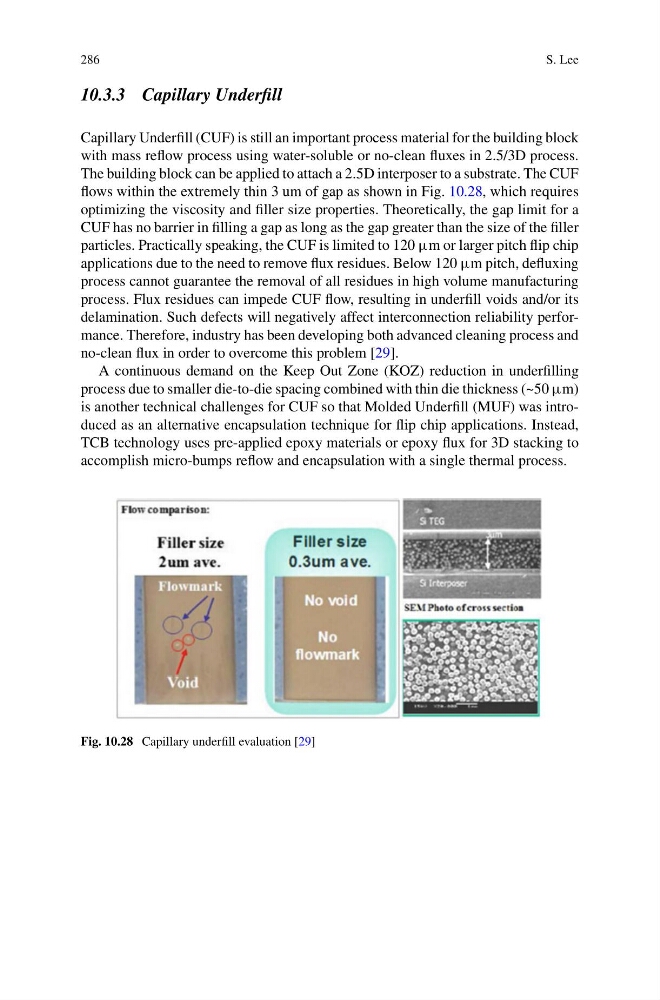
flows within the extremely thin 3 um of gap as shown in Fig. 10.28, which requires
optimizing the viscosity and filler size properties. Theoretically, the gap limit for a
CUF has no barrier in filling a gap as long as the gap greater than the size of the filler
particles. Practically speaking, the CUF is limited to 120 μm or larger pitch flip chip
applications due to the need to remove flux residues. Below 120 μm pitch, defluxing
process cannot guarantee the removal of all residues in high volume manufacturing
process. Flux residues can impede CUF flow, resulting in underfill voids and/or its
delamination. Such defects will negatively affect interconnection reliability performance. Therefore, industry has been developing both advanced cleaning process and
no-clean flux in order to overcome this problem [29].
A continuous demand on the Keep Out Zone (KOZ) reduction in underfilling
process due to smaller die-to-die spacing combined with thin die thickness (~50 μm)
is another technical challenges for CUF so that Molded Underfill (MUF) was introduced as an alternative encapsulation technique for flip chip applications. Instead,
TCB technology uses pre-applied epoxy materials or epoxy flux for 3D stacking to
accomplish micro-bumps reflow and encapsulation with a single thermal process.
Fig. 10.28 Capillary underfill evaluation [29]
S. Lee
10.3.3 Capillary Underfill
Capillary Underfill (CUF) is still an important process material for the building block
with mass reflow process using water-soluble or no-clean fluxes in 2.5/3D process.
The building block can be applied to attach a 2.5D interposer to a substrate. The CUF
flows within the extremely thin 3 um of gap as shown in Fig. 10.28, which requires
optimizing the viscosity and filler size properties. Theoretically, the gap limit for a
CUF has no barrier in filling a gap as long as the gap greater than the size of the filler
particles. Practically speaking, the CUF is limited to 120 μm or larger pitch flip chip
applications due to the need to remove flux residues. Below 120 μm pitch, defluxing
process cannot guarantee the removal of all residues in high volume manufacturing
process. Flux residues can impede CUF flow, resulting in underfill voids and/or its
delamination. Such defects will negatively affect interconnection reliability performance. Therefore, industry has been developing both advanced cleaning process and
no-clean flux in order to overcome this problem [29].
A continuous demand on the Keep Out Zone (KOZ) reduction in underfilling
process due to smaller die-to-die spacing combined with thin die thickness (~50 μm)
is another technical challenges for CUF so that Molded Underfill (MUF) was introduced as an alternative encapsulation technique for flip chip applications. Instead,
TCB technology uses pre-applied epoxy materials or epoxy flux for 3D stacking to
accomplish micro-bumps reflow and encapsulation with a single thermal process.
Fig. 10.28 Capillary underfill evaluation [29]