

10 Fundamentals of Bonding Technology and Process Materials …
285
10.3.2 No-Clean Flux
No-clean flux does not imply that no flux residues remain after the solder reflow
process. No-clean fluxes generally have the same aggressiveness as Rosin Mildly
Activated (RMA) fluxes, but leave fewer and less corrosive residues when compared
to water soluble flux. This property is achieved by (a) reducing the solids content
of the flux and (b) polymerizing those residues to minimize their corrosivitiy in the
presense of moisture. A solid content ratio refers to the ratio of solvent thinner to solid
component in the flux. A typical no-clean flux has less than 15% solids, compared
with 30–50% in cleanable fluxes. Unlike conventional solder reflows process, TCB
technology for 3D package stacking can meet less than ±2.0 um placement accuracy
without flux tackiness being necessary to maintain the position of the die attached on
the substrate within allowable offset range. Moreover, the no tackiness requirement
allows for a simpler no-clean flux formulation so that the latter can focus the low
residue characteristic of the no-clean flux so as to s and consequently, eliminate
the deflux process. Two goals should be met to eliminate the cleaning step: first,
dispensing the least amount of flux only barely to cover area of pads or bumps on
substrate and secondly, controlling the oxygen level during TCB much lower than
100 ppm. Then TCB will minimize the likelihood of corrosive residue.
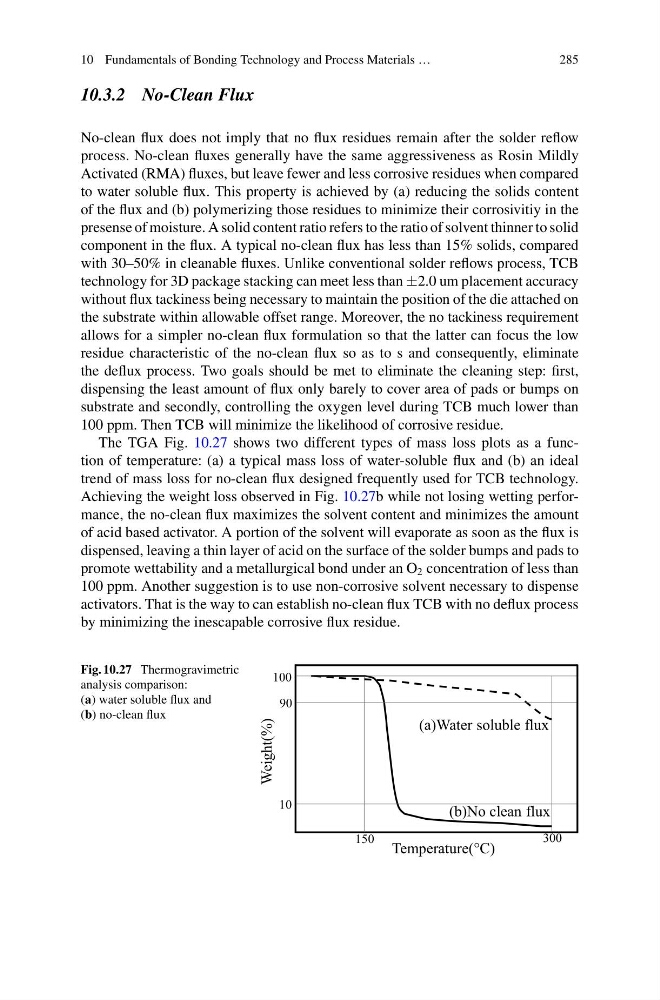
The TGA Fig. 10.27 shows two different types of mass loss plots as a function of temperature: (a) a typical mass loss of water-soluble flux and (b) an ideal
trend of mass loss for no-clean flux designed frequently used for TCB technology.
Achieving the weight loss observed in Fig. 10.27b while not losing wetting performance, the no-clean flux maximizes the solvent content and minimizes the amount
of acid based activator. A portion of the solvent will evaporate as soon as the flux is
dispensed, leaving a thin layer of acid on the surface of the solder bumps and pads to
promote wettability and a metallurgical bond under an O 2 concentration of less than
100 ppm. Another suggestion is to use non-corrosive solvent necessary to dispense
activators. That is the way to can establish no-clean flux TCB with no deflux process
by minimizing the inescapable corrosive flux residue.
Fig. 10.27 Thermogravimetric
analysis comparison:
(a) water soluble flux and
(b) no-clean flux
(b)No clean flux
(a)Water soluble flux
Temperature(°C)
Weight(%)
10
100
90
150
300
285
10.3.2 No-Clean Flux
No-clean flux does not imply that no flux residues remain after the solder reflow
process. No-clean fluxes generally have the same aggressiveness as Rosin Mildly
Activated (RMA) fluxes, but leave fewer and less corrosive residues when compared
to water soluble flux. This property is achieved by (a) reducing the solids content
of the flux and (b) polymerizing those residues to minimize their corrosivitiy in the
presense of moisture. A solid content ratio refers to the ratio of solvent thinner to solid
component in the flux. A typical no-clean flux has less than 15% solids, compared
with 30–50% in cleanable fluxes. Unlike conventional solder reflows process, TCB
technology for 3D package stacking can meet less than ±2.0 um placement accuracy
without flux tackiness being necessary to maintain the position of the die attached on
the substrate within allowable offset range. Moreover, the no tackiness requirement
allows for a simpler no-clean flux formulation so that the latter can focus the low
residue characteristic of the no-clean flux so as to s and consequently, eliminate
the deflux process. Two goals should be met to eliminate the cleaning step: first,
dispensing the least amount of flux only barely to cover area of pads or bumps on
substrate and secondly, controlling the oxygen level during TCB much lower than
100 ppm. Then TCB will minimize the likelihood of corrosive residue.
The TGA Fig. 10.27 shows two different types of mass loss plots as a function of temperature: (a) a typical mass loss of water-soluble flux and (b) an ideal
trend of mass loss for no-clean flux designed frequently used for TCB technology.
Achieving the weight loss observed in Fig. 10.27b while not losing wetting performance, the no-clean flux maximizes the solvent content and minimizes the amount
of acid based activator. A portion of the solvent will evaporate as soon as the flux is
dispensed, leaving a thin layer of acid on the surface of the solder bumps and pads to
promote wettability and a metallurgical bond under an O 2 concentration of less than
100 ppm. Another suggestion is to use non-corrosive solvent necessary to dispense
activators. That is the way to can establish no-clean flux TCB with no deflux process
by minimizing the inescapable corrosive flux residue.
Fig. 10.27 Thermogravimetric
analysis comparison:
(a) water soluble flux and
(b) no-clean flux
(b)No clean flux
(a)Water soluble flux
Temperature(°C)
Weight(%)
10
100
90
150
300