

284
S. Lee
This session reviews major assembly process materials compatible with TCB
technology with emphasis on formulation, technical challenges, and advantages in
order to provide guidance for optimal process design. With the fundamental understanding, readers are expected to select a building block compatible with package
configuration and equipment, and to understand how material formulation can be
evaluated to optimize assembly process.
10.3.1 Water Soluble Flux
Water-soluble fluxes are based on organic acids to provide oxide reduction performance. These fluxes produce corrosive residues after solder reflow so that pressurized
water wash process is necessary to eliminate the flux residuethe. As the water-soluble
flux has been used for traditional flip chip assembly based on a mass reflow process,
it can be used to attach the interposer to the substrate for 2.5D applications. The flux
also can be applied to TCB technology with no major changes in the flux formulation
[11]. The traditional water-soluble flux is comprised of vehicles, activators, surfactants, thickening agents, and solvents. The vehicle uses high-temperature tolerant
chemicals in the form of liquid or solid. However, the flux material will be a liquid
at the targeted solder melting point. The vehicle materials dissolve by-products from
reaction between activators and oxides, and carry the chemical components away
from the surface during wetting and spreading. Flux activators reduce oxides on
metal surfaces to allow for a metallurgical bond to form between the solder and base
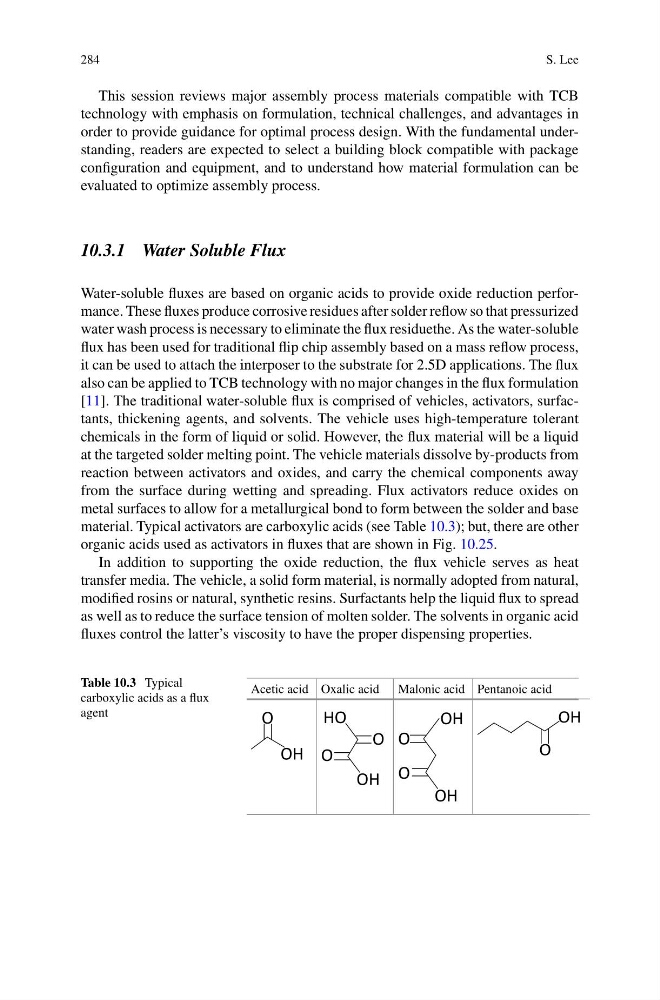
material. Typical activators are carboxylic acids (see Table 10.3); but, there are other
organic acids used as activators in fluxes that are shown in Fig. 10.25.
In addition to supporting the oxide reduction, the flux vehicle serves as heat
transfer media. The vehicle, a solid form material, is normally adopted from natural,
modified rosins or natural, synthetic resins. Surfactants help the liquid flux to spread
as well as to reduce the surface tension of molten solder. The solvents in organic acid
fluxes control the latter’s viscosity to have the proper dispensing properties.
Table 10.3 Typical
carboxylic acids as a flux
agent
Acetic acid Oxalic acid Malonic acid Pentanoic acid
O
OH
HO
OH
O
O
OH
O
O
OH
O
OH
S. Lee
This session reviews major assembly process materials compatible with TCB
technology with emphasis on formulation, technical challenges, and advantages in
order to provide guidance for optimal process design. With the fundamental understanding, readers are expected to select a building block compatible with package
configuration and equipment, and to understand how material formulation can be
evaluated to optimize assembly process.
10.3.1 Water Soluble Flux
Water-soluble fluxes are based on organic acids to provide oxide reduction performance. These fluxes produce corrosive residues after solder reflow so that pressurized
water wash process is necessary to eliminate the flux residuethe. As the water-soluble
flux has been used for traditional flip chip assembly based on a mass reflow process,
it can be used to attach the interposer to the substrate for 2.5D applications. The flux
also can be applied to TCB technology with no major changes in the flux formulation
[11]. The traditional water-soluble flux is comprised of vehicles, activators, surfactants, thickening agents, and solvents. The vehicle uses high-temperature tolerant
chemicals in the form of liquid or solid. However, the flux material will be a liquid
at the targeted solder melting point. The vehicle materials dissolve by-products from
reaction between activators and oxides, and carry the chemical components away
from the surface during wetting and spreading. Flux activators reduce oxides on
metal surfaces to allow for a metallurgical bond to form between the solder and base
material. Typical activators are carboxylic acids (see Table 10.3); but, there are other
organic acids used as activators in fluxes that are shown in Fig. 10.25.
In addition to supporting the oxide reduction, the flux vehicle serves as heat
transfer media. The vehicle, a solid form material, is normally adopted from natural,
modified rosins or natural, synthetic resins. Surfactants help the liquid flux to spread
as well as to reduce the surface tension of molten solder. The solvents in organic acid
fluxes control the latter’s viscosity to have the proper dispensing properties.
Table 10.3 Typical
carboxylic acids as a flux
agent
Acetic acid Oxalic acid Malonic acid Pentanoic acid
O
OH
HO
OH
O
O
OH
O
O
OH
O
OH