

10 Fundamentals of Bonding Technology and Process Materials …
283
SnO + 2RCOOH → Sn(RCOO) 2 + H 2 O
PbO + 2RCOOH → Sn(RCOO) 2 + H 2 O
CuO + 2RCOOH → Cu(RCOO) 2 + H 2 O
Cu 2 O + 2RCOOH → Cu(RCOO) 2 + Cu + H 2 O
(a)
(b)
Fig. 10.25 (a) Sn/Pb oxide and (b) Cu oxide reduction process
a common criteria for both traditional mass reflow as well as TCB. In the both
processes, the flux reduces oxides on the surfaces of the solder bumps and Cu pads
(see Fig. 10.25) over a high temperature ranging 140–160 °C. Figure 10.25 describes
how oxide can be removed from those surfaces in the case of carboxylic acid as the
flux agent or activator to provide a good wetting condition [1, 9].
The TCB process does not require the same level of tackiness in the flux formula as
is needed in mass reflow process. The tackiness is an essential characteristic of the flux
designed for mass reflow to hold the die in position on the substrate within allowable
limits that will allow self-alignment by the molten solder. However, TCB does not
allow self-alignment by moltel solder; therefore, the equipment must have a high
placement accuracy in all three axis. Instead of the tackiness, materials are required
to have greater thermal stability in terms of fluxing performance and mechanical
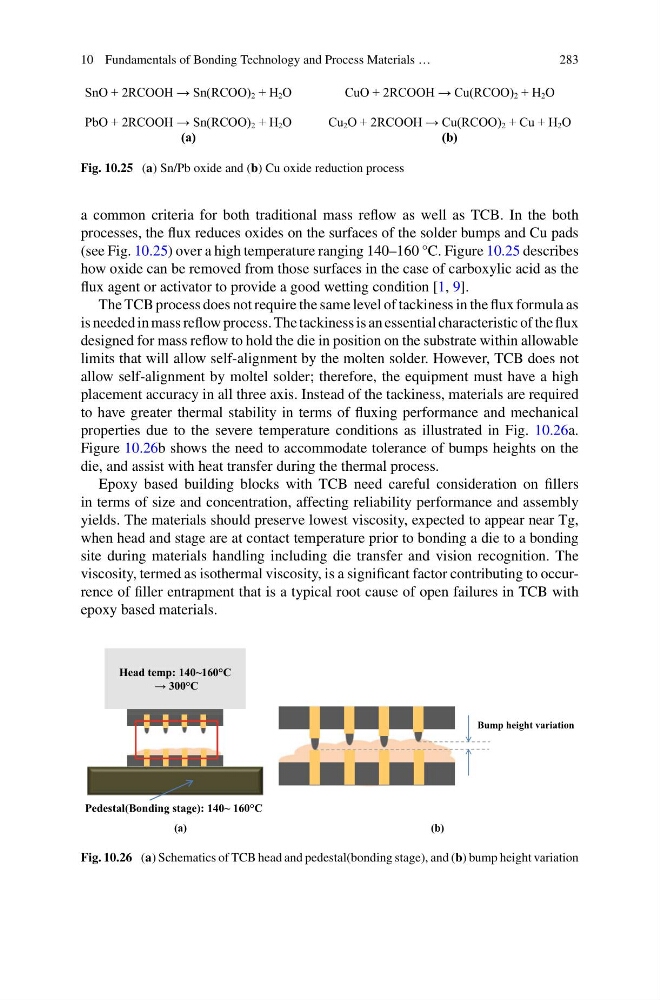
properties due to the severe temperature conditions as illustrated in Fig. 10.26a.
Figure 10.26b shows the need to accommodate tolerance of bumps heights on the
die, and assist with heat transfer during the thermal process.
Epoxy based building blocks with TCB need careful consideration on fillers
in terms of size and concentration, affecting reliability performance and assembly
yields. The materials should preserve lowest viscosity, expected to appear near Tg,
when head and stage are at contact temperature prior to bonding a die to a bonding
site during materials handling including die transfer and vision recognition. The
viscosity, termed as isothermal viscosity, is a significant factor contributing to occurrence of filler entrapment that is a typical root cause of open failures in TCB with
epoxy based materials.
(a)
(b)
Head temp: 140~160°C
→ 300°C
Pedestal(Bonding stage): 140~ 160°C
Bump height variation
Fig. 10.26 (a) Schematics of TCB head and pedestal(bonding stage), and (b) bump height variation
283
SnO + 2RCOOH → Sn(RCOO) 2 + H 2 O
PbO + 2RCOOH → Sn(RCOO) 2 + H 2 O
CuO + 2RCOOH → Cu(RCOO) 2 + H 2 O
Cu 2 O + 2RCOOH → Cu(RCOO) 2 + Cu + H 2 O
(a)
(b)
Fig. 10.25 (a) Sn/Pb oxide and (b) Cu oxide reduction process
a common criteria for both traditional mass reflow as well as TCB. In the both
processes, the flux reduces oxides on the surfaces of the solder bumps and Cu pads
(see Fig. 10.25) over a high temperature ranging 140–160 °C. Figure 10.25 describes
how oxide can be removed from those surfaces in the case of carboxylic acid as the
flux agent or activator to provide a good wetting condition [1, 9].
The TCB process does not require the same level of tackiness in the flux formula as
is needed in mass reflow process. The tackiness is an essential characteristic of the flux
designed for mass reflow to hold the die in position on the substrate within allowable
limits that will allow self-alignment by the molten solder. However, TCB does not
allow self-alignment by moltel solder; therefore, the equipment must have a high
placement accuracy in all three axis. Instead of the tackiness, materials are required
to have greater thermal stability in terms of fluxing performance and mechanical
properties due to the severe temperature conditions as illustrated in Fig. 10.26a.
Figure 10.26b shows the need to accommodate tolerance of bumps heights on the
die, and assist with heat transfer during the thermal process.
Epoxy based building blocks with TCB need careful consideration on fillers
in terms of size and concentration, affecting reliability performance and assembly
yields. The materials should preserve lowest viscosity, expected to appear near Tg,
when head and stage are at contact temperature prior to bonding a die to a bonding
site during materials handling including die transfer and vision recognition. The
viscosity, termed as isothermal viscosity, is a significant factor contributing to occurrence of filler entrapment that is a typical root cause of open failures in TCB with
epoxy based materials.
(a)
(b)
Head temp: 140~160°C
→ 300°C
Pedestal(Bonding stage): 140~ 160°C
Bump height variation
Fig. 10.26 (a) Schematics of TCB head and pedestal(bonding stage), and (b) bump height variation