

282
S. Lee
(a)
(b)
Metal finished coupon
Solder
Material
Cover glass
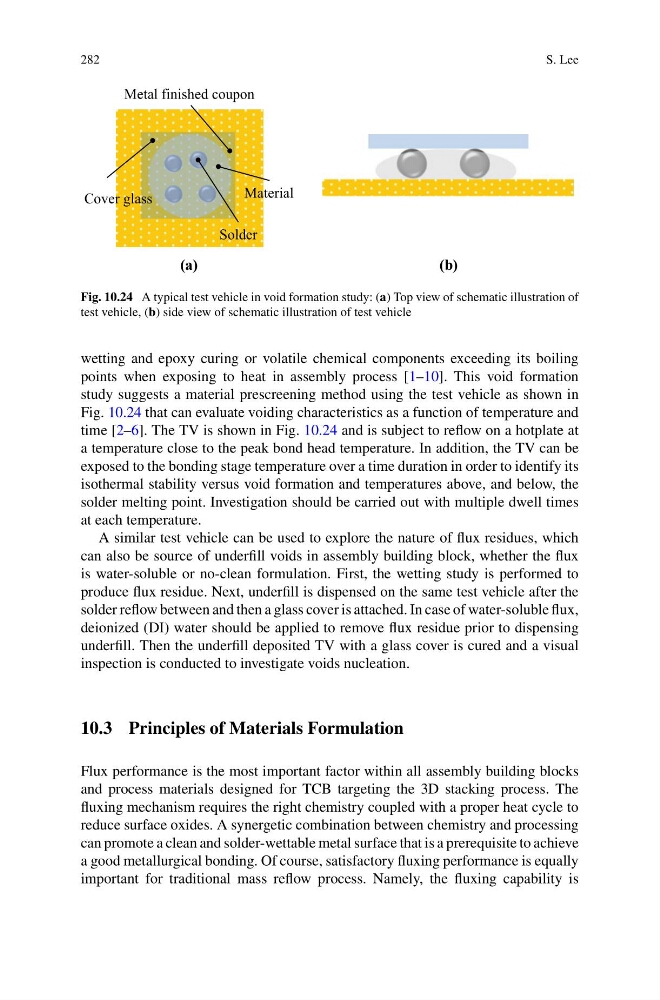
Fig. 10.24 A typical test vehicle in void formation study: (a) Top view of schematic illustration of
test vehicle, (b) side view of schematic illustration of test vehicle
wetting and epoxy curing or volatile chemical components exceeding its boiling
points when exposing to heat in assembly process [1–10]. This void formation
study suggests a material prescreening method using the test vehicle as shown in
Fig. 10.24 that can evaluate voiding characteristics as a function of temperature and
time [2–6]. The TV is shown in Fig. 10.24 and is subject to reflow on a hotplate at
a temperature close to the peak bond head temperature. In addition, the TV can be
exposed to the bonding stage temperature over a time duration in order to identify its
isothermal stability versus void formation and temperatures above, and below, the
solder melting point. Investigation should be carried out with multiple dwell times
at each temperature.
A similar test vehicle can be used to explore the nature of flux residues, which
can also be source of underfill voids in assembly building block, whether the flux
is water-soluble or no-clean formulation. First, the wetting study is performed to
produce flux residue. Next, underfill is dispensed on the same test vehicle after the
solder reflow between and then a glass cover is attached. In case of water-soluble flux,
deionized (DI) water should be applied to remove flux residue prior to dispensing
underfill. Then the underfill deposited TV with a glass cover is cured and a visual
inspection is conducted to investigate voids nucleation.
10.3 Principles of Materials Formulation
Flux performance is the most important factor within all assembly building blocks
and process materials designed for TCB targeting the 3D stacking process. The
fluxing mechanism requires the right chemistry coupled with a proper heat cycle to
reduce surface oxides. A synergetic combination between chemistry and processing
can promote a clean and solder-wettable metal surface that is a prerequisite to achieve
a good metallurgical bonding. Of course, satisfactory fluxing performance is equally
important for traditional mass reflow process. Namely, the fluxing capability is
S. Lee
(a)
(b)
Metal finished coupon
Solder
Material
Cover glass
Fig. 10.24 A typical test vehicle in void formation study: (a) Top view of schematic illustration of
test vehicle, (b) side view of schematic illustration of test vehicle
wetting and epoxy curing or volatile chemical components exceeding its boiling
points when exposing to heat in assembly process [1–10]. This void formation
study suggests a material prescreening method using the test vehicle as shown in
Fig. 10.24 that can evaluate voiding characteristics as a function of temperature and
time [2–6]. The TV is shown in Fig. 10.24 and is subject to reflow on a hotplate at
a temperature close to the peak bond head temperature. In addition, the TV can be
exposed to the bonding stage temperature over a time duration in order to identify its
isothermal stability versus void formation and temperatures above, and below, the
solder melting point. Investigation should be carried out with multiple dwell times
at each temperature.
A similar test vehicle can be used to explore the nature of flux residues, which
can also be source of underfill voids in assembly building block, whether the flux
is water-soluble or no-clean formulation. First, the wetting study is performed to
produce flux residue. Next, underfill is dispensed on the same test vehicle after the
solder reflow between and then a glass cover is attached. In case of water-soluble flux,
deionized (DI) water should be applied to remove flux residue prior to dispensing
underfill. Then the underfill deposited TV with a glass cover is cured and a visual
inspection is conducted to investigate voids nucleation.
10.3 Principles of Materials Formulation
Flux performance is the most important factor within all assembly building blocks
and process materials designed for TCB targeting the 3D stacking process. The
fluxing mechanism requires the right chemistry coupled with a proper heat cycle to
reduce surface oxides. A synergetic combination between chemistry and processing
can promote a clean and solder-wettable metal surface that is a prerequisite to achieve
a good metallurgical bonding. Of course, satisfactory fluxing performance is equally
important for traditional mass reflow process. Namely, the fluxing capability is