

10 Fundamentals of Bonding Technology and Process Materials …
281
(a)
(b)
α
1
2
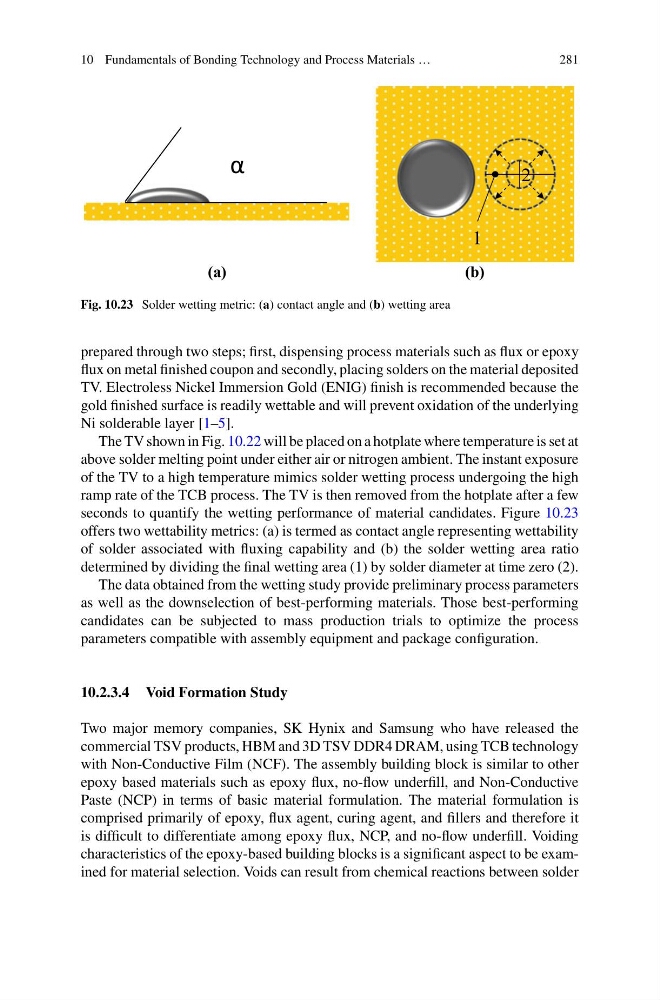
Fig. 10.23 Solder wetting metric: (a) contact angle and (b) wetting area
prepared through two steps; first, dispensing process materials such as flux or epoxy
flux on metal finished coupon and secondly, placing solders on the material deposited
TV. Electroless Nickel Immersion Gold (ENIG) finish is recommended because the
gold finished surface is readily wettable and will prevent oxidation of the underlying
Ni solderable layer [1–5].
The TV shown in Fig. 10.22 will be placed on a hotplate where temperature is set at
above solder melting point under either air or nitrogen ambient. The instant exposure
of the TV to a high temperature mimics solder wetting process undergoing the high
ramp rate of the TCB process. The TV is then removed from the hotplate after a few
seconds to quantify the wetting performance of material candidates. Figure 10.23
offers two wettability metrics: (a) is termed as contact angle representing wettability
of solder associated with fluxing capability and (b) the solder wetting area ratio
determined by dividing the final wetting area (1) by solder diameter at time zero (2).
The data obtained from the wetting study provide preliminary process parameters
as well as the downselection of best-performing materials. Those best-performing
candidates can be subjected to mass production trials to optimize the process
parameters compatible with assembly equipment and package configuration.
10.2.3.4 Void Formation Study
Two major memory companies, SK Hynix and Samsung who have released the
commercial TSV products, HBM and 3D TSV DDR4 DRAM, using TCB technology
with Non-Conductive Film (NCF). The assembly building block is similar to other
epoxy based materials such as epoxy flux, no-flow underfill, and Non-Conductive
Paste (NCP) in terms of basic material formulation. The material formulation is
comprised primarily of epoxy, flux agent, curing agent, and fillers and therefore it
is difficult to differentiate among epoxy flux, NCP, and no-flow underfill. Voiding
characteristics of the epoxy-based building blocks is a significant aspect to be examined for material selection. Voids can result from chemical reactions between solder
281
(a)
(b)
α
1
2
Fig. 10.23 Solder wetting metric: (a) contact angle and (b) wetting area
prepared through two steps; first, dispensing process materials such as flux or epoxy
flux on metal finished coupon and secondly, placing solders on the material deposited
TV. Electroless Nickel Immersion Gold (ENIG) finish is recommended because the
gold finished surface is readily wettable and will prevent oxidation of the underlying
Ni solderable layer [1–5].
The TV shown in Fig. 10.22 will be placed on a hotplate where temperature is set at
above solder melting point under either air or nitrogen ambient. The instant exposure
of the TV to a high temperature mimics solder wetting process undergoing the high
ramp rate of the TCB process. The TV is then removed from the hotplate after a few
seconds to quantify the wetting performance of material candidates. Figure 10.23
offers two wettability metrics: (a) is termed as contact angle representing wettability
of solder associated with fluxing capability and (b) the solder wetting area ratio
determined by dividing the final wetting area (1) by solder diameter at time zero (2).
The data obtained from the wetting study provide preliminary process parameters
as well as the downselection of best-performing materials. Those best-performing
candidates can be subjected to mass production trials to optimize the process
parameters compatible with assembly equipment and package configuration.
10.2.3.4 Void Formation Study
Two major memory companies, SK Hynix and Samsung who have released the
commercial TSV products, HBM and 3D TSV DDR4 DRAM, using TCB technology
with Non-Conductive Film (NCF). The assembly building block is similar to other
epoxy based materials such as epoxy flux, no-flow underfill, and Non-Conductive
Paste (NCP) in terms of basic material formulation. The material formulation is
comprised primarily of epoxy, flux agent, curing agent, and fillers and therefore it
is difficult to differentiate among epoxy flux, NCP, and no-flow underfill. Voiding
characteristics of the epoxy-based building blocks is a significant aspect to be examined for material selection. Voids can result from chemical reactions between solder