

280
S. Lee
Fig. 10.21 DMA: The glass
transition (Tg) temperature
in storage modulus and tan
delta. Source PerkinElmer
Modulus(Pa)
Tanδ
Temperature(˚C)
Peak Tanδ=140.5˚C
Peak Tanδ=136.7˚C
Onset Tanδ=130.0˚C
Onset E”=127.3˚C
Onset E”=133.1˚C
Peak E”=136.7˚C
coefficient of thermal expansion, or CTE. Both detect transitions, but DMA is much
more sensitive.
10.2.3.3 Wetting Study
Wetting capability firstly should be investigated on the process materials regardless
of assembly building blocks in the TCB. This wetting study is designed to mimic the
rapid heating of a TCB process in order to investigate actual wetting performance
of materials because existing metrology techniques such as TGA, DSC, TMA, and
DMA can not simulate thermal process that occur over less than few seconds. In
addition, this experimentation removes the effects of equipment and test vehicle on
wetting performance so that the wetting study only inspects material impact on solder
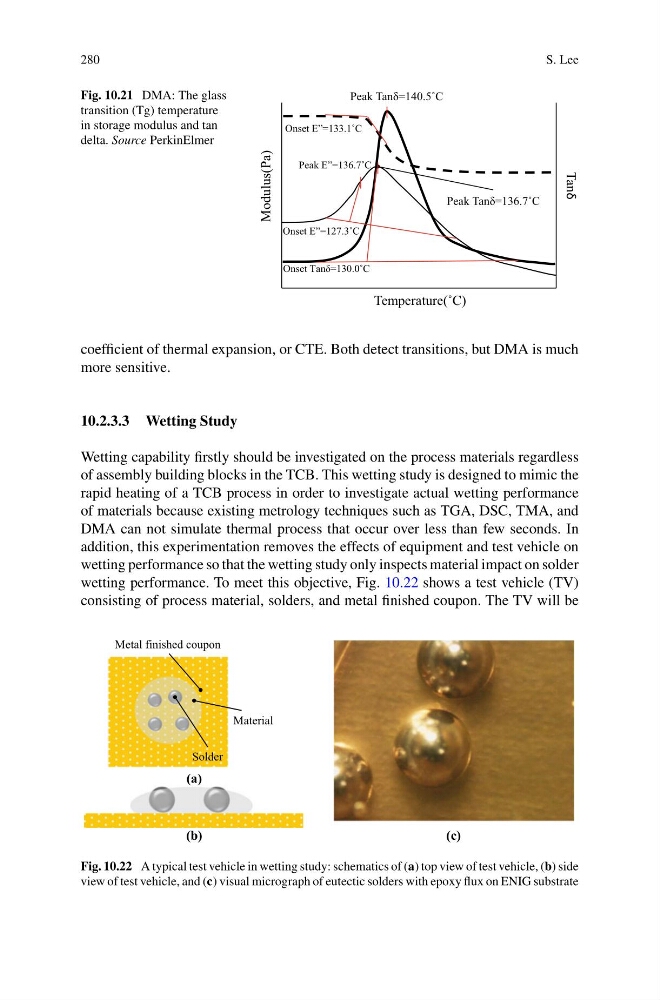
wetting performance. To meet this objective, Fig. 10.22 shows a test vehicle (TV)
consisting of process material, solders, and metal finished coupon. The TV will be
(a)
(b)
(c)
Metal finished coupon
Solder
Material
Fig. 10.22 A typical test vehicle in wetting study: schematics of (a) top view of test vehicle, (b) side
view of test vehicle, and (c) visual micrograph of eutectic solders with epoxy flux on ENIG substrate
S. Lee
Fig. 10.21 DMA: The glass
transition (Tg) temperature
in storage modulus and tan
delta. Source PerkinElmer
Modulus(Pa)
Tanδ
Temperature(˚C)
Peak Tanδ=140.5˚C
Peak Tanδ=136.7˚C
Onset Tanδ=130.0˚C
Onset E”=127.3˚C
Onset E”=133.1˚C
Peak E”=136.7˚C
coefficient of thermal expansion, or CTE. Both detect transitions, but DMA is much
more sensitive.
10.2.3.3 Wetting Study
Wetting capability firstly should be investigated on the process materials regardless
of assembly building blocks in the TCB. This wetting study is designed to mimic the
rapid heating of a TCB process in order to investigate actual wetting performance
of materials because existing metrology techniques such as TGA, DSC, TMA, and
DMA can not simulate thermal process that occur over less than few seconds. In
addition, this experimentation removes the effects of equipment and test vehicle on
wetting performance so that the wetting study only inspects material impact on solder
wetting performance. To meet this objective, Fig. 10.22 shows a test vehicle (TV)
consisting of process material, solders, and metal finished coupon. The TV will be
(a)
(b)
(c)
Metal finished coupon
Solder
Material
Fig. 10.22 A typical test vehicle in wetting study: schematics of (a) top view of test vehicle, (b) side
view of test vehicle, and (c) visual micrograph of eutectic solders with epoxy flux on ENIG substrate