

276
S. Lee
10.2.3.2 Basic Properties Measurement
Thermal analysis is necessary to characterize material formulation and the traditional techniques include Thermogravimetric Analysis (TGA), Differential Scanning
Calorimetry (DSC), Dynamic Mechanical Analysis (DMA), and Thermomechanical
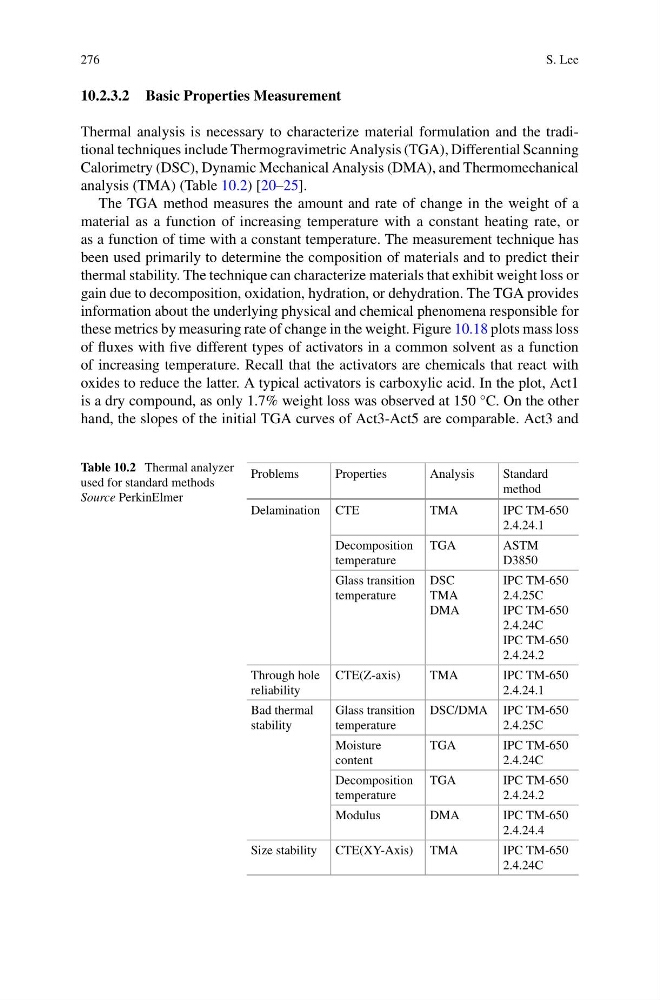
analysis (TMA) (Table 10.2) [20–25].
The TGA method measures the amount and rate of change in the weight of a
material as a function of increasing temperature with a constant heating rate, or
as a function of time with a constant temperature. The measurement technique has
been used primarily to determine the composition of materials and to predict their
thermal stability. The technique can characterize materials that exhibit weight loss or
gain due to decomposition, oxidation, hydration, or dehydration. The TGA provides
information about the underlying physical and chemical phenomena responsible for
these metrics by measuring rate of change in the weight. Figure 10.18 plots mass loss
of fluxes with five different types of activators in a common solvent as a function
of increasing temperature. Recall that the activators are chemicals that react with
oxides to reduce the latter. A typical activators is carboxylic acid. In the plot, Act1
is a dry compound, as only 1.7% weight loss was observed at 150 °C. On the other
hand, the slopes of the initial TGA curves of Act3-Act5 are comparable. Act3 and
Table 10.2 Thermal analyzer
used for standard methods
Source PerkinElmer
Problems
Properties
Analysis
Standard
method
Delamination CTE
TMA
IPC TM-650
2.4.24.1
Decomposition
temperature
TGA
ASTM
D3850
Glass transition
temperature
DSC
TMA
DMA
IPC TM-650
2.4.25C
IPC TM-650
2.4.24C
IPC TM-650
2.4.24.2
Through hole
reliability
CTE(Z-axis)
TMA
IPC TM-650
2.4.24.1
Bad thermal
stability
Glass transition
temperature
DSC/DMA IPC TM-650
2.4.25C
Moisture
content
TGA
IPC TM-650
2.4.24C
Decomposition
temperature
TGA
IPC TM-650
2.4.24.2
Modulus
DMA
IPC TM-650
2.4.24.4
Size stability CTE(XY-Axis) TMA
IPC TM-650
2.4.24C
S. Lee
10.2.3.2 Basic Properties Measurement
Thermal analysis is necessary to characterize material formulation and the traditional techniques include Thermogravimetric Analysis (TGA), Differential Scanning
Calorimetry (DSC), Dynamic Mechanical Analysis (DMA), and Thermomechanical
analysis (TMA) (Table 10.2) [20–25].
The TGA method measures the amount and rate of change in the weight of a
material as a function of increasing temperature with a constant heating rate, or
as a function of time with a constant temperature. The measurement technique has
been used primarily to determine the composition of materials and to predict their
thermal stability. The technique can characterize materials that exhibit weight loss or
gain due to decomposition, oxidation, hydration, or dehydration. The TGA provides
information about the underlying physical and chemical phenomena responsible for
these metrics by measuring rate of change in the weight. Figure 10.18 plots mass loss
of fluxes with five different types of activators in a common solvent as a function
of increasing temperature. Recall that the activators are chemicals that react with
oxides to reduce the latter. A typical activators is carboxylic acid. In the plot, Act1
is a dry compound, as only 1.7% weight loss was observed at 150 °C. On the other
hand, the slopes of the initial TGA curves of Act3-Act5 are comparable. Act3 and
Table 10.2 Thermal analyzer
used for standard methods
Source PerkinElmer
Problems
Properties
Analysis
Standard
method
Delamination CTE
TMA
IPC TM-650
2.4.24.1
Decomposition
temperature
TGA
ASTM
D3850
Glass transition
temperature
DSC
TMA
DMA
IPC TM-650
2.4.25C
IPC TM-650
2.4.24C
IPC TM-650
2.4.24.2
Through hole
reliability
CTE(Z-axis)
TMA
IPC TM-650
2.4.24.1
Bad thermal
stability
Glass transition
temperature
DSC/DMA IPC TM-650
2.4.25C
Moisture
content
TGA
IPC TM-650
2.4.24C
Decomposition
temperature
TGA
IPC TM-650
2.4.24.2
Modulus
DMA
IPC TM-650
2.4.24.4
Size stability CTE(XY-Axis) TMA
IPC TM-650
2.4.24C