

10 Fundamentals of Bonding Technology and Process Materials …
275
60
70
80
90
100
110
Left
Middle
Right
Gap height(μm)
Measured position
TCB Center
TCB Edge
Mass Reflow Center
Mass Reflow Edge
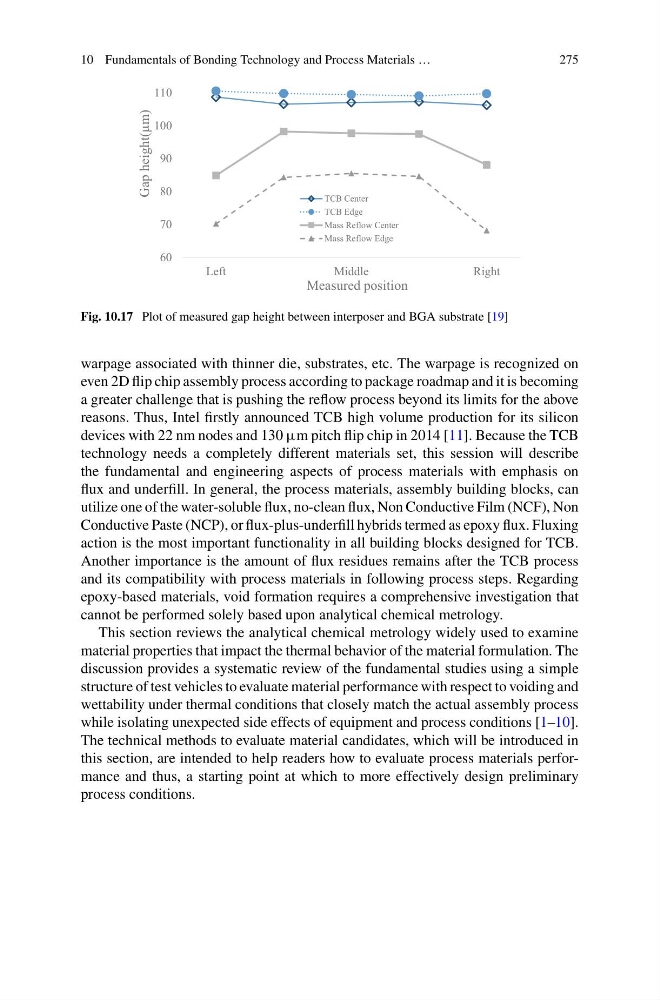
Fig. 10.17 Plot of measured gap height between interposer and BGA substrate [19]
warpage associated with thinner die, substrates, etc. The warpage is recognized on
even 2D flip chip assembly process according to package roadmap and it is becoming
a greater challenge that is pushing the reflow process beyond its limits for the above
reasons. Thus, Intel firstly announced TCB high volume production for its silicon
devices with 22 nm nodes and 130 μm pitch flip chip in 2014 [11]. Because the TCB
technology needs a completely different materials set, this session will describe
the fundamental and engineering aspects of process materials with emphasis on
flux and underfill. In general, the process materials, assembly building blocks, can
utilize one of the water-soluble flux, no-clean flux, Non Conductive Film (NCF), Non
Conductive Paste (NCP), or flux-plus-underfill hybrids termed as epoxy flux. Fluxing
action is the most important functionality in all building blocks designed for TCB.
Another importance is the amount of flux residues remains after the TCB process
and its compatibility with process materials in following process steps. Regarding
epoxy-based materials, void formation requires a comprehensive investigation that
cannot be performed solely based upon analytical chemical metrology.
This section reviews the analytical chemical metrology widely used to examine
material properties that impact the thermal behavior of the material formulation. The
discussion provides a systematic review of the fundamental studies using a simple
structure of test vehicles to evaluate material performance with respect to voiding and
wettability under thermal conditions that closely match the actual assembly process
while isolating unexpected side effects of equipment and process conditions [1–10].
The technical methods to evaluate material candidates, which will be introduced in
this section, are intended to help readers how to evaluate process materials performance and thus, a starting point at which to more effectively design preliminary
process conditions.
275
60
70
80
90
100
110
Left
Middle
Right
Gap height(μm)
Measured position
TCB Center
TCB Edge
Mass Reflow Center
Mass Reflow Edge
Fig. 10.17 Plot of measured gap height between interposer and BGA substrate [19]
warpage associated with thinner die, substrates, etc. The warpage is recognized on
even 2D flip chip assembly process according to package roadmap and it is becoming
a greater challenge that is pushing the reflow process beyond its limits for the above
reasons. Thus, Intel firstly announced TCB high volume production for its silicon
devices with 22 nm nodes and 130 μm pitch flip chip in 2014 [11]. Because the TCB
technology needs a completely different materials set, this session will describe
the fundamental and engineering aspects of process materials with emphasis on
flux and underfill. In general, the process materials, assembly building blocks, can
utilize one of the water-soluble flux, no-clean flux, Non Conductive Film (NCF), Non
Conductive Paste (NCP), or flux-plus-underfill hybrids termed as epoxy flux. Fluxing
action is the most important functionality in all building blocks designed for TCB.
Another importance is the amount of flux residues remains after the TCB process
and its compatibility with process materials in following process steps. Regarding
epoxy-based materials, void formation requires a comprehensive investigation that
cannot be performed solely based upon analytical chemical metrology.
This section reviews the analytical chemical metrology widely used to examine
material properties that impact the thermal behavior of the material formulation. The
discussion provides a systematic review of the fundamental studies using a simple
structure of test vehicles to evaluate material performance with respect to voiding and
wettability under thermal conditions that closely match the actual assembly process
while isolating unexpected side effects of equipment and process conditions [1–10].
The technical methods to evaluate material candidates, which will be introduced in
this section, are intended to help readers how to evaluate process materials performance and thus, a starting point at which to more effectively design preliminary
process conditions.