

10 Fundamentals of Bonding Technology and Process Materials …
269
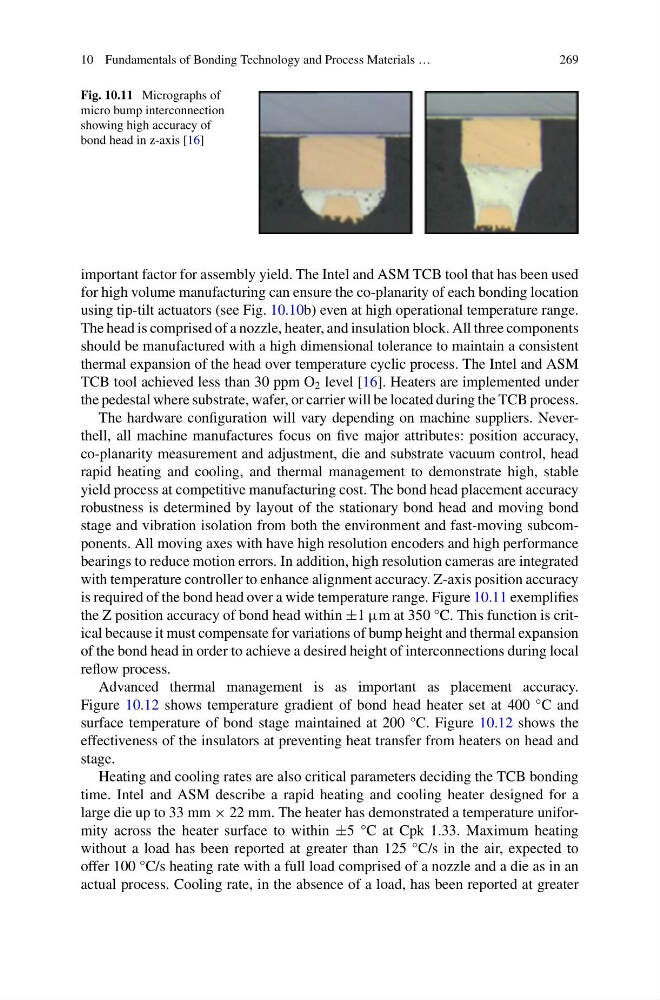
Fig. 10.11 Micrographs of
micro bump interconnection
showing high accuracy of
bond head in z-axis [16]
important factor for assembly yield. The Intel and ASM TCB tool that has been used
for high volume manufacturing can ensure the co-planarity of each bonding location
using tip-tilt actuators (see Fig. 10.10b) even at high operational temperature range.
The head is comprised of a nozzle, heater, and insulation block. All three components
should be manufactured with a high dimensional tolerance to maintain a consistent
thermal expansion of the head over temperature cyclic process. The Intel and ASM
TCB tool achieved less than 30 ppm O 2 level [16]. Heaters are implemented under
the pedestal where substrate, wafer, or carrier will be located during the TCB process.
The hardware configuration will vary depending on machine suppliers. Neverthell, all machine manufactures focus on five major attributes: position accuracy,
co-planarity measurement and adjustment, die and substrate vacuum control, head
rapid heating and cooling, and thermal management to demonstrate high, stable
yield process at competitive manufacturing cost. The bond head placement accuracy
robustness is determined by layout of the stationary bond head and moving bond
stage and vibration isolation from both the environment and fast-moving subcomponents. All moving axes with have high resolution encoders and high performance
bearings to reduce motion errors. In addition, high resolution cameras are integrated
with temperature controller to enhance alignment accuracy. Z-axis position accuracy
is required of the bond head over a wide temperature range. Figure 10.11 exemplifies
the Z position accuracy of bond head within ±1 μm at 350 °C. This function is critical because it must compensate for variations of bump height and thermal expansion
of the bond head in order to achieve a desired height of interconnections during local
reflow process.
Advanced thermal management is as important as placement accuracy.
Figure 10.12 shows temperature gradient of bond head heater set at 400 °C and
surface temperature of bond stage maintained at 200 °C. Figure 10.12 shows the
effectiveness of the insulators at preventing heat transfer from heaters on head and
stage.
Heating and cooling rates are also critical parameters deciding the TCB bonding
time. Intel and ASM describe a rapid heating and cooling heater designed for a
large die up to 33 mm × 22 mm. The heater has demonstrated a temperature uniformity across the heater surface to within ±5 °C at Cpk 1.33. Maximum heating
without a load has been reported at greater than 125 °C/s in the air, expected to
offer 100 °C/s heating rate with a full load comprised of a nozzle and a die as in an
actual process. Cooling rate, in the absence of a load, has been reported at greater
269
Fig. 10.11 Micrographs of
micro bump interconnection
showing high accuracy of
bond head in z-axis [16]
important factor for assembly yield. The Intel and ASM TCB tool that has been used
for high volume manufacturing can ensure the co-planarity of each bonding location
using tip-tilt actuators (see Fig. 10.10b) even at high operational temperature range.
The head is comprised of a nozzle, heater, and insulation block. All three components
should be manufactured with a high dimensional tolerance to maintain a consistent
thermal expansion of the head over temperature cyclic process. The Intel and ASM
TCB tool achieved less than 30 ppm O 2 level [16]. Heaters are implemented under
the pedestal where substrate, wafer, or carrier will be located during the TCB process.
The hardware configuration will vary depending on machine suppliers. Neverthell, all machine manufactures focus on five major attributes: position accuracy,
co-planarity measurement and adjustment, die and substrate vacuum control, head
rapid heating and cooling, and thermal management to demonstrate high, stable
yield process at competitive manufacturing cost. The bond head placement accuracy
robustness is determined by layout of the stationary bond head and moving bond
stage and vibration isolation from both the environment and fast-moving subcomponents. All moving axes with have high resolution encoders and high performance
bearings to reduce motion errors. In addition, high resolution cameras are integrated
with temperature controller to enhance alignment accuracy. Z-axis position accuracy
is required of the bond head over a wide temperature range. Figure 10.11 exemplifies
the Z position accuracy of bond head within ±1 μm at 350 °C. This function is critical because it must compensate for variations of bump height and thermal expansion
of the bond head in order to achieve a desired height of interconnections during local
reflow process.
Advanced thermal management is as important as placement accuracy.
Figure 10.12 shows temperature gradient of bond head heater set at 400 °C and
surface temperature of bond stage maintained at 200 °C. Figure 10.12 shows the
effectiveness of the insulators at preventing heat transfer from heaters on head and
stage.
Heating and cooling rates are also critical parameters deciding the TCB bonding
time. Intel and ASM describe a rapid heating and cooling heater designed for a
large die up to 33 mm × 22 mm. The heater has demonstrated a temperature uniformity across the heater surface to within ±5 °C at Cpk 1.33. Maximum heating
without a load has been reported at greater than 125 °C/s in the air, expected to
offer 100 °C/s heating rate with a full load comprised of a nozzle and a die as in an
actual process. Cooling rate, in the absence of a load, has been reported at greater