

1 Introduction to 3D Microelectronic Packaging
9
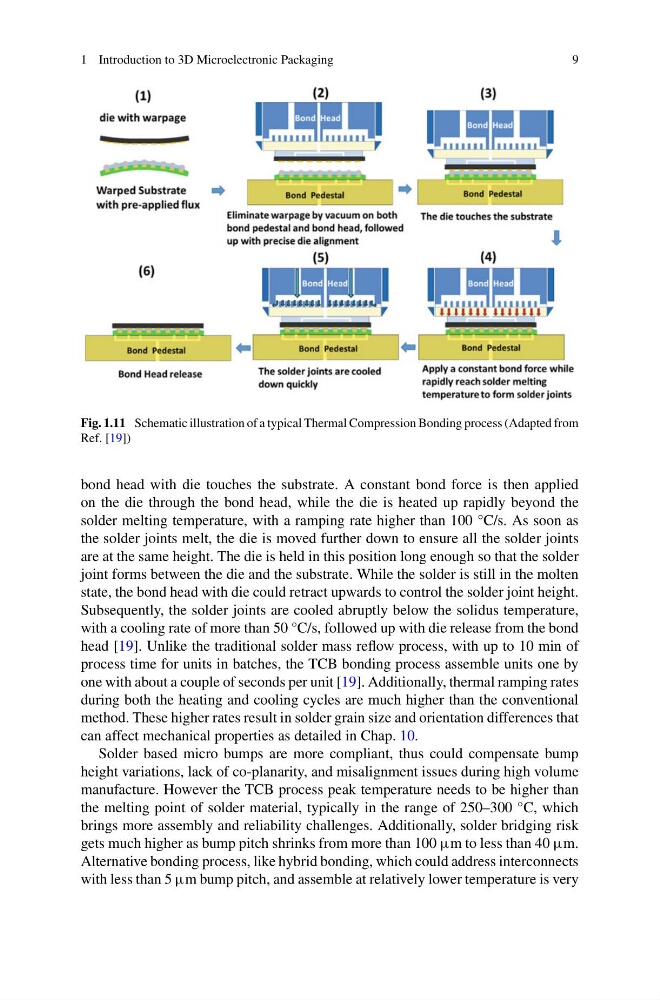
Fig. 1.11 Schematic illustration of a typical Thermal Compression Bonding process (Adapted from
Ref. [19])
bond head with die touches the substrate. A constant bond force is then applied
on the die through the bond head, while the die is heated up rapidly beyond the
solder melting temperature, with a ramping rate higher than 100 °C/s. As soon as
the solder joints melt, the die is moved further down to ensure all the solder joints
are at the same height. The die is held in this position long enough so that the solder
joint forms between the die and the substrate. While the solder is still in the molten
state, the bond head with die could retract upwards to control the solder joint height.
Subsequently, the solder joints are cooled abruptly below the solidus temperature,
with a cooling rate of more than 50 °C/s, followed up with die release from the bond
head [19]. Unlike the traditional solder mass reflow process, with up to 10 min of
process time for units in batches, the TCB bonding process assemble units one by
one with about a couple of seconds per unit [19]. Additionally, thermal ramping rates
during both the heating and cooling cycles are much higher than the conventional
method. These higher rates result in solder grain size and orientation differences that
can affect mechanical properties as detailed in Chap. 10.
Solder based micro bumps are more compliant, thus could compensate bump
height variations, lack of co-planarity, and misalignment issues during high volume
manufacture. However the TCB process peak temperature needs to be higher than
the melting point of solder material, typically in the range of 250–300 °C, which
brings more assembly and reliability challenges. Additionally, solder bridging risk
gets much higher as bump pitch shrinks from more than 100 µm to less than 40 µm.
Alternative bonding process, like hybrid bonding, which could address interconnects
with less than 5 µm bump pitch, and assemble at relatively lower temperature is very
9
Fig. 1.11 Schematic illustration of a typical Thermal Compression Bonding process (Adapted from
Ref. [19])
bond head with die touches the substrate. A constant bond force is then applied
on the die through the bond head, while the die is heated up rapidly beyond the
solder melting temperature, with a ramping rate higher than 100 °C/s. As soon as
the solder joints melt, the die is moved further down to ensure all the solder joints
are at the same height. The die is held in this position long enough so that the solder
joint forms between the die and the substrate. While the solder is still in the molten
state, the bond head with die could retract upwards to control the solder joint height.
Subsequently, the solder joints are cooled abruptly below the solidus temperature,
with a cooling rate of more than 50 °C/s, followed up with die release from the bond
head [19]. Unlike the traditional solder mass reflow process, with up to 10 min of
process time for units in batches, the TCB bonding process assemble units one by
one with about a couple of seconds per unit [19]. Additionally, thermal ramping rates
during both the heating and cooling cycles are much higher than the conventional
method. These higher rates result in solder grain size and orientation differences that
can affect mechanical properties as detailed in Chap. 10.
Solder based micro bumps are more compliant, thus could compensate bump
height variations, lack of co-planarity, and misalignment issues during high volume
manufacture. However the TCB process peak temperature needs to be higher than
the melting point of solder material, typically in the range of 250–300 °C, which
brings more assembly and reliability challenges. Additionally, solder bridging risk
gets much higher as bump pitch shrinks from more than 100 µm to less than 40 µm.
Alternative bonding process, like hybrid bonding, which could address interconnects
with less than 5 µm bump pitch, and assemble at relatively lower temperature is very