

8 Direct Cu to Cu Bonding and Alternative Bonding Techniques …
223
8.8 Alternative Cu–Cu Bonding Techniques: Insertion
Bonding
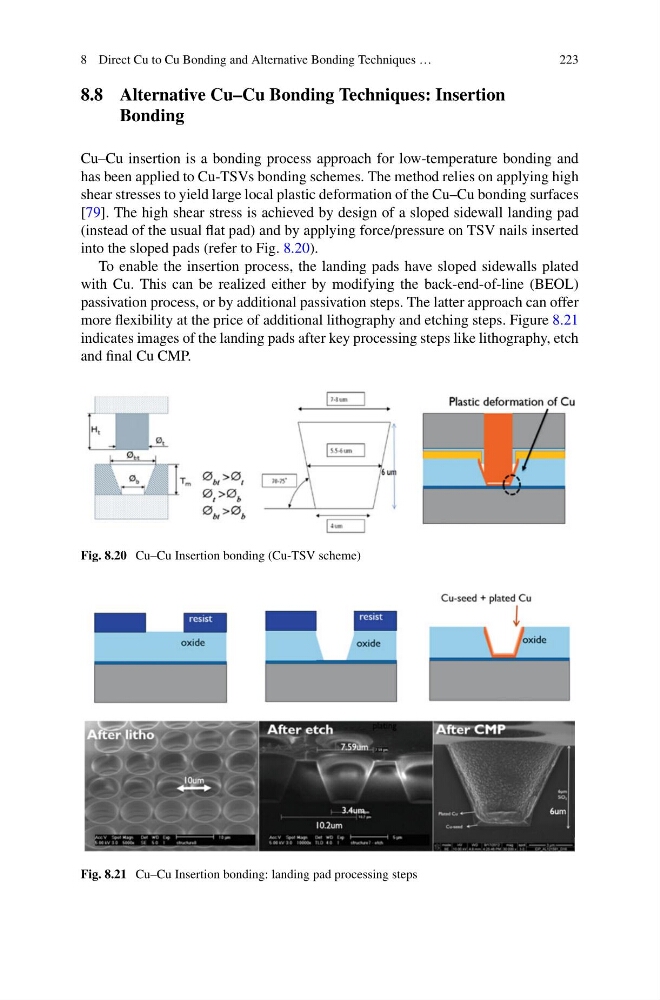
Cu–Cu insertion is a bonding process approach for low-temperature bonding and
has been applied to Cu-TSVs bonding schemes. The method relies on applying high
shear stresses to yield large local plastic deformation of the Cu–Cu bonding surfaces
[79]. The high shear stress is achieved by design of a sloped sidewall landing pad
(instead of the usual flat pad) and by applying force/pressure on TSV nails inserted
into the sloped pads (refer to Fig. 8.20).
To enable the insertion process, the landing pads have sloped sidewalls plated
with Cu. This can be realized either by modifying the back-end-of-line (BEOL)
passivation process, or by additional passivation steps. The latter approach can offer
more flexibility at the price of additional lithography and etching steps. Figure 8.21
indicates images of the landing pads after key processing steps like lithography, etch
and final Cu CMP.
Fig. 8.20 Cu–Cu Insertion bonding (Cu-TSV scheme)
Fig. 8.21 Cu–Cu Insertion bonding: landing pad processing steps
223
8.8 Alternative Cu–Cu Bonding Techniques: Insertion
Bonding
Cu–Cu insertion is a bonding process approach for low-temperature bonding and
has been applied to Cu-TSVs bonding schemes. The method relies on applying high
shear stresses to yield large local plastic deformation of the Cu–Cu bonding surfaces
[79]. The high shear stress is achieved by design of a sloped sidewall landing pad
(instead of the usual flat pad) and by applying force/pressure on TSV nails inserted
into the sloped pads (refer to Fig. 8.20).
To enable the insertion process, the landing pads have sloped sidewalls plated
with Cu. This can be realized either by modifying the back-end-of-line (BEOL)
passivation process, or by additional passivation steps. The latter approach can offer
more flexibility at the price of additional lithography and etching steps. Figure 8.21
indicates images of the landing pads after key processing steps like lithography, etch
and final Cu CMP.
Fig. 8.20 Cu–Cu Insertion bonding (Cu-TSV scheme)
Fig. 8.21 Cu–Cu Insertion bonding: landing pad processing steps