

222
T. Suga et al.
(a) “Adhesive-first” hybrid bonding
Si
Si
Si
Si
Si
Si
Si
Si
Thermo-compression
(below 250°C)
Thermo-compression
(350-400°C)
Thermo-compression
(below 200°C)
No compression, batch
process (below 200°C)
(b) “Cu-first” hybrid bonding
Adhesive bonding and curing
Cu-Cu bonding
Cu-Cu and adhesive bonding
after surface activation
Adhesive curing
unbonded
Cu
Cu
Cu
Cu
Highly cured
polymer
Adhesive remains
partially cured
bonded
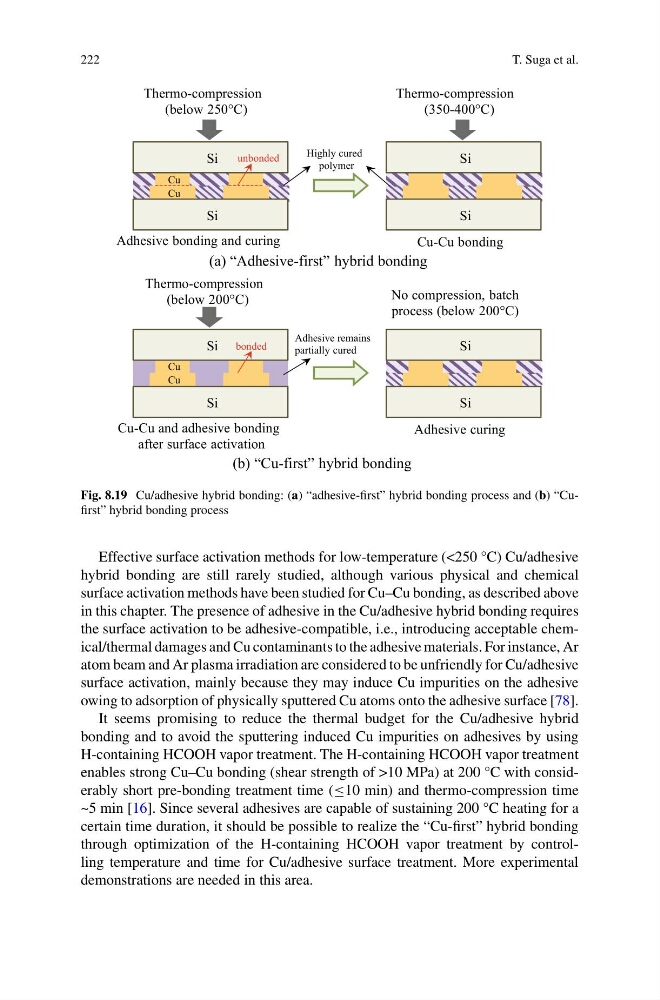
Fig. 8.19 Cu/adhesive hybrid bonding: (a) “adhesive-first” hybrid bonding process and (b) “Cufirst” hybrid bonding process
Effective surface activation methods for low-temperature (<250 °C) Cu/adhesive
hybrid bonding are still rarely studied, although various physical and chemical
surface activation methods have been studied for Cu–Cu bonding, as described above
in this chapter. The presence of adhesive in the Cu/adhesive hybrid bonding requires
the surface activation to be adhesive-compatible, i.e., introducing acceptable chemical/thermal damages and Cu contaminants to the adhesive materials. For instance, Ar
atom beam and Ar plasma irradiation are considered to be unfriendly for Cu/adhesive
surface activation, mainly because they may induce Cu impurities on the adhesive
owing to adsorption of physically sputtered Cu atoms onto the adhesive surface [78].
It seems promising to reduce the thermal budget for the Cu/adhesive hybrid
bonding and to avoid the sputtering induced Cu impurities on adhesives by using
H-containing HCOOH vapor treatment. The H-containing HCOOH vapor treatment
enables strong Cu–Cu bonding (shear strength of >10 MPa) at 200 °C with considerably short pre-bonding treatment time (≤10 min) and thermo-compression time
~5 min [16]. Since several adhesives are capable of sustaining 200 °C heating for a
certain time duration, it should be possible to realize the “Cu-first” hybrid bonding
through optimization of the H-containing HCOOH vapor treatment by controlling temperature and time for Cu/adhesive surface treatment. More experimental
demonstrations are needed in this area.
T. Suga et al.
(a) “Adhesive-first” hybrid bonding
Si
Si
Si
Si
Si
Si
Si
Si
Thermo-compression
(below 250°C)
Thermo-compression
(350-400°C)
Thermo-compression
(below 200°C)
No compression, batch
process (below 200°C)
(b) “Cu-first” hybrid bonding
Adhesive bonding and curing
Cu-Cu bonding
Cu-Cu and adhesive bonding
after surface activation
Adhesive curing
unbonded
Cu
Cu
Cu
Cu
Highly cured
polymer
Adhesive remains
partially cured
bonded
Fig. 8.19 Cu/adhesive hybrid bonding: (a) “adhesive-first” hybrid bonding process and (b) “Cufirst” hybrid bonding process
Effective surface activation methods for low-temperature (<250 °C) Cu/adhesive
hybrid bonding are still rarely studied, although various physical and chemical
surface activation methods have been studied for Cu–Cu bonding, as described above
in this chapter. The presence of adhesive in the Cu/adhesive hybrid bonding requires
the surface activation to be adhesive-compatible, i.e., introducing acceptable chemical/thermal damages and Cu contaminants to the adhesive materials. For instance, Ar
atom beam and Ar plasma irradiation are considered to be unfriendly for Cu/adhesive
surface activation, mainly because they may induce Cu impurities on the adhesive
owing to adsorption of physically sputtered Cu atoms onto the adhesive surface [78].
It seems promising to reduce the thermal budget for the Cu/adhesive hybrid
bonding and to avoid the sputtering induced Cu impurities on adhesives by using
H-containing HCOOH vapor treatment. The H-containing HCOOH vapor treatment
enables strong Cu–Cu bonding (shear strength of >10 MPa) at 200 °C with considerably short pre-bonding treatment time (≤10 min) and thermo-compression time
~5 min [16]. Since several adhesives are capable of sustaining 200 °C heating for a
certain time duration, it should be possible to realize the “Cu-first” hybrid bonding
through optimization of the H-containing HCOOH vapor treatment by controlling temperature and time for Cu/adhesive surface treatment. More experimental
demonstrations are needed in this area.