

8 Direct Cu to Cu Bonding and Alternative Bonding Techniques …
221
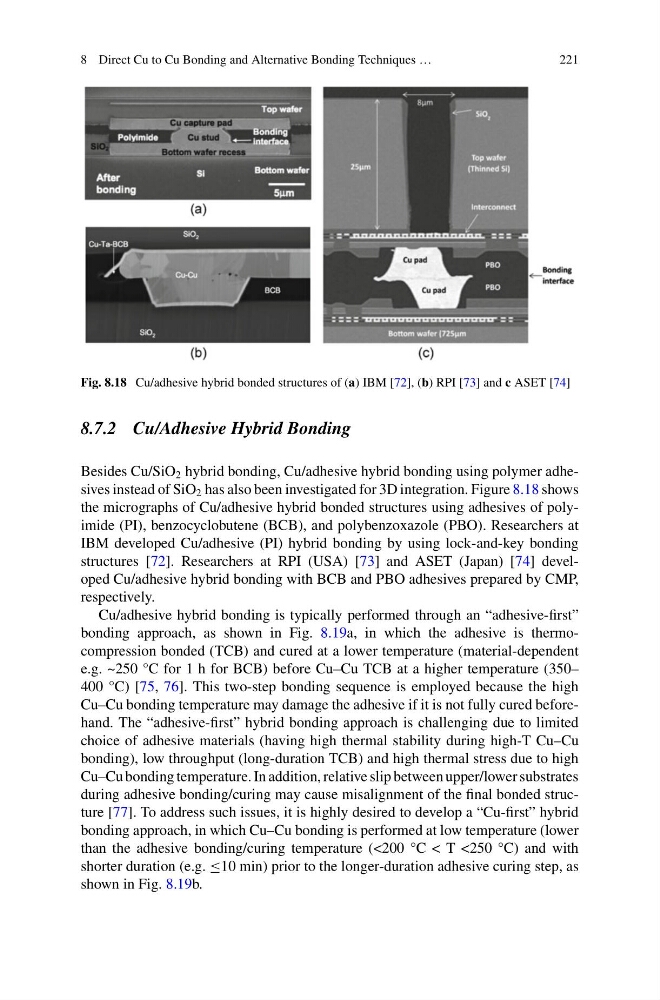
Fig. 8.18 Cu/adhesive hybrid bonded structures of (a) IBM [72], (b) RPI [73] and c ASET [74]
8.7.2 Cu/Adhesive Hybrid Bonding
Besides Cu/SiO 2 hybrid bonding, Cu/adhesive hybrid bonding using polymer adhesives instead of SiO 2 has also been investigated for 3D integration. Figure 8.18 shows
the micrographs of Cu/adhesive hybrid bonded structures using adhesives of polyimide (PI), benzocyclobutene (BCB), and polybenzoxazole (PBO). Researchers at
IBM developed Cu/adhesive (PI) hybrid bonding by using lock-and-key bonding
structures [72]. Researchers at RPI (USA) [73] and ASET (Japan) [74] developed Cu/adhesive hybrid bonding with BCB and PBO adhesives prepared by CMP,
respectively.
Cu/adhesive hybrid bonding is typically performed through an “adhesive-first”
bonding approach, as shown in Fig. 8.19a, in which the adhesive is thermocompression bonded (TCB) and cured at a lower temperature (material-dependent
e.g. ~250 °C for 1 h for BCB) before Cu–Cu TCB at a higher temperature (350–
400 °C) [75, 76]. This two-step bonding sequence is employed because the high
Cu–Cu bonding temperature may damage the adhesive if it is not fully cured beforehand. The “adhesive-first” hybrid bonding approach is challenging due to limited
choice of adhesive materials (having high thermal stability during high-T Cu–Cu
bonding), low throughput (long-duration TCB) and high thermal stress due to high
Cu–Cu bonding temperature. In addition, relative slip between upper/lower substrates
during adhesive bonding/curing may cause misalignment of the final bonded structure [77]. To address such issues, it is highly desired to develop a “Cu-first” hybrid
bonding approach, in which Cu–Cu bonding is performed at low temperature (lower
than the adhesive bonding/curing temperature (<200 °C < T <250 °C) and with
shorter duration (e.g. ≤10 min) prior to the longer-duration adhesive curing step, as
shown in Fig. 8.19b.
221
Fig. 8.18 Cu/adhesive hybrid bonded structures of (a) IBM [72], (b) RPI [73] and c ASET [74]
8.7.2 Cu/Adhesive Hybrid Bonding
Besides Cu/SiO 2 hybrid bonding, Cu/adhesive hybrid bonding using polymer adhesives instead of SiO 2 has also been investigated for 3D integration. Figure 8.18 shows
the micrographs of Cu/adhesive hybrid bonded structures using adhesives of polyimide (PI), benzocyclobutene (BCB), and polybenzoxazole (PBO). Researchers at
IBM developed Cu/adhesive (PI) hybrid bonding by using lock-and-key bonding
structures [72]. Researchers at RPI (USA) [73] and ASET (Japan) [74] developed Cu/adhesive hybrid bonding with BCB and PBO adhesives prepared by CMP,
respectively.
Cu/adhesive hybrid bonding is typically performed through an “adhesive-first”
bonding approach, as shown in Fig. 8.19a, in which the adhesive is thermocompression bonded (TCB) and cured at a lower temperature (material-dependent
e.g. ~250 °C for 1 h for BCB) before Cu–Cu TCB at a higher temperature (350–
400 °C) [75, 76]. This two-step bonding sequence is employed because the high
Cu–Cu bonding temperature may damage the adhesive if it is not fully cured beforehand. The “adhesive-first” hybrid bonding approach is challenging due to limited
choice of adhesive materials (having high thermal stability during high-T Cu–Cu
bonding), low throughput (long-duration TCB) and high thermal stress due to high
Cu–Cu bonding temperature. In addition, relative slip between upper/lower substrates
during adhesive bonding/curing may cause misalignment of the final bonded structure [77]. To address such issues, it is highly desired to develop a “Cu-first” hybrid
bonding approach, in which Cu–Cu bonding is performed at low temperature (lower
than the adhesive bonding/curing temperature (<200 °C < T <250 °C) and with
shorter duration (e.g. ≤10 min) prior to the longer-duration adhesive curing step, as
shown in Fig. 8.19b.