

216
T. Suga et al.
and Cu–Sn/adhesive combinations, Cu/SiO 2 and Cu/adhesive hybrid bonding are
the most promising options for high electrical performance.
The methods used for Cu/SiO 2 and Cu/adhesive hybrid bonding are different
because of the different mechanisms of SiO 2 –SiO 2 bonding and polymer adhesive
bonding. The SiO 2 –SiO 2 bonding is typically based on the hydrophilic bonding
mechanism, which requires hydrophilic surface modification prior to bonding; the
adhesive bonding usually uses thermosetting polymer adhesives, for instance, benzocyclobutene (BCB), polyimide (PI), and polybenzoxazole (PBO), and the bonding
is based on TCB.
8.7.1 Cu/SiO 2 Hybrid Bonding
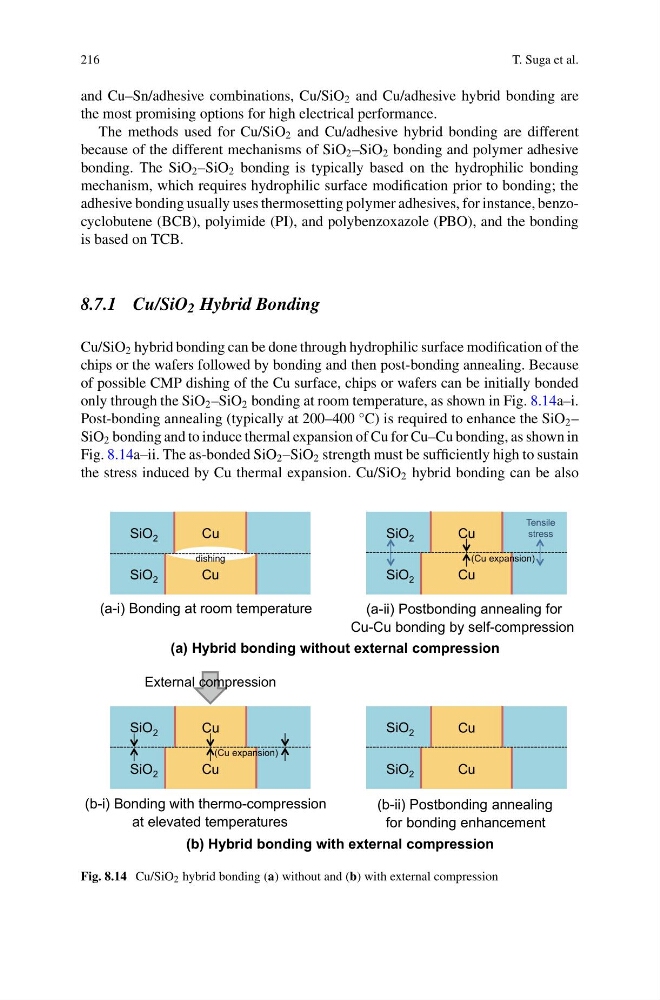
Cu/SiO 2 hybrid bonding can be done through hydrophilic surface modification of the
chips or the wafers followed by bonding and then post-bonding annealing. Because
of possible CMP dishing of the Cu surface, chips or wafers can be initially bonded
only through the SiO 2 –SiO 2 bonding at room temperature, as shown in Fig. 8.14a–i.
Post-bonding annealing (typically at 200–400 °C) is required to enhance the SiO 2 –
SiO 2 bonding and to induce thermal expansion of Cu for Cu–Cu bonding, as shown in
Fig. 8.14a–ii. The as-bonded SiO 2 –SiO 2 strength must be sufficiently high to sustain
the stress induced by Cu thermal expansion. Cu/SiO 2 hybrid bonding can be also
SiO 2
SiO 2
Cu
Cu
SiO 2
SiO 2
Cu
Cu
dishing
SiO 2
SiO 2
Cu
Cu
SiO 2
SiO 2
Cu
Cu
External compression
(b-ii) Postbonding annealing
for bonding enhancement
(a-i) Bonding at room temperature
(b-i) Bonding with thermo-compression
at elevated temperatures
(a-ii) Postbonding annealing for
Cu-Cu bonding by self-compression
(a) Hybrid bonding without external compression
(b) Hybrid bonding with external compression
Tensile
stress
(Cu expansion)
(Cu expansion)
Fig. 8.14 Cu/SiO 2 hybrid bonding (a) without and (b) with external compression
T. Suga et al.
and Cu–Sn/adhesive combinations, Cu/SiO 2 and Cu/adhesive hybrid bonding are
the most promising options for high electrical performance.
The methods used for Cu/SiO 2 and Cu/adhesive hybrid bonding are different
because of the different mechanisms of SiO 2 –SiO 2 bonding and polymer adhesive
bonding. The SiO 2 –SiO 2 bonding is typically based on the hydrophilic bonding
mechanism, which requires hydrophilic surface modification prior to bonding; the
adhesive bonding usually uses thermosetting polymer adhesives, for instance, benzocyclobutene (BCB), polyimide (PI), and polybenzoxazole (PBO), and the bonding
is based on TCB.
8.7.1 Cu/SiO 2 Hybrid Bonding
Cu/SiO 2 hybrid bonding can be done through hydrophilic surface modification of the
chips or the wafers followed by bonding and then post-bonding annealing. Because
of possible CMP dishing of the Cu surface, chips or wafers can be initially bonded
only through the SiO 2 –SiO 2 bonding at room temperature, as shown in Fig. 8.14a–i.
Post-bonding annealing (typically at 200–400 °C) is required to enhance the SiO 2 –
SiO 2 bonding and to induce thermal expansion of Cu for Cu–Cu bonding, as shown in
Fig. 8.14a–ii. The as-bonded SiO 2 –SiO 2 strength must be sufficiently high to sustain
the stress induced by Cu thermal expansion. Cu/SiO 2 hybrid bonding can be also
SiO 2
SiO 2
Cu
Cu
SiO 2
SiO 2
Cu
Cu
dishing
SiO 2
SiO 2
Cu
Cu
SiO 2
SiO 2
Cu
Cu
External compression
(b-ii) Postbonding annealing
for bonding enhancement
(a-i) Bonding at room temperature
(b-i) Bonding with thermo-compression
at elevated temperatures
(a-ii) Postbonding annealing for
Cu-Cu bonding by self-compression
(a) Hybrid bonding without external compression
(b) Hybrid bonding with external compression
Tensile
stress
(Cu expansion)
(Cu expansion)
Fig. 8.14 Cu/SiO 2 hybrid bonding (a) without and (b) with external compression