

8 Direct Cu to Cu Bonding and Alternative Bonding Techniques …
211
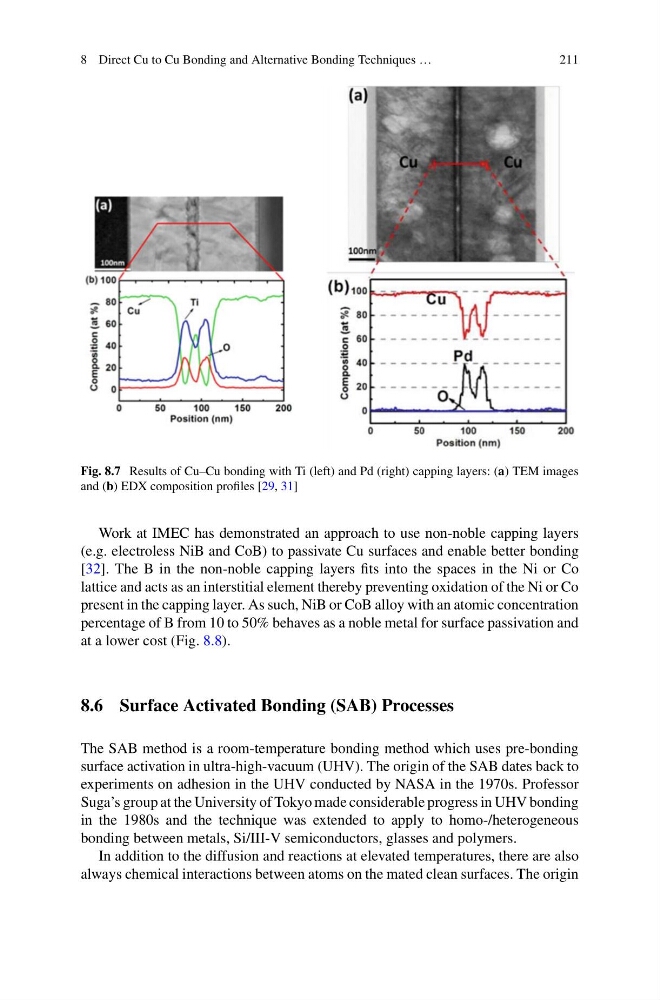
Fig. 8.7 Results of Cu–Cu bonding with Ti (left) and Pd (right) capping layers: (a) TEM images
and (b) EDX composition profiles [29, 31]
Work at IMEC has demonstrated an approach to use non-noble capping layers
(e.g. electroless NiB and CoB) to passivate Cu surfaces and enable better bonding
[32]. The B in the non-noble capping layers fits into the spaces in the Ni or Co
lattice and acts as an interstitial element thereby preventing oxidation of the Ni or Co
present in the capping layer. As such, NiB or CoB alloy with an atomic concentration
percentage of B from 10 to 50% behaves as a noble metal for surface passivation and
at a lower cost (Fig. 8.8).
8.6 Surface Activated Bonding (SAB) Processes
The SAB method is a room-temperature bonding method which uses pre-bonding
surface activation in ultra-high-vacuum (UHV). The origin of the SAB dates back to
experiments on adhesion in the UHV conducted by NASA in the 1970s. Professor
Suga’s group at the University of Tokyo made considerable progress in UHV bonding
in the 1980s and the technique was extended to apply to homo-/heterogeneous
bonding between metals, Si/III-V semiconductors, glasses and polymers.
In addition to the diffusion and reactions at elevated temperatures, there are also
always chemical interactions between atoms on the mated clean surfaces. The origin
211
Fig. 8.7 Results of Cu–Cu bonding with Ti (left) and Pd (right) capping layers: (a) TEM images
and (b) EDX composition profiles [29, 31]
Work at IMEC has demonstrated an approach to use non-noble capping layers
(e.g. electroless NiB and CoB) to passivate Cu surfaces and enable better bonding
[32]. The B in the non-noble capping layers fits into the spaces in the Ni or Co
lattice and acts as an interstitial element thereby preventing oxidation of the Ni or Co
present in the capping layer. As such, NiB or CoB alloy with an atomic concentration
percentage of B from 10 to 50% behaves as a noble metal for surface passivation and
at a lower cost (Fig. 8.8).
8.6 Surface Activated Bonding (SAB) Processes
The SAB method is a room-temperature bonding method which uses pre-bonding
surface activation in ultra-high-vacuum (UHV). The origin of the SAB dates back to
experiments on adhesion in the UHV conducted by NASA in the 1970s. Professor
Suga’s group at the University of Tokyo made considerable progress in UHV bonding
in the 1980s and the technique was extended to apply to homo-/heterogeneous
bonding between metals, Si/III-V semiconductors, glasses and polymers.
In addition to the diffusion and reactions at elevated temperatures, there are also
always chemical interactions between atoms on the mated clean surfaces. The origin