

8 Direct Cu to Cu Bonding and Alternative Bonding Techniques …
203
Lower substrate
Upper substrate
Cu
Lower substrate
Upper substrate
Lower substrate
Upper substrate
Cu
Cu
Cu
Cu
Cu
IMCs
IMCs
Solder
IMCs
(a)
(b)
(c)
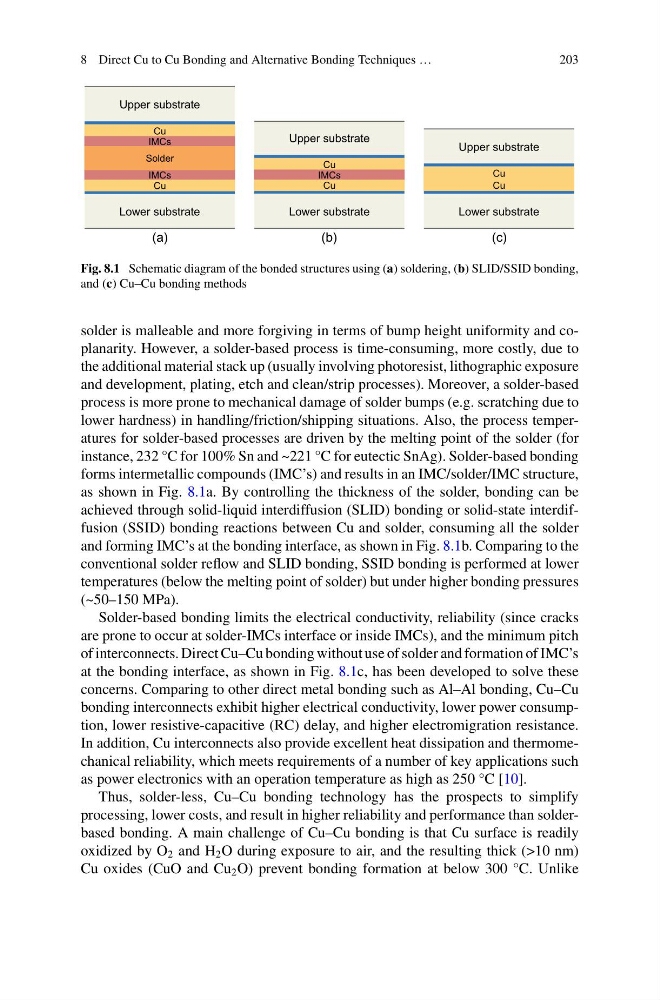
Fig. 8.1 Schematic diagram of the bonded structures using (a) soldering, (b) SLID/SSID bonding,
and (c) Cu–Cu bonding methods
solder is malleable and more forgiving in terms of bump height uniformity and coplanarity. However, a solder-based process is time-consuming, more costly, due to
the additional material stack up (usually involving photoresist, lithographic exposure
and development, plating, etch and clean/strip processes). Moreover, a solder-based
process is more prone to mechanical damage of solder bumps (e.g. scratching due to
lower hardness) in handling/friction/shipping situations. Also, the process temperatures for solder-based processes are driven by the melting point of the solder (for
instance, 232 °C for 100% Sn and ~221 °C for eutectic SnAg). Solder-based bonding
forms intermetallic compounds (IMC’s) and results in an IMC/solder/IMC structure,
as shown in Fig. 8.1a. By controlling the thickness of the solder, bonding can be
achieved through solid-liquid interdiffusion (SLID) bonding or solid-state interdiffusion (SSID) bonding reactions between Cu and solder, consuming all the solder
and forming IMC’s at the bonding interface, as shown in Fig. 8.1b. Comparing to the
conventional solder reflow and SLID bonding, SSID bonding is performed at lower
temperatures (below the melting point of solder) but under higher bonding pressures
(~50–150 MPa).
Solder-based bonding limits the electrical conductivity, reliability (since cracks
are prone to occur at solder-IMCs interface or inside IMCs), and the minimum pitch
of interconnects. Direct Cu–Cu bonding without use of solder and formation of IMC’s
at the bonding interface, as shown in Fig. 8.1c, has been developed to solve these
concerns. Comparing to other direct metal bonding such as Al–Al bonding, Cu–Cu
bonding interconnects exhibit higher electrical conductivity, lower power consumption, lower resistive-capacitive (RC) delay, and higher electromigration resistance.
In addition, Cu interconnects also provide excellent heat dissipation and thermomechanical reliability, which meets requirements of a number of key applications such
as power electronics with an operation temperature as high as 250 °C [10].
Thus, solder-less, Cu–Cu bonding technology has the prospects to simplify
processing, lower costs, and result in higher reliability and performance than solderbased bonding. A main challenge of Cu–Cu bonding is that Cu surface is readily
oxidized by O 2 and H 2 O during exposure to air, and the resulting thick (>10 nm)
Cu oxides (CuO and Cu 2 O) prevent bonding formation at below 300 °C. Unlike
203
Lower substrate
Upper substrate
Cu
Lower substrate
Upper substrate
Lower substrate
Upper substrate
Cu
Cu
Cu
Cu
Cu
IMCs
IMCs
Solder
IMCs
(a)
(b)
(c)
Fig. 8.1 Schematic diagram of the bonded structures using (a) soldering, (b) SLID/SSID bonding,
and (c) Cu–Cu bonding methods
solder is malleable and more forgiving in terms of bump height uniformity and coplanarity. However, a solder-based process is time-consuming, more costly, due to
the additional material stack up (usually involving photoresist, lithographic exposure
and development, plating, etch and clean/strip processes). Moreover, a solder-based
process is more prone to mechanical damage of solder bumps (e.g. scratching due to
lower hardness) in handling/friction/shipping situations. Also, the process temperatures for solder-based processes are driven by the melting point of the solder (for
instance, 232 °C for 100% Sn and ~221 °C for eutectic SnAg). Solder-based bonding
forms intermetallic compounds (IMC’s) and results in an IMC/solder/IMC structure,
as shown in Fig. 8.1a. By controlling the thickness of the solder, bonding can be
achieved through solid-liquid interdiffusion (SLID) bonding or solid-state interdiffusion (SSID) bonding reactions between Cu and solder, consuming all the solder
and forming IMC’s at the bonding interface, as shown in Fig. 8.1b. Comparing to the
conventional solder reflow and SLID bonding, SSID bonding is performed at lower
temperatures (below the melting point of solder) but under higher bonding pressures
(~50–150 MPa).
Solder-based bonding limits the electrical conductivity, reliability (since cracks
are prone to occur at solder-IMCs interface or inside IMCs), and the minimum pitch
of interconnects. Direct Cu–Cu bonding without use of solder and formation of IMC’s
at the bonding interface, as shown in Fig. 8.1c, has been developed to solve these
concerns. Comparing to other direct metal bonding such as Al–Al bonding, Cu–Cu
bonding interconnects exhibit higher electrical conductivity, lower power consumption, lower resistive-capacitive (RC) delay, and higher electromigration resistance.
In addition, Cu interconnects also provide excellent heat dissipation and thermomechanical reliability, which meets requirements of a number of key applications such
as power electronics with an operation temperature as high as 250 °C [10].
Thus, solder-less, Cu–Cu bonding technology has the prospects to simplify
processing, lower costs, and result in higher reliability and performance than solderbased bonding. A main challenge of Cu–Cu bonding is that Cu surface is readily
oxidized by O 2 and H 2 O during exposure to air, and the resulting thick (>10 nm)
Cu oxides (CuO and Cu 2 O) prevent bonding formation at below 300 °C. Unlike