

6 Atomic Scale Kinetics of TSV Protrusion
149
(a)
(b)
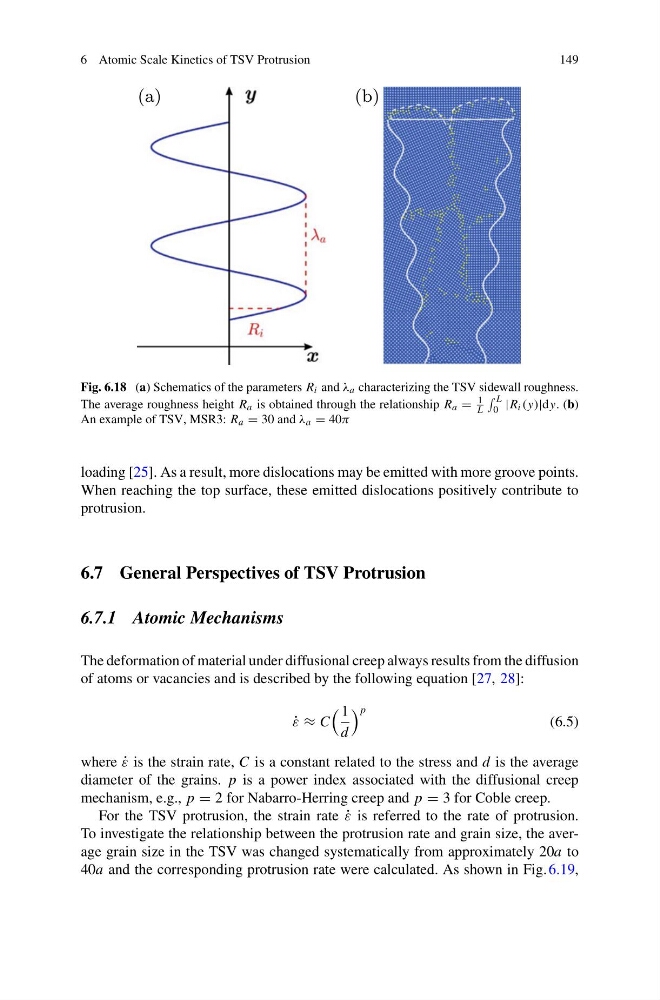
Fig. 6.18 (a) Schematics of the parameters R i and λ a characterizing the TSV sidewall roughness.
The average roughness height R a is obtained through the relationship R a =
1
L
L
0 |R i (y)|dy. (b)
An example of TSV, MSR3: R a = 30 and λ a = 40π
loading [25]. As a result, more dislocations may be emitted with more groove points.
When reaching the top surface, these emitted dislocations positively contribute to
protrusion.
6.7 General Perspectives of TSV Protrusion
6.7.1 Atomic Mechanisms
The deformation of material under diffusional creep always results from the diffusion
of atoms or vacancies and is described by the following equation [27, 28]:
˙
ε ≈ C
1
d
p
(6.5)
where ˙
ε is the strain rate, C is a constant related to the stress and d is the average
diameter of the grains. p is a power index associated with the diffusional creep
mechanism, e.g., p = 2 for Nabarro-Herring creep and p = 3 for Coble creep.
For the TSV protrusion, the strain rate ˙
ε is referred to the rate of protrusion.
To investigate the relationship between the protrusion rate and grain size, the average grain size in the TSV was changed systematically from approximately 20a to
40a and the corresponding protrusion rate were calculated. As shown in Fig. 6.19,
149
(a)
(b)
Fig. 6.18 (a) Schematics of the parameters R i and λ a characterizing the TSV sidewall roughness.
The average roughness height R a is obtained through the relationship R a =
1
L
L
0 |R i (y)|dy. (b)
An example of TSV, MSR3: R a = 30 and λ a = 40π
loading [25]. As a result, more dislocations may be emitted with more groove points.
When reaching the top surface, these emitted dislocations positively contribute to
protrusion.
6.7 General Perspectives of TSV Protrusion
6.7.1 Atomic Mechanisms
The deformation of material under diffusional creep always results from the diffusion
of atoms or vacancies and is described by the following equation [27, 28]:
˙
ε ≈ C
1
d
p
(6.5)
where ˙
ε is the strain rate, C is a constant related to the stress and d is the average
diameter of the grains. p is a power index associated with the diffusional creep
mechanism, e.g., p = 2 for Nabarro-Herring creep and p = 3 for Coble creep.
For the TSV protrusion, the strain rate ˙
ε is referred to the rate of protrusion.
To investigate the relationship between the protrusion rate and grain size, the average grain size in the TSV was changed systematically from approximately 20a to
40a and the corresponding protrusion rate were calculated. As shown in Fig. 6.19,