

148
J. Liu et al.
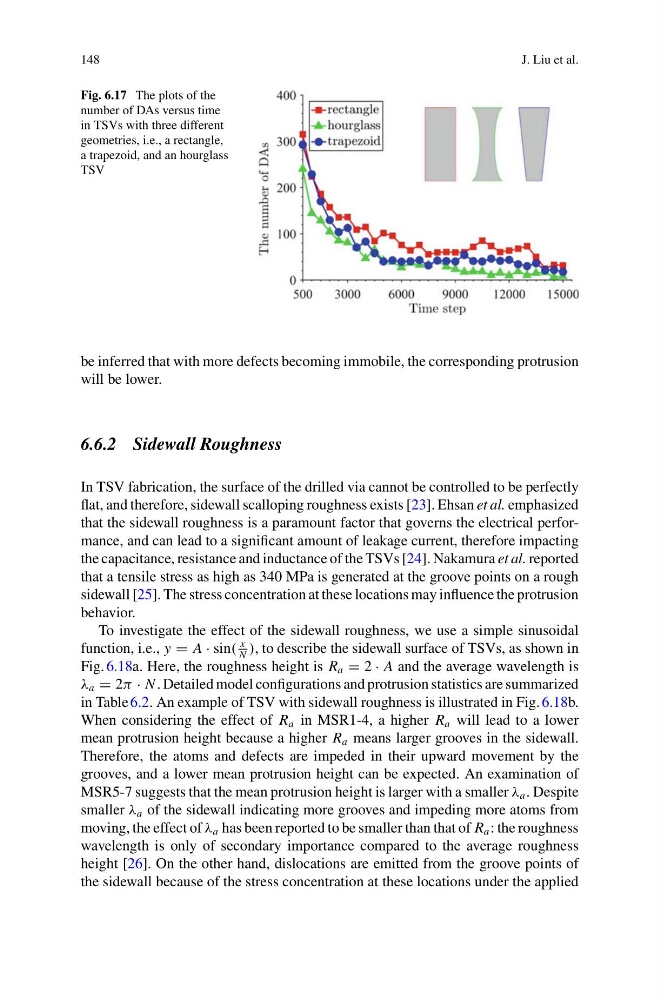
Fig. 6.17 The plots of the
number of DAs versus time
in TSVs with three different
geometries, i.e., a rectangle,
a trapezoid, and an hourglass
TSV
be inferred that with more defects becoming immobile, the corresponding protrusion
will be lower.
6.6.2 Sidewall Roughness
In TSV fabrication, the surface of the drilled via cannot be controlled to be perfectly
flat, and therefore, sidewall scalloping roughness exists [23]. Ehsan et al. emphasized
that the sidewall roughness is a paramount factor that governs the electrical performance, and can lead to a significant amount of leakage current, therefore impacting
the capacitance, resistance and inductance of the TSVs [24]. Nakamura et al. reported
that a tensile stress as high as 340 MPa is generated at the groove points on a rough
sidewall [25]. The stress concentration at these locations may influence the protrusion
behavior.
To investigate the effect of the sidewall roughness, we use a simple sinusoidal
function, i.e., y = A · sin(
x
N
), to describe the sidewall surface of TSVs, as shown in
Fig. 6.18a. Here, the roughness height is R a = 2 · A and the average wavelength is
λ a = 2π · N . Detailed model configurations and protrusion statistics are summarized
in Table 6.2. An example of TSV with sidewall roughness is illustrated in Fig. 6.18b.
When considering the effect of R a in MSR1-4, a higher R a will lead to a lower
mean protrusion height because a higher R a means larger grooves in the sidewall.
Therefore, the atoms and defects are impeded in their upward movement by the
grooves, and a lower mean protrusion height can be expected. An examination of
MSR5-7 suggests that the mean protrusion height is larger with a smaller λ a . Despite
smaller λ a of the sidewall indicating more grooves and impeding more atoms from
moving, the effect of λ a has been reported to be smaller than that of R a : the roughness
wavelength is only of secondary importance compared to the average roughness
height [26]. On the other hand, dislocations are emitted from the groove points of
the sidewall because of the stress concentration at these locations under the applied
J. Liu et al.
Fig. 6.17 The plots of the
number of DAs versus time
in TSVs with three different
geometries, i.e., a rectangle,
a trapezoid, and an hourglass
TSV
be inferred that with more defects becoming immobile, the corresponding protrusion
will be lower.
6.6.2 Sidewall Roughness
In TSV fabrication, the surface of the drilled via cannot be controlled to be perfectly
flat, and therefore, sidewall scalloping roughness exists [23]. Ehsan et al. emphasized
that the sidewall roughness is a paramount factor that governs the electrical performance, and can lead to a significant amount of leakage current, therefore impacting
the capacitance, resistance and inductance of the TSVs [24]. Nakamura et al. reported
that a tensile stress as high as 340 MPa is generated at the groove points on a rough
sidewall [25]. The stress concentration at these locations may influence the protrusion
behavior.
To investigate the effect of the sidewall roughness, we use a simple sinusoidal
function, i.e., y = A · sin(
x
N
), to describe the sidewall surface of TSVs, as shown in
Fig. 6.18a. Here, the roughness height is R a = 2 · A and the average wavelength is
λ a = 2π · N . Detailed model configurations and protrusion statistics are summarized
in Table 6.2. An example of TSV with sidewall roughness is illustrated in Fig. 6.18b.
When considering the effect of R a in MSR1-4, a higher R a will lead to a lower
mean protrusion height because a higher R a means larger grooves in the sidewall.
Therefore, the atoms and defects are impeded in their upward movement by the
grooves, and a lower mean protrusion height can be expected. An examination of
MSR5-7 suggests that the mean protrusion height is larger with a smaller λ a . Despite
smaller λ a of the sidewall indicating more grooves and impeding more atoms from
moving, the effect of λ a has been reported to be smaller than that of R a : the roughness
wavelength is only of secondary importance compared to the average roughness
height [26]. On the other hand, dislocations are emitted from the groove points of
the sidewall because of the stress concentration at these locations under the applied