

5 Phase-Field-Crystal Model: A Tool for Probing Atoms in TSV
109
as [2, 4]:
δF
δρ(r)
ρ(r) − ρ 0 (r)
= ρ(r) ln
ρ(r)
− ρ(r)
(5.4)
In addition, the third term of Eq. (5.3) is an excess energy over the “ideal gas”
contribution, responsible for the formation of structured phases, i.e., crystal lattices
[5, 6]. The general form of the n-point correlation function is defined as [7, 8]:
C n (r 1 , r 2 , . . . , r n ) ≡ −
δ
n F
δρ(r 1 )δρ(r 2 ) . . . δρ(r n )
(5.5)
Therefore, the second order functional derivative of F with respect to the density ρ
is defined as the 2-point direct correlation function:
C 2 (r, r
) ≡ −
δ
2 F
δρ(r)δρ(r
)
(5.6)
The 2-point direct correlation function C 2 (r, r
) measures correlation between two
densities ρ(r) and ρ(r
) at various positions in space. It gives a measure of the
probability that if an atom exists at position r and at the same time another atom
exists at position r
[7]. It is usually assumed that C 2 is only dependent on the
distance between the two points, i.e., C 2 (r, r
) = C 2 (|r − r
|) [7, 8]. The term
dr
C 2 (|r − r
|)
ρ(r
) − ρ l (r
)
is a convolution,
1 mimicking the symmetry of the
crystalline lattice in Fourier space. As an example, Fig. 5.1 plots the ˆ
C 2 (k) of Cu at
1393 K, with data from neutron diffraction experiment [9, 10].
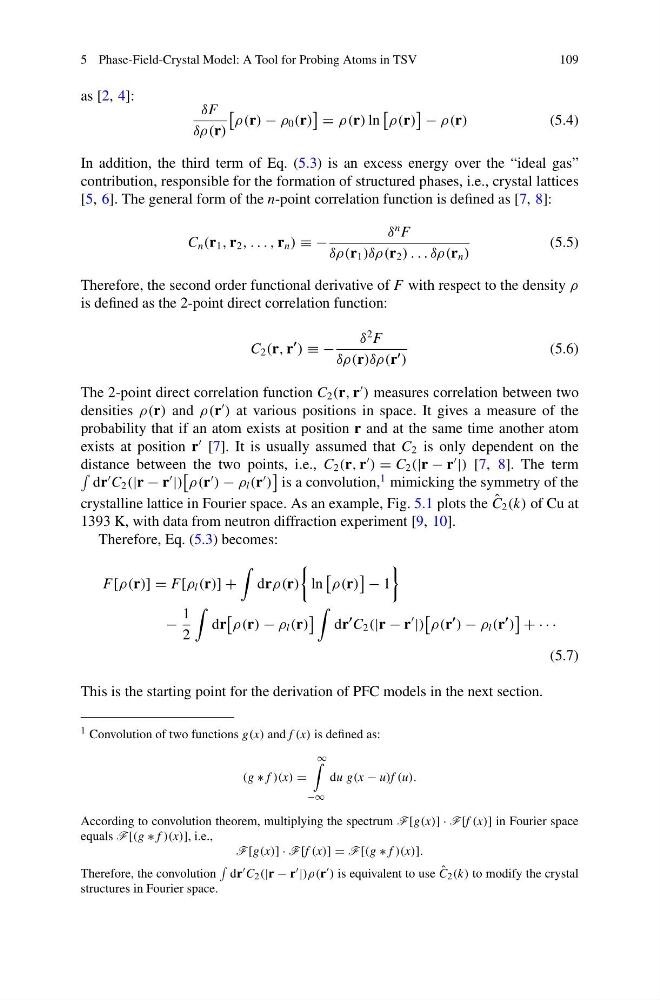
Therefore, Eq. (5.3) becomes:
F[ρ(r)] = F[ρ l (r)] +
drρ(r)
ln
ρ(r)
− 1
−
1
2
dr
ρ(r) − ρ l (r)
dr
C 2 (|r − r
|)
ρ(r
) − ρ l (r
)
+ · · ·
(5.7)
This is the starting point for the derivation of PFC models in the next section.
1 Convolution of two functions g(x) and f (x) is defined as:
(g ∗ f )(x) =
∞
−∞
du g(x − u)f (u).
According to convolution theorem, multiplying the spectrum F [g(x)] · F [f (x)] in Fourier space
equals F [(g ∗ f )(x)], i.e.,
F [g(x)] · F [f (x)] = F [(g ∗ f )(x)].
Therefore, the convolution
dr C 2 (|r − r |)ρ(r ) is equivalent to use ˆ
C 2 (k) to modify the crystal
structures in Fourier space.
109
as [2, 4]:
δF
δρ(r)
ρ(r) − ρ 0 (r)
= ρ(r) ln
ρ(r)
− ρ(r)
(5.4)
In addition, the third term of Eq. (5.3) is an excess energy over the “ideal gas”
contribution, responsible for the formation of structured phases, i.e., crystal lattices
[5, 6]. The general form of the n-point correlation function is defined as [7, 8]:
C n (r 1 , r 2 , . . . , r n ) ≡ −
δ
n F
δρ(r 1 )δρ(r 2 ) . . . δρ(r n )
(5.5)
Therefore, the second order functional derivative of F with respect to the density ρ
is defined as the 2-point direct correlation function:
C 2 (r, r
) ≡ −
δ
2 F
δρ(r)δρ(r
)
(5.6)
The 2-point direct correlation function C 2 (r, r
) measures correlation between two
densities ρ(r) and ρ(r
) at various positions in space. It gives a measure of the
probability that if an atom exists at position r and at the same time another atom
exists at position r
[7]. It is usually assumed that C 2 is only dependent on the
distance between the two points, i.e., C 2 (r, r
) = C 2 (|r − r
|) [7, 8]. The term
dr
C 2 (|r − r
|)
ρ(r
) − ρ l (r
)
is a convolution,
1 mimicking the symmetry of the
crystalline lattice in Fourier space. As an example, Fig. 5.1 plots the ˆ
C 2 (k) of Cu at
1393 K, with data from neutron diffraction experiment [9, 10].
Therefore, Eq. (5.3) becomes:
F[ρ(r)] = F[ρ l (r)] +
drρ(r)
ln
ρ(r)
− 1
−
1
2
dr
ρ(r) − ρ l (r)
dr
C 2 (|r − r
|)
ρ(r
) − ρ l (r
)
+ · · ·
(5.7)
This is the starting point for the derivation of PFC models in the next section.
1 Convolution of two functions g(x) and f (x) is defined as:
(g ∗ f )(x) =
∞
−∞
du g(x − u)f (u).
According to convolution theorem, multiplying the spectrum F [g(x)] · F [f (x)] in Fourier space
equals F [(g ∗ f )(x)], i.e.,
F [g(x)] · F [f (x)] = F [(g ∗ f )(x)].
Therefore, the convolution
dr C 2 (|r − r |)ρ(r ) is equivalent to use ˆ
C 2 (k) to modify the crystal
structures in Fourier space.