

108
J. Liu et al.
5.2 PFC Model Basics
5.2.1 Classic Density Functional Theory
In this section, a brief review of CDFT will be given. More detailed derivation of
the CDFT were proposed by Ramakrishnan and Yussouff [1] and reviewed by Singh
[2]. In addition, the lecture note of Oxtoby [3] provided another good introduction
on this subject.
In general, the free energy F of a material system depending on its density ρ can
be written as a function F(ρ). Because the density can vary with space and itself a
function of the position vector r, i.e., ρ(r), the free energy of such density becomes a
functional, represented by F[ρ(r)]. Note that the dependent variable r is frequently
omitted and the free energy functional is written as F[ρ] in this chapter.
Usually, a function f (x) can be expressed as a Taylor expansion about a point x 0
in the form of:
f (x) = f (x 0 ) +
df
dx
x 0
(x − x 0 ) +
1
2
d
2 f
dx 2
x 0
(x − x 0 )
2
+ · · ·
(5.1)
A function of multivariables can be expressed as:
f (x 1 , x 2 , . . . , x n ) ≡ f (x) = f (x 0 ) +
n
i=1
df
dx i
x 0
(x i − x i0 )
+
1
2
n
i=1
n
j=1
d
2 f
dx i dx j
x 0
(x i − x i0 )(x j − x j0 ) + · · ·
(5.2)
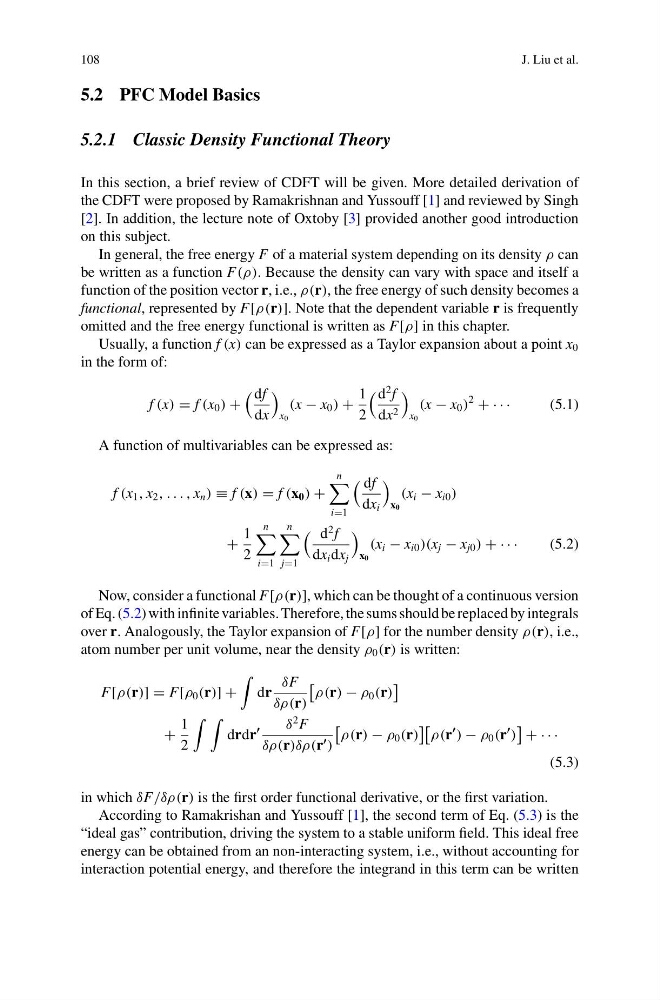
Now, consider a functional F[ρ(r)], which can be thought of a continuous version
of Eq. (5.2) with infinite variables. Therefore, the sums should be replaced by integrals
over r. Analogously, the Taylor expansion of F[ρ] for the number density ρ(r), i.e.,
atom number per unit volume, near the density ρ 0 (r) is written:
F[ρ(r)] = F[ρ 0 (r)] +
dr
δF
δρ(r)
ρ(r) − ρ 0 (r)
+
1
2
drdr
δ
2 F
δρ(r)δρ(r
)
ρ(r) − ρ 0 (r)
ρ(r
) − ρ 0 (r
)
+ · · ·
(5.3)
in which δF/δρ(r) is the first order functional derivative, or the first variation.
According to Ramakrishan and Yussouff [1], the second term of Eq. (5.3) is the
“ideal gas” contribution, driving the system to a stable uniform field. This ideal free
energy can be obtained from an non-interacting system, i.e., without accounting for
interaction potential energy, and therefore the integrand in this term can be written
J. Liu et al.
5.2 PFC Model Basics
5.2.1 Classic Density Functional Theory
In this section, a brief review of CDFT will be given. More detailed derivation of
the CDFT were proposed by Ramakrishnan and Yussouff [1] and reviewed by Singh
[2]. In addition, the lecture note of Oxtoby [3] provided another good introduction
on this subject.
In general, the free energy F of a material system depending on its density ρ can
be written as a function F(ρ). Because the density can vary with space and itself a
function of the position vector r, i.e., ρ(r), the free energy of such density becomes a
functional, represented by F[ρ(r)]. Note that the dependent variable r is frequently
omitted and the free energy functional is written as F[ρ] in this chapter.
Usually, a function f (x) can be expressed as a Taylor expansion about a point x 0
in the form of:
f (x) = f (x 0 ) +
df
dx
x 0
(x − x 0 ) +
1
2
d
2 f
dx 2
x 0
(x − x 0 )
2
+ · · ·
(5.1)
A function of multivariables can be expressed as:
f (x 1 , x 2 , . . . , x n ) ≡ f (x) = f (x 0 ) +
n
i=1
df
dx i
x 0
(x i − x i0 )
+
1
2
n
i=1
n
j=1
d
2 f
dx i dx j
x 0
(x i − x i0 )(x j − x j0 ) + · · ·
(5.2)
Now, consider a functional F[ρ(r)], which can be thought of a continuous version
of Eq. (5.2) with infinite variables. Therefore, the sums should be replaced by integrals
over r. Analogously, the Taylor expansion of F[ρ] for the number density ρ(r), i.e.,
atom number per unit volume, near the density ρ 0 (r) is written:
F[ρ(r)] = F[ρ 0 (r)] +
dr
δF
δρ(r)
ρ(r) − ρ 0 (r)
+
1
2
drdr
δ
2 F
δρ(r)δρ(r
)
ρ(r) − ρ 0 (r)
ρ(r
) − ρ 0 (r
)
+ · · ·
(5.3)
in which δF/δρ(r) is the first order functional derivative, or the first variation.
According to Ramakrishan and Yussouff [1], the second term of Eq. (5.3) is the
“ideal gas” contribution, driving the system to a stable uniform field. This ideal free
energy can be obtained from an non-interacting system, i.e., without accounting for
interaction potential energy, and therefore the integrand in this term can be written