

4 Microstructure and Mechanical Reliability Issues of TSV
99
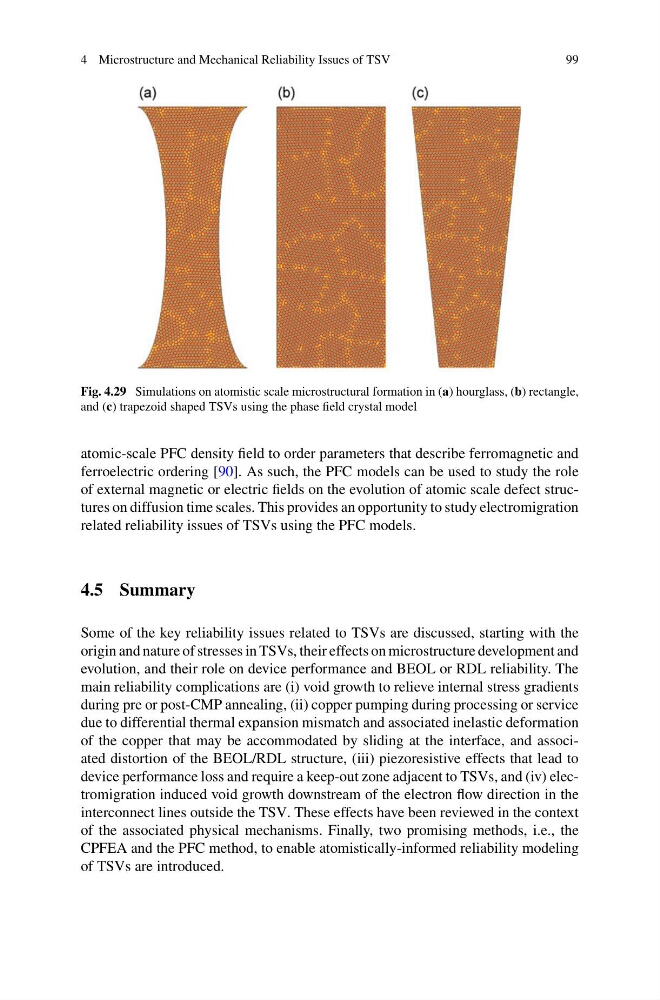
Fig. 4.29 Simulations on atomistic scale microstructural formation in (a) hourglass, (b) rectangle,
and (c) trapezoid shaped TSVs using the phase field crystal model
atomic-scale PFC density field to order parameters that describe ferromagnetic and
ferroelectric ordering [90]. As such, the PFC models can be used to study the role
of external magnetic or electric fields on the evolution of atomic scale defect structures on diffusion time scales. This provides an opportunity to study electromigration
related reliability issues of TSVs using the PFC models.
4.5 Summary
Some of the key reliability issues related to TSVs are discussed, starting with the
origin and nature of stresses in TSVs, their effects on microstructure development and
evolution, and their role on device performance and BEOL or RDL reliability. The
main reliability complications are (i) void growth to relieve internal stress gradients
during pre or post-CMP annealing, (ii) copper pumping during processing or service
due to differential thermal expansion mismatch and associated inelastic deformation
of the copper that may be accommodated by sliding at the interface, and associated distortion of the BEOL/RDL structure, (iii) piezoresistive effects that lead to
device performance loss and require a keep-out zone adjacent to TSVs, and (iv) electromigration induced void growth downstream of the electron flow direction in the
interconnect lines outside the TSV. These effects have been reviewed in the context
of the associated physical mechanisms. Finally, two promising methods, i.e., the
CPFEA and the PFC method, to enable atomistically-informed reliability modeling
of TSVs are introduced.
99
Fig. 4.29 Simulations on atomistic scale microstructural formation in (a) hourglass, (b) rectangle,
and (c) trapezoid shaped TSVs using the phase field crystal model
atomic-scale PFC density field to order parameters that describe ferromagnetic and
ferroelectric ordering [90]. As such, the PFC models can be used to study the role
of external magnetic or electric fields on the evolution of atomic scale defect structures on diffusion time scales. This provides an opportunity to study electromigration
related reliability issues of TSVs using the PFC models.
4.5 Summary
Some of the key reliability issues related to TSVs are discussed, starting with the
origin and nature of stresses in TSVs, their effects on microstructure development and
evolution, and their role on device performance and BEOL or RDL reliability. The
main reliability complications are (i) void growth to relieve internal stress gradients
during pre or post-CMP annealing, (ii) copper pumping during processing or service
due to differential thermal expansion mismatch and associated inelastic deformation
of the copper that may be accommodated by sliding at the interface, and associated distortion of the BEOL/RDL structure, (iii) piezoresistive effects that lead to
device performance loss and require a keep-out zone adjacent to TSVs, and (iv) electromigration induced void growth downstream of the electron flow direction in the
interconnect lines outside the TSV. These effects have been reviewed in the context
of the associated physical mechanisms. Finally, two promising methods, i.e., the
CPFEA and the PFC method, to enable atomistically-informed reliability modeling
of TSVs are introduced.