

98
P. Kumar et al.
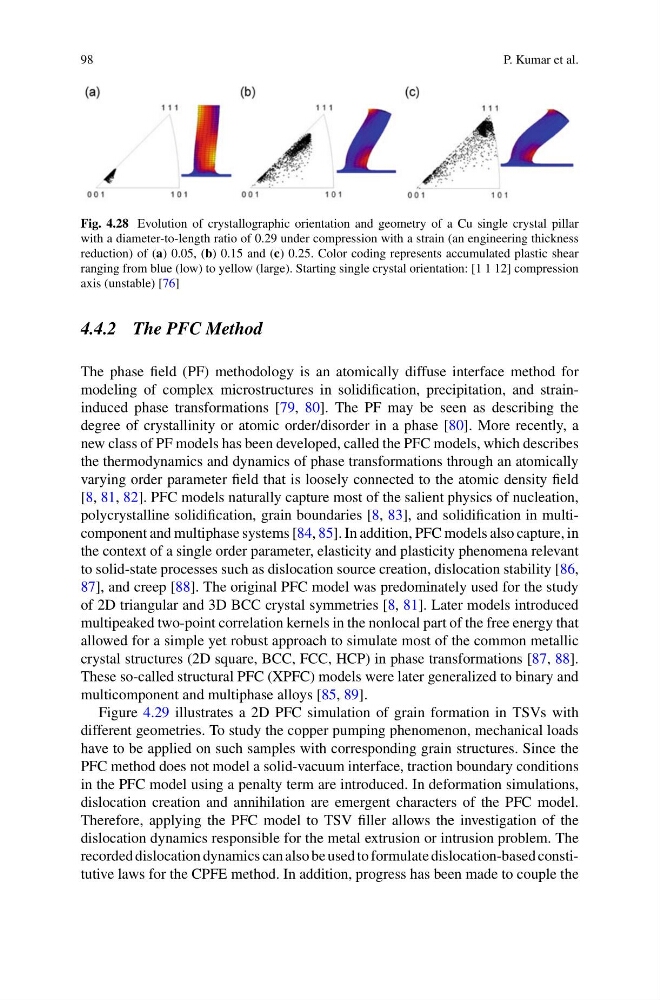
Fig. 4.28 Evolution of crystallographic orientation and geometry of a Cu single crystal pillar
with a diameter-to-length ratio of 0.29 under compression with a strain (an engineering thickness
reduction) of (a) 0.05, (b) 0.15 and (c) 0.25. Color coding represents accumulated plastic shear
ranging from blue (low) to yellow (large). Starting single crystal orientation: [1 1 12] compression
axis (unstable) [76]
4.4.2 The PFC Method
The phase field (PF) methodology is an atomically diffuse interface method for
modeling of complex microstructures in solidification, precipitation, and straininduced phase transformations [79, 80]. The PF may be seen as describing the
degree of crystallinity or atomic order/disorder in a phase [80]. More recently, a
new class of PF models has been developed, called the PFC models, which describes
the thermodynamics and dynamics of phase transformations through an atomically
varying order parameter field that is loosely connected to the atomic density field
[8, 81, 82]. PFC models naturally capture most of the salient physics of nucleation,
polycrystalline solidification, grain boundaries [8, 83], and solidification in multicomponent and multiphase systems [84, 85]. In addition, PFC models also capture, in
the context of a single order parameter, elasticity and plasticity phenomena relevant
to solid-state processes such as dislocation source creation, dislocation stability [86,
87], and creep [88]. The original PFC model was predominately used for the study
of 2D triangular and 3D BCC crystal symmetries [8, 81]. Later models introduced
multipeaked two-point correlation kernels in the nonlocal part of the free energy that
allowed for a simple yet robust approach to simulate most of the common metallic
crystal structures (2D square, BCC, FCC, HCP) in phase transformations [87, 88].
These so-called structural PFC (XPFC) models were later generalized to binary and
multicomponent and multiphase alloys [85, 89].
Figure 4.29 illustrates a 2D PFC simulation of grain formation in TSVs with
different geometries. To study the copper pumping phenomenon, mechanical loads
have to be applied on such samples with corresponding grain structures. Since the
PFC method does not model a solid-vacuum interface, traction boundary conditions
in the PFC model using a penalty term are introduced. In deformation simulations,
dislocation creation and annihilation are emergent characters of the PFC model.
Therefore, applying the PFC model to TSV filler allows the investigation of the
dislocation dynamics responsible for the metal extrusion or intrusion problem. The
recorded dislocation dynamics can also be used to formulate dislocation-based constitutive laws for the CPFE method. In addition, progress has been made to couple the
P. Kumar et al.
Fig. 4.28 Evolution of crystallographic orientation and geometry of a Cu single crystal pillar
with a diameter-to-length ratio of 0.29 under compression with a strain (an engineering thickness
reduction) of (a) 0.05, (b) 0.15 and (c) 0.25. Color coding represents accumulated plastic shear
ranging from blue (low) to yellow (large). Starting single crystal orientation: [1 1 12] compression
axis (unstable) [76]
4.4.2 The PFC Method
The phase field (PF) methodology is an atomically diffuse interface method for
modeling of complex microstructures in solidification, precipitation, and straininduced phase transformations [79, 80]. The PF may be seen as describing the
degree of crystallinity or atomic order/disorder in a phase [80]. More recently, a
new class of PF models has been developed, called the PFC models, which describes
the thermodynamics and dynamics of phase transformations through an atomically
varying order parameter field that is loosely connected to the atomic density field
[8, 81, 82]. PFC models naturally capture most of the salient physics of nucleation,
polycrystalline solidification, grain boundaries [8, 83], and solidification in multicomponent and multiphase systems [84, 85]. In addition, PFC models also capture, in
the context of a single order parameter, elasticity and plasticity phenomena relevant
to solid-state processes such as dislocation source creation, dislocation stability [86,
87], and creep [88]. The original PFC model was predominately used for the study
of 2D triangular and 3D BCC crystal symmetries [8, 81]. Later models introduced
multipeaked two-point correlation kernels in the nonlocal part of the free energy that
allowed for a simple yet robust approach to simulate most of the common metallic
crystal structures (2D square, BCC, FCC, HCP) in phase transformations [87, 88].
These so-called structural PFC (XPFC) models were later generalized to binary and
multicomponent and multiphase alloys [85, 89].
Figure 4.29 illustrates a 2D PFC simulation of grain formation in TSVs with
different geometries. To study the copper pumping phenomenon, mechanical loads
have to be applied on such samples with corresponding grain structures. Since the
PFC method does not model a solid-vacuum interface, traction boundary conditions
in the PFC model using a penalty term are introduced. In deformation simulations,
dislocation creation and annihilation are emergent characters of the PFC model.
Therefore, applying the PFC model to TSV filler allows the investigation of the
dislocation dynamics responsible for the metal extrusion or intrusion problem. The
recorded dislocation dynamics can also be used to formulate dislocation-based constitutive laws for the CPFE method. In addition, progress has been made to couple the