

4 Microstructure and Mechanical Reliability Issues of TSV
91
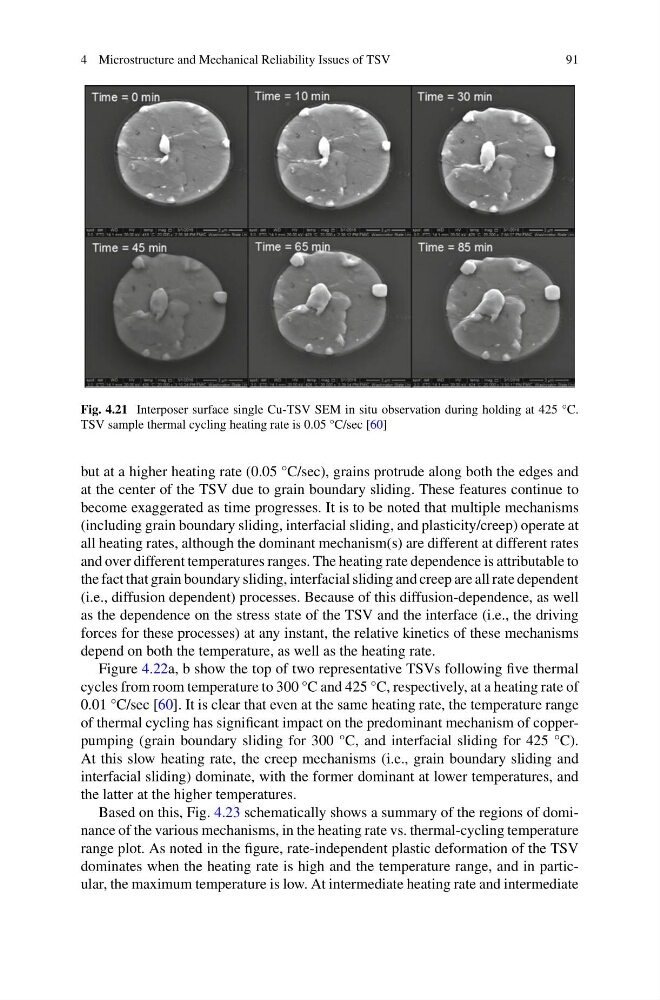
Fig. 4.21 Interposer surface single Cu-TSV SEM in situ observation during holding at 425 °C.
TSV sample thermal cycling heating rate is 0.05 °C/sec [60]
but at a higher heating rate (0.05 °C/sec), grains protrude along both the edges and
at the center of the TSV due to grain boundary sliding. These features continue to
become exaggerated as time progresses. It is to be noted that multiple mechanisms
(including grain boundary sliding, interfacial sliding, and plasticity/creep) operate at
all heating rates, although the dominant mechanism(s) are different at different rates
and over different temperatures ranges. The heating rate dependence is attributable to
the fact that grain boundary sliding, interfacial sliding and creep are all rate dependent
(i.e., diffusion dependent) processes. Because of this diffusion-dependence, as well
as the dependence on the stress state of the TSV and the interface (i.e., the driving
forces for these processes) at any instant, the relative kinetics of these mechanisms
depend on both the temperature, as well as the heating rate.
Figure 4.22a, b show the top of two representative TSVs following five thermal
cycles from room temperature to 300 °C and 425 °C, respectively, at a heating rate of
0.01 °C/sec [60]. It is clear that even at the same heating rate, the temperature range
of thermal cycling has significant impact on the predominant mechanism of copperpumping (grain boundary sliding for 300 °C, and interfacial sliding for 425 °C).
At this slow heating rate, the creep mechanisms (i.e., grain boundary sliding and
interfacial sliding) dominate, with the former dominant at lower temperatures, and
the latter at the higher temperatures.
Based on this, Fig. 4.23 schematically shows a summary of the regions of dominance of the various mechanisms, in the heating rate vs. thermal-cycling temperature
range plot. As noted in the figure, rate-independent plastic deformation of the TSV
dominates when the heating rate is high and the temperature range, and in particular, the maximum temperature is low. At intermediate heating rate and intermediate
91
Fig. 4.21 Interposer surface single Cu-TSV SEM in situ observation during holding at 425 °C.
TSV sample thermal cycling heating rate is 0.05 °C/sec [60]
but at a higher heating rate (0.05 °C/sec), grains protrude along both the edges and
at the center of the TSV due to grain boundary sliding. These features continue to
become exaggerated as time progresses. It is to be noted that multiple mechanisms
(including grain boundary sliding, interfacial sliding, and plasticity/creep) operate at
all heating rates, although the dominant mechanism(s) are different at different rates
and over different temperatures ranges. The heating rate dependence is attributable to
the fact that grain boundary sliding, interfacial sliding and creep are all rate dependent
(i.e., diffusion dependent) processes. Because of this diffusion-dependence, as well
as the dependence on the stress state of the TSV and the interface (i.e., the driving
forces for these processes) at any instant, the relative kinetics of these mechanisms
depend on both the temperature, as well as the heating rate.
Figure 4.22a, b show the top of two representative TSVs following five thermal
cycles from room temperature to 300 °C and 425 °C, respectively, at a heating rate of
0.01 °C/sec [60]. It is clear that even at the same heating rate, the temperature range
of thermal cycling has significant impact on the predominant mechanism of copperpumping (grain boundary sliding for 300 °C, and interfacial sliding for 425 °C).
At this slow heating rate, the creep mechanisms (i.e., grain boundary sliding and
interfacial sliding) dominate, with the former dominant at lower temperatures, and
the latter at the higher temperatures.
Based on this, Fig. 4.23 schematically shows a summary of the regions of dominance of the various mechanisms, in the heating rate vs. thermal-cycling temperature
range plot. As noted in the figure, rate-independent plastic deformation of the TSV
dominates when the heating rate is high and the temperature range, and in particular, the maximum temperature is low. At intermediate heating rate and intermediate