

4 Microstructure and Mechanical Reliability Issues of TSV
87
contributions. In Eq. 4.2, the first term gives the effect of shear stress, while the second
term gives the impact of superimposed electromigration (EM). Since Z
* is negative,
the second term (due to EM) acts against the first term (due to stress-driven creep)
when both driving forces (T i and E) are positive, and thus reduce the interfacial sliding
rate. Conversely, if T i and E have opposite signs, the two terms in Eq. 4.2 augment
each other and increase the interfacial sliding kinetics. Figure 4.15 shows the effect
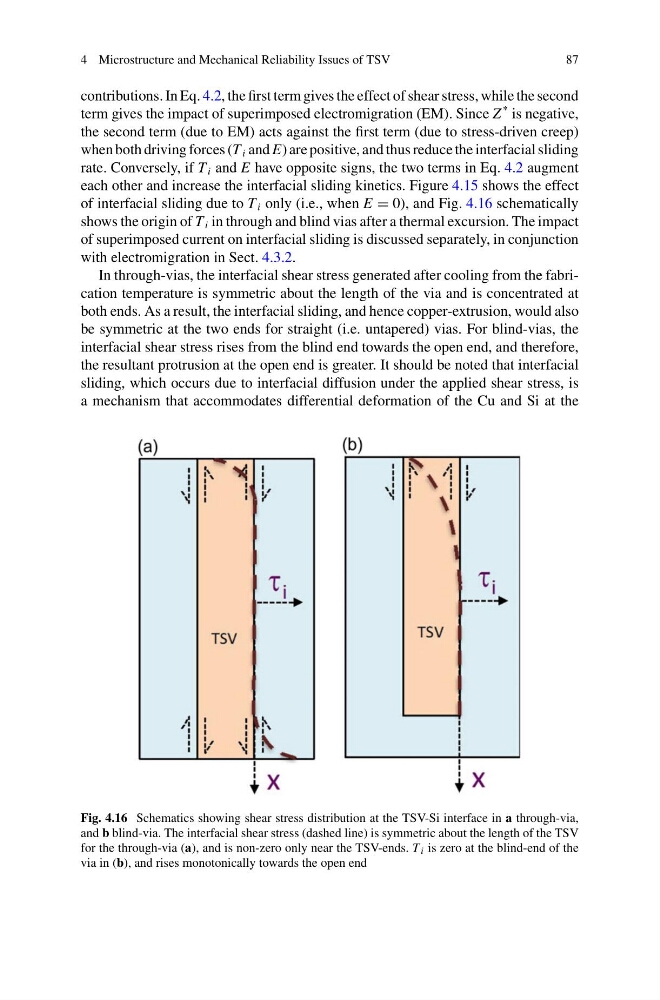
of interfacial sliding due to T i only (i.e., when E = 0), and Fig. 4.16 schematically
shows the origin of T i in through and blind vias after a thermal excursion. The impact
of superimposed current on interfacial sliding is discussed separately, in conjunction
with electromigration in Sect. 4.3.2.
In through-vias, the interfacial shear stress generated after cooling from the fabrication temperature is symmetric about the length of the via and is concentrated at
both ends. As a result, the interfacial sliding, and hence copper-extrusion, would also
be symmetric at the two ends for straight (i.e. untapered) vias. For blind-vias, the
interfacial shear stress rises from the blind end towards the open end, and therefore,
the resultant protrusion at the open end is greater. It should be noted that interfacial
sliding, which occurs due to interfacial diffusion under the applied shear stress, is
a mechanism that accommodates differential deformation of the Cu and Si at the
Fig. 4.16 Schematics showing shear stress distribution at the TSV-Si interface in a through-via,
and b blind-via. The interfacial shear stress (dashed line) is symmetric about the length of the TSV
for the through-via (a), and is non-zero only near the TSV-ends. T i is zero at the blind-end of the
via in (b), and rises monotonically towards the open end
87
contributions. In Eq. 4.2, the first term gives the effect of shear stress, while the second
term gives the impact of superimposed electromigration (EM). Since Z
* is negative,
the second term (due to EM) acts against the first term (due to stress-driven creep)
when both driving forces (T i and E) are positive, and thus reduce the interfacial sliding
rate. Conversely, if T i and E have opposite signs, the two terms in Eq. 4.2 augment
each other and increase the interfacial sliding kinetics. Figure 4.15 shows the effect
of interfacial sliding due to T i only (i.e., when E = 0), and Fig. 4.16 schematically
shows the origin of T i in through and blind vias after a thermal excursion. The impact
of superimposed current on interfacial sliding is discussed separately, in conjunction
with electromigration in Sect. 4.3.2.
In through-vias, the interfacial shear stress generated after cooling from the fabrication temperature is symmetric about the length of the via and is concentrated at
both ends. As a result, the interfacial sliding, and hence copper-extrusion, would also
be symmetric at the two ends for straight (i.e. untapered) vias. For blind-vias, the
interfacial shear stress rises from the blind end towards the open end, and therefore,
the resultant protrusion at the open end is greater. It should be noted that interfacial
sliding, which occurs due to interfacial diffusion under the applied shear stress, is
a mechanism that accommodates differential deformation of the Cu and Si at the
Fig. 4.16 Schematics showing shear stress distribution at the TSV-Si interface in a through-via,
and b blind-via. The interfacial shear stress (dashed line) is symmetric about the length of the TSV
for the through-via (a), and is non-zero only near the TSV-ends. T i is zero at the blind-end of the
via in (b), and rises monotonically towards the open end