

88
P. Kumar et al.
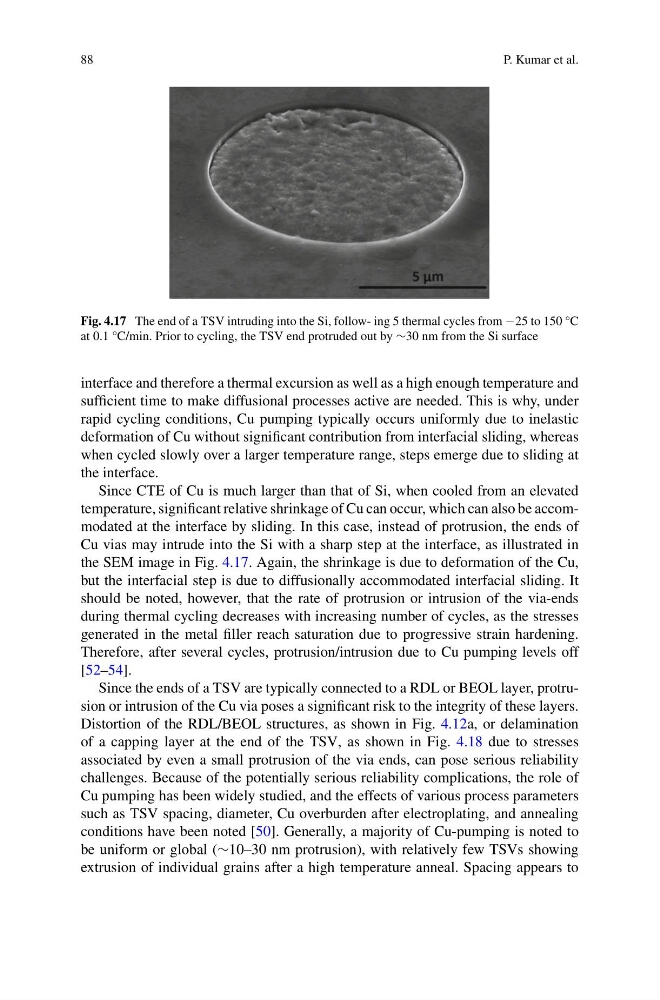
Fig. 4.17 The end of a TSV intruding into the Si, follow- ing 5 thermal cycles from −25 to 150 °C
at 0.1 °C/min. Prior to cycling, the TSV end protruded out by ∼30 nm from the Si surface
interface and therefore a thermal excursion as well as a high enough temperature and
sufficient time to make diffusional processes active are needed. This is why, under
rapid cycling conditions, Cu pumping typically occurs uniformly due to inelastic
deformation of Cu without significant contribution from interfacial sliding, whereas
when cycled slowly over a larger temperature range, steps emerge due to sliding at
the interface.
Since CTE of Cu is much larger than that of Si, when cooled from an elevated
temperature, significant relative shrinkage of Cu can occur, which can also be accommodated at the interface by sliding. In this case, instead of protrusion, the ends of
Cu vias may intrude into the Si with a sharp step at the interface, as illustrated in
the SEM image in Fig. 4.17. Again, the shrinkage is due to deformation of the Cu,
but the interfacial step is due to diffusionally accommodated interfacial sliding. It
should be noted, however, that the rate of protrusion or intrusion of the via-ends
during thermal cycling decreases with increasing number of cycles, as the stresses
generated in the metal filler reach saturation due to progressive strain hardening.
Therefore, after several cycles, protrusion/intrusion due to Cu pumping levels off
[52–54].
Since the ends of a TSV are typically connected to a RDL or BEOL layer, protrusion or intrusion of the Cu via poses a significant risk to the integrity of these layers.
Distortion of the RDL/BEOL structures, as shown in Fig. 4.12a, or delamination
of a capping layer at the end of the TSV, as shown in Fig. 4.18 due to stresses
associated by even a small protrusion of the via ends, can pose serious reliability
challenges. Because of the potentially serious reliability complications, the role of
Cu pumping has been widely studied, and the effects of various process parameters
such as TSV spacing, diameter, Cu overburden after electroplating, and annealing
conditions have been noted [50]. Generally, a majority of Cu-pumping is noted to
be uniform or global (∼10–30 nm protrusion), with relatively few TSVs showing
extrusion of individual grains after a high temperature anneal. Spacing appears to
P. Kumar et al.
Fig. 4.17 The end of a TSV intruding into the Si, follow- ing 5 thermal cycles from −25 to 150 °C
at 0.1 °C/min. Prior to cycling, the TSV end protruded out by ∼30 nm from the Si surface
interface and therefore a thermal excursion as well as a high enough temperature and
sufficient time to make diffusional processes active are needed. This is why, under
rapid cycling conditions, Cu pumping typically occurs uniformly due to inelastic
deformation of Cu without significant contribution from interfacial sliding, whereas
when cycled slowly over a larger temperature range, steps emerge due to sliding at
the interface.
Since CTE of Cu is much larger than that of Si, when cooled from an elevated
temperature, significant relative shrinkage of Cu can occur, which can also be accommodated at the interface by sliding. In this case, instead of protrusion, the ends of
Cu vias may intrude into the Si with a sharp step at the interface, as illustrated in
the SEM image in Fig. 4.17. Again, the shrinkage is due to deformation of the Cu,
but the interfacial step is due to diffusionally accommodated interfacial sliding. It
should be noted, however, that the rate of protrusion or intrusion of the via-ends
during thermal cycling decreases with increasing number of cycles, as the stresses
generated in the metal filler reach saturation due to progressive strain hardening.
Therefore, after several cycles, protrusion/intrusion due to Cu pumping levels off
[52–54].
Since the ends of a TSV are typically connected to a RDL or BEOL layer, protrusion or intrusion of the Cu via poses a significant risk to the integrity of these layers.
Distortion of the RDL/BEOL structures, as shown in Fig. 4.12a, or delamination
of a capping layer at the end of the TSV, as shown in Fig. 4.18 due to stresses
associated by even a small protrusion of the via ends, can pose serious reliability
challenges. Because of the potentially serious reliability complications, the role of
Cu pumping has been widely studied, and the effects of various process parameters
such as TSV spacing, diameter, Cu overburden after electroplating, and annealing
conditions have been noted [50]. Generally, a majority of Cu-pumping is noted to
be uniform or global (∼10–30 nm protrusion), with relatively few TSVs showing
extrusion of individual grains after a high temperature anneal. Spacing appears to