

73
3, which negatively affects the production of methane. A low organic loading rate
on the other hand will produce low volumes of biogas that will make AD operation
uneconomical. The recommended organic loading rate for an anaerobic tank without medium is 1–4 kg V m
−3
day
−1
(Eder et al. 2006). HRT is the time that the substrates stay inside the anaerobic digester reactor. HRT strongly depends on the
substrates and it usually varies from 30 to 60 days. In general, 30 days are typical
HRT for nonstirring digesters, the digesters with high decomposition rates can be
reduced to an HRT of 10–20 days.
5.1.3.7 Toxins
Biogas production happens in the absence of oxygen; therefore, the presence of
oxygen will inhibit the process. In this case, oxygen is considered to be toxic to
anaerobic bacteria. In addition, there are many substances that are potentially toxic
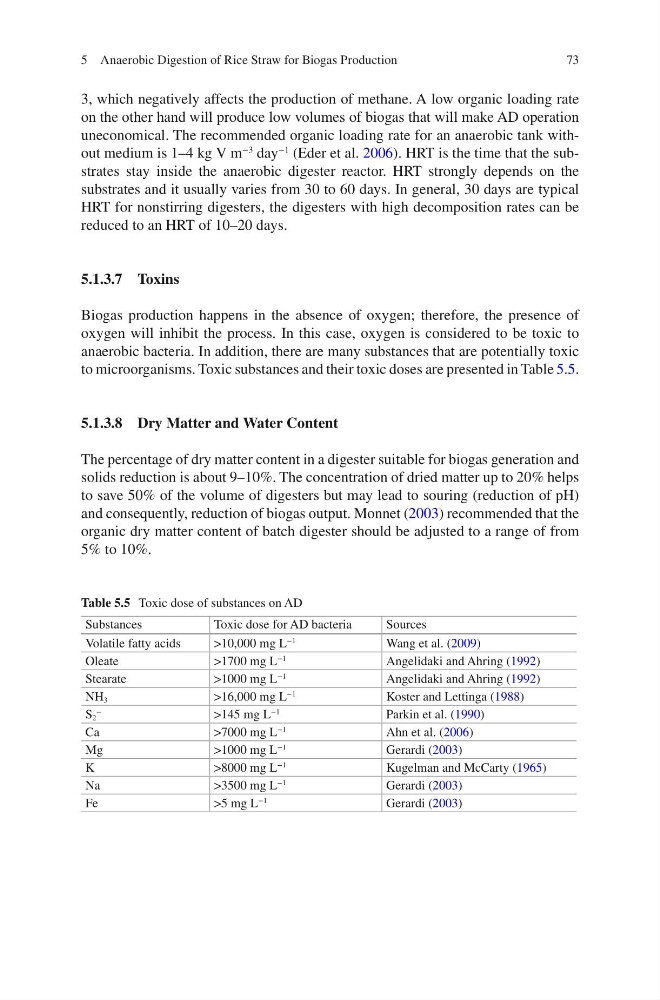
to microorganisms. Toxic substances and their toxic doses are presented in Table 5.5.
5.1.3.8 Dry Matter and Water Content
The percentage of dry matter content in a digester suitable for biogas generation and
solids reduction is about 9–10%. The concentration of dried matter up to 20% helps
to save 50% of the volume of digesters but may lead to souring (reduction of pH)
and consequently, reduction of biogas output. Monnet (2003) recommended that the
organic dry matter content of batch digester should be adjusted to a range of from
5% to 10%.
Table 5.5 Toxic dose of substances on AD
Substances
Toxic dose for AD bacteria
Sources
Volatile fatty acids
>10,000 mg L
−1
Wang et al. (2009)
Oleate
>1700 mg L
−1
Angelidaki and Ahring (1992)
Stearate
>1000 mg L
−1
Angelidaki and Ahring (1992)
NH 3
>16,000 mg L
−1
Koster and Lettinga (1988)
S 2
−
>145 mg L
−1
Parkin et al. (1990)
Ca
>7000 mg L
−1
Ahn et al. (2006)
Mg
>1000 mg L
−1
Gerardi (2003)
K
>8000 mg L
−1
Kugelman and McCarty (1965)
Na
>3500 mg L
−1
Gerardi (2003)
Fe
>5 mg L
−1
Gerardi (2003)
5 Anaerobic Digestion of Rice Straw for Biogas Production
3, which negatively affects the production of methane. A low organic loading rate
on the other hand will produce low volumes of biogas that will make AD operation
uneconomical. The recommended organic loading rate for an anaerobic tank without medium is 1–4 kg V m
−3
day
−1
(Eder et al. 2006). HRT is the time that the substrates stay inside the anaerobic digester reactor. HRT strongly depends on the
substrates and it usually varies from 30 to 60 days. In general, 30 days are typical
HRT for nonstirring digesters, the digesters with high decomposition rates can be
reduced to an HRT of 10–20 days.
5.1.3.7 Toxins
Biogas production happens in the absence of oxygen; therefore, the presence of
oxygen will inhibit the process. In this case, oxygen is considered to be toxic to
anaerobic bacteria. In addition, there are many substances that are potentially toxic
to microorganisms. Toxic substances and their toxic doses are presented in Table 5.5.
5.1.3.8 Dry Matter and Water Content
The percentage of dry matter content in a digester suitable for biogas generation and
solids reduction is about 9–10%. The concentration of dried matter up to 20% helps
to save 50% of the volume of digesters but may lead to souring (reduction of pH)
and consequently, reduction of biogas output. Monnet (2003) recommended that the
organic dry matter content of batch digester should be adjusted to a range of from
5% to 10%.
Table 5.5 Toxic dose of substances on AD
Substances
Toxic dose for AD bacteria
Sources
Volatile fatty acids
>10,000 mg L
−1
Wang et al. (2009)
Oleate
>1700 mg L
−1
Angelidaki and Ahring (1992)
Stearate
>1000 mg L
−1
Angelidaki and Ahring (1992)
NH 3
>16,000 mg L
−1
Koster and Lettinga (1988)
S 2
−
>145 mg L
−1
Parkin et al. (1990)
Ca
>7000 mg L
−1
Ahn et al. (2006)
Mg
>1000 mg L
−1
Gerardi (2003)
K
>8000 mg L
−1
Kugelman and McCarty (1965)
Na
>3500 mg L
−1
Gerardi (2003)
Fe
>5 mg L
−1
Gerardi (2003)
5 Anaerobic Digestion of Rice Straw for Biogas Production