

74
5.1.3.9 Stirring
Stirring maximizes contact of bacteria with organic waste to accelerate the digestion
process. It also minimizes the solids deposition on the bottom of the digesters and
avoids foaming and scum on the fermentation solution surface.
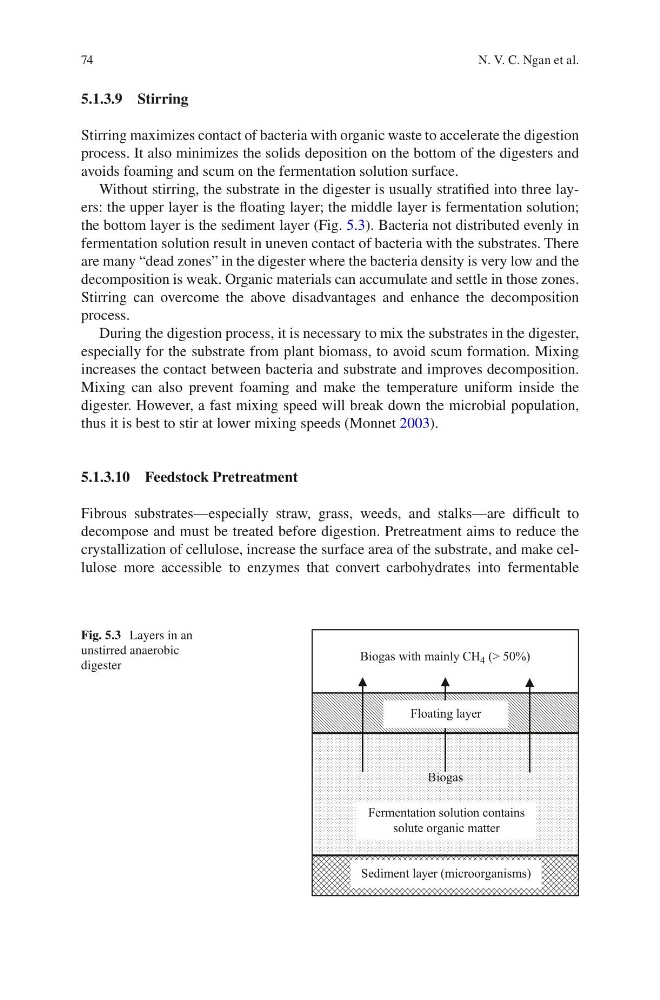
Without stirring, the substrate in the digester is usually stratified into three layers: the upper layer is the floating layer; the middle layer is fermentation solution;
the bottom layer is the sediment layer (Fig. 5.3). Bacteria not distributed evenly in
fermentation solution result in uneven contact of bacteria with the substrates. There
are many “dead zones” in the digester where the bacteria density is very low and the
decomposition is weak. Organic materials can accumulate and settle in those zones.
Stirring can overcome the above disadvantages and enhance the decomposition
process.
During the digestion process, it is necessary to mix the substrates in the digester,
especially for the substrate from plant biomass, to avoid scum formation. Mixing
increases the contact between bacteria and substrate and improves decomposition.
Mixing can also prevent foaming and make the temperature uniform inside the
digester. However, a fast mixing speed will break down the microbial population,
thus it is best to stir at lower mixing speeds (Monnet 2003).
5.1.3.10 Feedstock Pretreatment
Fibrous substrates—especially straw, grass, weeds, and stalks—are difficult to
decompose and must be treated before digestion. Pretreatment aims to reduce the
crystallization of cellulose, increase the surface area of the substrate, and make cellulose more accessible to enzymes that convert carbohydrates into fermentable
Biogas with mainly CH 4 (> 50%)
Biogas
Floating layer
Fermentation solution contains
solute organic matter
Sediment layer (microorganisms)
Fig. 5.3 Layers in an
unstirred anaerobic
digester
N. V. C. Ngan et al.
5.1.3.9 Stirring
Stirring maximizes contact of bacteria with organic waste to accelerate the digestion
process. It also minimizes the solids deposition on the bottom of the digesters and
avoids foaming and scum on the fermentation solution surface.
Without stirring, the substrate in the digester is usually stratified into three layers: the upper layer is the floating layer; the middle layer is fermentation solution;
the bottom layer is the sediment layer (Fig. 5.3). Bacteria not distributed evenly in
fermentation solution result in uneven contact of bacteria with the substrates. There
are many “dead zones” in the digester where the bacteria density is very low and the
decomposition is weak. Organic materials can accumulate and settle in those zones.
Stirring can overcome the above disadvantages and enhance the decomposition
process.
During the digestion process, it is necessary to mix the substrates in the digester,
especially for the substrate from plant biomass, to avoid scum formation. Mixing
increases the contact between bacteria and substrate and improves decomposition.
Mixing can also prevent foaming and make the temperature uniform inside the
digester. However, a fast mixing speed will break down the microbial population,
thus it is best to stir at lower mixing speeds (Monnet 2003).
5.1.3.10 Feedstock Pretreatment
Fibrous substrates—especially straw, grass, weeds, and stalks—are difficult to
decompose and must be treated before digestion. Pretreatment aims to reduce the
crystallization of cellulose, increase the surface area of the substrate, and make cellulose more accessible to enzymes that convert carbohydrates into fermentable
Biogas with mainly CH 4 (> 50%)
Biogas
Floating layer
Fermentation solution contains
solute organic matter
Sediment layer (microorganisms)
Fig. 5.3 Layers in an
unstirred anaerobic
digester
N. V. C. Ngan et al.