

52
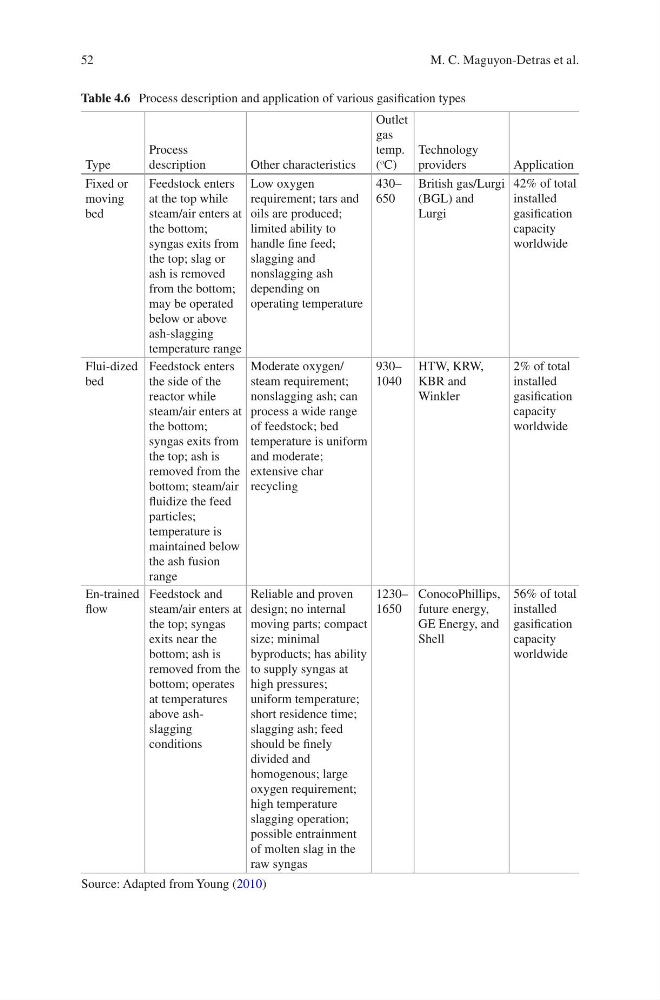
Table 4.6 Process description and application of various gasification types
Type
Process
description
Other characteristics
Outlet
gas
temp.
(
o C)
Technology
providers
Application
Fixed or
moving
bed
Feedstock enters
at the top while
steam/air enters at
the bottom;
syngas exits from
the top; slag or
ash is removed
from the bottom;
may be operated
below or above
ash-slagging
temperature range
Low oxygen
requirement; tars and
oils are produced;
limited ability to
handle fine feed;
slagging and
nonslagging ash
depending on
operating temperature
430–
650
British gas/Lurgi
(BGL) and
Lurgi
42% of total
installed
gasification
capacity
worldwide
Flui-dized
bed
Feedstock enters
the side of the
reactor while
steam/air enters at
the bottom;
syngas exits from
the top; ash is
removed from the
bottom; steam/air
fluidize the feed
particles;
temperature is
maintained below
the ash fusion
range
Moderate oxygen/
steam requirement;
nonslagging ash; can
process a wide range
of feedstock; bed
temperature is uniform
and moderate;
extensive char
recycling
930–
1040
HTW, KRW,
KBR and
Winkler
2% of total
installed
gasification
capacity
worldwide
En-trained
flow
Feedstock and
steam/air enters at
the top; syngas
exits near the
bottom; ash is
removed from the
bottom; operates
at temperatures
above ashslagging
conditions
Reliable and proven
design; no internal
moving parts; compact
size; minimal
byproducts; has ability
to supply syngas at
high pressures;
uniform temperature;
short residence time;
slagging ash; feed
should be finely
divided and
homogenous; large
oxygen requirement;
high temperature
slagging operation;
possible entrainment
of molten slag in the
raw syngas
1230–
1650
ConocoPhillips,
future energy,
GE Energy, and
Shell
56% of total
installed
gasification
capacity
worldwide
Source: Adapted from Young (2010)
M. C. Maguyon-Detras et al.
Table 4.6 Process description and application of various gasification types
Type
Process
description
Other characteristics
Outlet
gas
temp.
(
o C)
Technology
providers
Application
Fixed or
moving
bed
Feedstock enters
at the top while
steam/air enters at
the bottom;
syngas exits from
the top; slag or
ash is removed
from the bottom;
may be operated
below or above
ash-slagging
temperature range
Low oxygen
requirement; tars and
oils are produced;
limited ability to
handle fine feed;
slagging and
nonslagging ash
depending on
operating temperature
430–
650
British gas/Lurgi
(BGL) and
Lurgi
42% of total
installed
gasification
capacity
worldwide
Flui-dized
bed
Feedstock enters
the side of the
reactor while
steam/air enters at
the bottom;
syngas exits from
the top; ash is
removed from the
bottom; steam/air
fluidize the feed
particles;
temperature is
maintained below
the ash fusion
range
Moderate oxygen/
steam requirement;
nonslagging ash; can
process a wide range
of feedstock; bed
temperature is uniform
and moderate;
extensive char
recycling
930–
1040
HTW, KRW,
KBR and
Winkler
2% of total
installed
gasification
capacity
worldwide
En-trained
flow
Feedstock and
steam/air enters at
the top; syngas
exits near the
bottom; ash is
removed from the
bottom; operates
at temperatures
above ashslagging
conditions
Reliable and proven
design; no internal
moving parts; compact
size; minimal
byproducts; has ability
to supply syngas at
high pressures;
uniform temperature;
short residence time;
slagging ash; feed
should be finely
divided and
homogenous; large
oxygen requirement;
high temperature
slagging operation;
possible entrainment
of molten slag in the
raw syngas
1230–
1650
ConocoPhillips,
future energy,
GE Energy, and
Shell
56% of total
installed
gasification
capacity
worldwide
Source: Adapted from Young (2010)
M. C. Maguyon-Detras et al.