

51
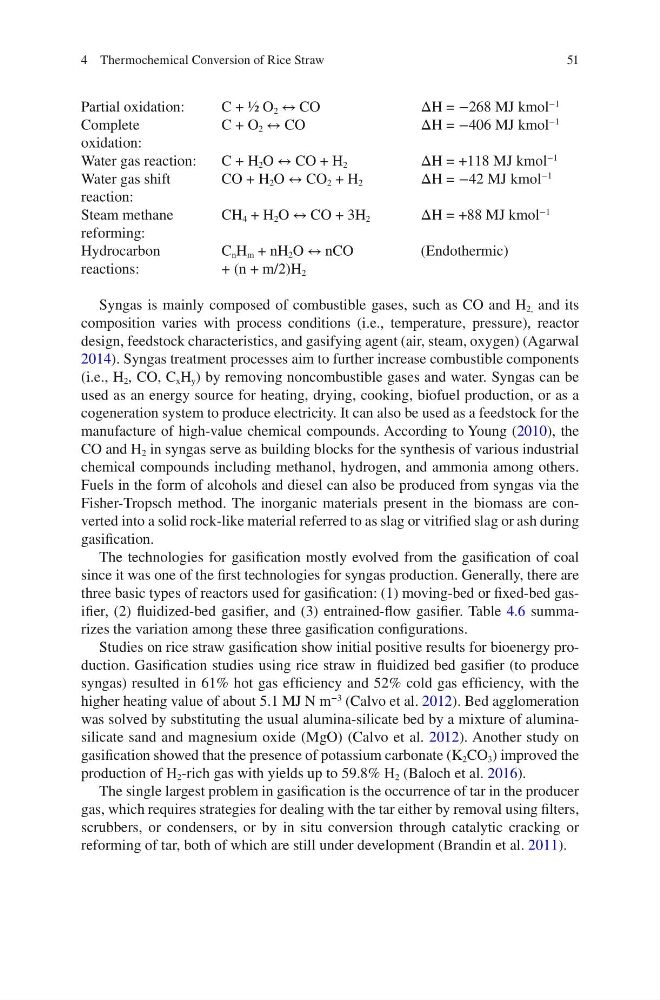
Partial oxidation:
C + ½ O 2 ↔ CO
ΔH = −268 MJ kmol
−1
Complete
oxidation:
C + O 2 ↔ CO
ΔH = −406 MJ kmol
−1
Water gas reaction:
C + H 2 O ↔ CO + H 2
ΔH = +118 MJ kmol
−1
Water gas shift
reaction:
CO + H 2 O ↔ CO 2 + H 2
ΔH = −42 MJ kmol
−1
Steam methane
reforming:
CH 4 + H 2 O ↔ CO + 3H 2
ΔH = +88 MJ kmol
−1
Hydrocarbon
reactions:
C n H m + nH 2 O ↔ nCO
+ (n + m/2)H 2
(Endothermic)
Syngas is mainly composed of combustible gases, such as CO and H 2, and its
composition varies with process conditions (i.e., temperature, pressure), reactor
design, feedstock characteristics, and gasifying agent (air, steam, oxygen) (Agarwal
2014). Syngas treatment processes aim to further increase combustible components
(i.e., H 2 , CO, C x H y ) by removing noncombustible gases and water. Syngas can be
used as an energy source for heating, drying, cooking, biofuel production, or as a
cogeneration system to produce electricity. It can also be used as a feedstock for the
manufacture of high-value chemical compounds. According to Young (2010), the
CO and H 2 in syngas serve as building blocks for the synthesis of various industrial
chemical compounds including methanol, hydrogen, and ammonia among others.
Fuels in the form of alcohols and diesel can also be produced from syngas via the
Fisher-Tropsch method. The inorganic materials present in the biomass are converted into a solid rock-like material referred to as slag or vitrified slag or ash during
gasification.
The technologies for gasification mostly evolved from the gasification of coal
since it was one of the first technologies for syngas production. Generally, there are
three basic types of reactors used for gasification: (1) moving-bed or fixed-bed gasifier, (2) fluidized-bed gasifier, and (3) entrained-flow gasifier. Table 4.6 summarizes the variation among these three gasification configurations.
Studies on rice straw gasification show initial positive results for bioenergy production. Gasification studies using rice straw in fluidized bed gasifier (to produce
syngas) resulted in 61% hot gas efficiency and 52% cold gas efficiency, with the
higher heating value of about 5.1 MJ N m
−3
(Calvo et al. 2012). Bed agglomeration
was solved by substituting the usual alumina-silicate bed by a mixture of aluminasilicate sand and magnesium oxide (MgO) (Calvo et al. 2012). Another study on
gasification showed that the presence of potassium carbonate (K 2 CO 3 ) improved the
production of H 2 -rich gas with yields up to 59.8% H 2 (Baloch et al. 2016).
The single largest problem in gasification is the occurrence of tar in the producer
gas, which requires strategies for dealing with the tar either by removal using filters,
scrubbers, or condensers, or by in situ conversion through catalytic cracking or
reforming of tar, both of which are still under development (Brandin et al. 2011).
4 Thermochemical Conversion of Rice Straw
Partial oxidation:
C + ½ O 2 ↔ CO
ΔH = −268 MJ kmol
−1
Complete
oxidation:
C + O 2 ↔ CO
ΔH = −406 MJ kmol
−1
Water gas reaction:
C + H 2 O ↔ CO + H 2
ΔH = +118 MJ kmol
−1
Water gas shift
reaction:
CO + H 2 O ↔ CO 2 + H 2
ΔH = −42 MJ kmol
−1
Steam methane
reforming:
CH 4 + H 2 O ↔ CO + 3H 2
ΔH = +88 MJ kmol
−1
Hydrocarbon
reactions:
C n H m + nH 2 O ↔ nCO
+ (n + m/2)H 2
(Endothermic)
Syngas is mainly composed of combustible gases, such as CO and H 2, and its
composition varies with process conditions (i.e., temperature, pressure), reactor
design, feedstock characteristics, and gasifying agent (air, steam, oxygen) (Agarwal
2014). Syngas treatment processes aim to further increase combustible components
(i.e., H 2 , CO, C x H y ) by removing noncombustible gases and water. Syngas can be
used as an energy source for heating, drying, cooking, biofuel production, or as a
cogeneration system to produce electricity. It can also be used as a feedstock for the
manufacture of high-value chemical compounds. According to Young (2010), the
CO and H 2 in syngas serve as building blocks for the synthesis of various industrial
chemical compounds including methanol, hydrogen, and ammonia among others.
Fuels in the form of alcohols and diesel can also be produced from syngas via the
Fisher-Tropsch method. The inorganic materials present in the biomass are converted into a solid rock-like material referred to as slag or vitrified slag or ash during
gasification.
The technologies for gasification mostly evolved from the gasification of coal
since it was one of the first technologies for syngas production. Generally, there are
three basic types of reactors used for gasification: (1) moving-bed or fixed-bed gasifier, (2) fluidized-bed gasifier, and (3) entrained-flow gasifier. Table 4.6 summarizes the variation among these three gasification configurations.
Studies on rice straw gasification show initial positive results for bioenergy production. Gasification studies using rice straw in fluidized bed gasifier (to produce
syngas) resulted in 61% hot gas efficiency and 52% cold gas efficiency, with the
higher heating value of about 5.1 MJ N m
−3
(Calvo et al. 2012). Bed agglomeration
was solved by substituting the usual alumina-silicate bed by a mixture of aluminasilicate sand and magnesium oxide (MgO) (Calvo et al. 2012). Another study on
gasification showed that the presence of potassium carbonate (K 2 CO 3 ) improved the
production of H 2 -rich gas with yields up to 59.8% H 2 (Baloch et al. 2016).
The single largest problem in gasification is the occurrence of tar in the producer
gas, which requires strategies for dealing with the tar either by removal using filters,
scrubbers, or condensers, or by in situ conversion through catalytic cracking or
reforming of tar, both of which are still under development (Brandin et al. 2011).
4 Thermochemical Conversion of Rice Straw