

53
4.3.3 Combustion
Combustion is the confined and controlled process of burning organic materials
(i.e., biomass, wastes) with sufficient amount of air (usually 110 to 150% of stoichiometric oxygen) at temperatures typically between 700 and 1350 °C to produce
heat, mechanical, or electrical energy using various equipment such as stoves, furnaces, boilers, etc. (Tan 2013). Any kind of waste material with moisture content of
<50% can be used as fuel for combustion (Agarwal 2014). This process can reduce
the volume of waste up to about 90% (70% by mass) depending on the feedstock
and reactor types, and process conditions. However, efficient air pollution control
devices are required for treatment of the flue gases, which may contain various air
pollutants (i.e. NOx, SOx, PMs, dioxins). Bottom ash and fly ash are also produced
from the inorganic fraction of the fuel used. The scale of a combustion plant may
range from domestic-level heating to large industrial plant. The complete combustion reaction of hydrocarbons is shown below:
C H
O
H O
n m + +
(
) ®
+(
)
n m
nCO
m
/
/
4
2
2
2
2
Unlike for rice husks, research and applications of bioenergy via thermal conversion
of rice straw are in developmental stage. And among the different thermochemical
processes, direct combustion is the most established because of its simplicity and
high efficiency; thus, it can be used for the economic heat generation from biomass
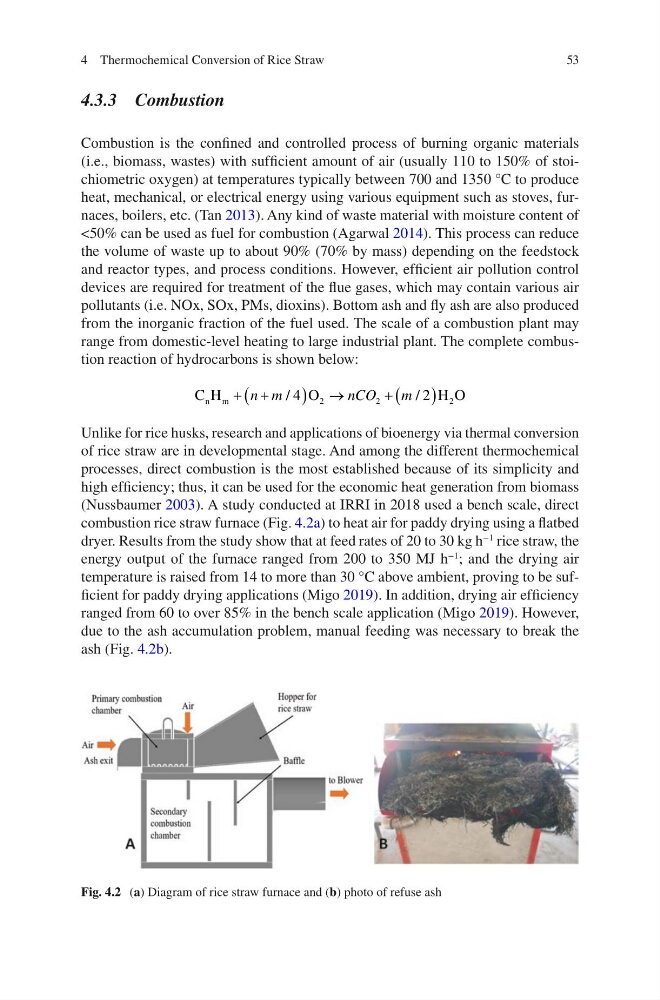
(Nussbaumer 2003). A study conducted at IRRI in 2018 used a bench scale, direct
combustion rice straw furnace (Fig. 4.2a) to heat air for paddy drying using a flatbed
dryer. Results from the study show that at feed rates of 20 to 30 kg h
−1
rice straw, the
energy output of the furnace ranged from 200 to 350 MJ h
−1
; and the drying air
temperature is raised from 14 to more than 30 °C above ambient, proving to be sufficient for paddy drying applications (Migo 2019). In addition, drying air efficiency
ranged from 60 to over 85% in the bench scale application (Migo 2019). However,
due to the ash accumulation problem, manual feeding was necessary to break the
ash (Fig. 4.2b).
Fig. 4.2 (a) Diagram of rice straw furnace and (b) photo of refuse ash
4 Thermochemical Conversion of Rice Straw
4.3.3 Combustion
Combustion is the confined and controlled process of burning organic materials
(i.e., biomass, wastes) with sufficient amount of air (usually 110 to 150% of stoichiometric oxygen) at temperatures typically between 700 and 1350 °C to produce
heat, mechanical, or electrical energy using various equipment such as stoves, furnaces, boilers, etc. (Tan 2013). Any kind of waste material with moisture content of
<50% can be used as fuel for combustion (Agarwal 2014). This process can reduce
the volume of waste up to about 90% (70% by mass) depending on the feedstock
and reactor types, and process conditions. However, efficient air pollution control
devices are required for treatment of the flue gases, which may contain various air
pollutants (i.e. NOx, SOx, PMs, dioxins). Bottom ash and fly ash are also produced
from the inorganic fraction of the fuel used. The scale of a combustion plant may
range from domestic-level heating to large industrial plant. The complete combustion reaction of hydrocarbons is shown below:
C H
O
H O
n m + +
(
) ®
+(
)
n m
nCO
m
/
/
4
2
2
2
2
Unlike for rice husks, research and applications of bioenergy via thermal conversion
of rice straw are in developmental stage. And among the different thermochemical
processes, direct combustion is the most established because of its simplicity and
high efficiency; thus, it can be used for the economic heat generation from biomass
(Nussbaumer 2003). A study conducted at IRRI in 2018 used a bench scale, direct
combustion rice straw furnace (Fig. 4.2a) to heat air for paddy drying using a flatbed
dryer. Results from the study show that at feed rates of 20 to 30 kg h
−1
rice straw, the
energy output of the furnace ranged from 200 to 350 MJ h
−1
; and the drying air
temperature is raised from 14 to more than 30 °C above ambient, proving to be sufficient for paddy drying applications (Migo 2019). In addition, drying air efficiency
ranged from 60 to over 85% in the bench scale application (Migo 2019). However,
due to the ash accumulation problem, manual feeding was necessary to break the
ash (Fig. 4.2b).
Fig. 4.2 (a) Diagram of rice straw furnace and (b) photo of refuse ash
4 Thermochemical Conversion of Rice Straw