

48
4.3 Currently Developed Technologies and Practices of Rice
Straw Thermal Conversion
Figure 4.1 shows the various routes for bioenergy production in the form of heat,
steam, biofuels, or power from rice straw via thermal conversion methods and the
potential high-value nonenergy byproducts.
4.3.1 Pyrolysis
Pyrolysis is an irreversible thermal conversion process done at temperatures typically above 300 °C in the complete absence of an oxidant. This process, also known
as destructive distillation, degrades biomass components into three primary
products: char, bio-oil, and synthesis or producer gas (Bridgwater 2006; Capareda
2014). Several reaction parameters (i.e., temperature, heating rate, residence time,
pressure, and catalyst) and biomass type and characteristics (i.e., particle size)
greatly affect the proportion and quality of the pyrolysis products (Mahinpey et al.
2009). Table 4.5 shows the process parameters and product yields for various pyrolysis modes including gasification. Generally, more char is obtained at lower temperatures while higher amounts of syngas are produced at higher temperatures due
to a higher degree of devolatilization and cracking. The liquid product or bio-oil
produced in higher amounts at 500–550 °C may contain various chemicals ranging
from aliphatic compounds, acids, alcohols, esters, and nitrogenous compounds (i.e.,
amines, nitriles) (Chen et al. 2015; Maguyon and Capareda 2013; Maguyon-Detras
and Capareda 2017). As shown in Fig. 4.1, all pyrolysis products can be used as fuel.
Char produced from pyrolysis has properties very similar to natural coal and it
contains relatively higher energy than the raw biomass (Tag et al. 2016). Bio-oil, on
the other hand, has a typically complex composition, high moisture content, and
high acidity, hence, physical and chemical upgrading (i.e., column chromatography,
distillation, solvent extraction, hydrogenation, and deoxygenation) must be done
prior to its application as liquid fuels (i.e., diesel, gasoline) (Teella et al. 2011; Wang
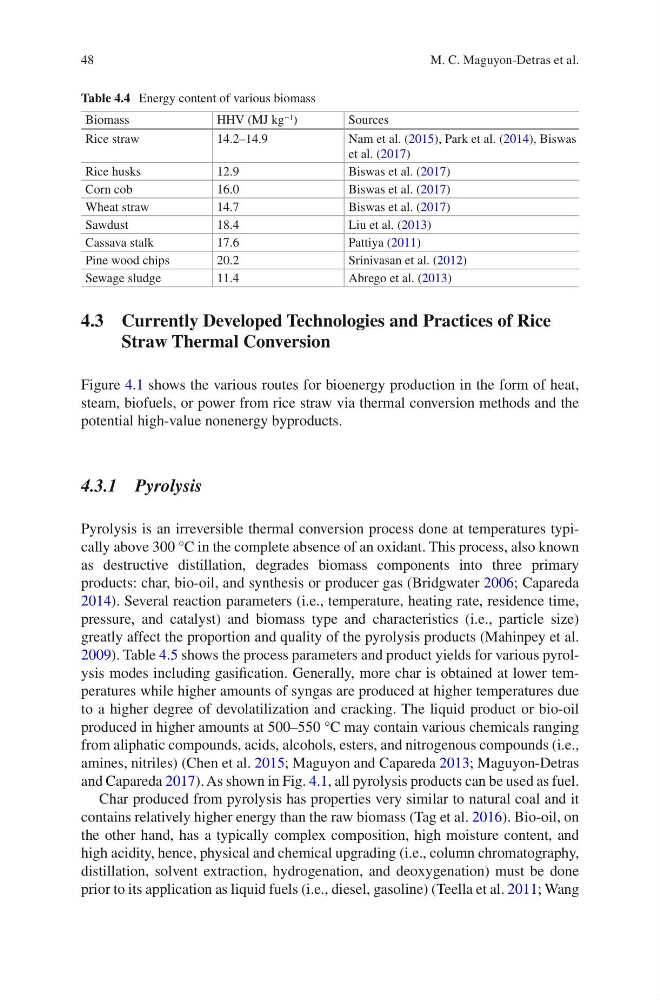
Table 4.4 Energy content of various biomass
Biomass
HHV (MJ kg
−1 )
Sources
Rice straw
14.2–14.9
Nam et al. (2015), Park et al. (2014), Biswas
et al. (2017)
Rice husks
12.9
Biswas et al. (2017)
Corn cob
16.0
Biswas et al. (2017)
Wheat straw
14.7
Biswas et al. (2017)
Sawdust
18.4
Liu et al. (2013)
Cassava stalk
17.6
Pattiya (2011)
Pine wood chips
20.2
Srinivasan et al. (2012)
Sewage sludge
11.4
Abrego et al. (2013)
M. C. Maguyon-Detras et al.
4.3 Currently Developed Technologies and Practices of Rice
Straw Thermal Conversion
Figure 4.1 shows the various routes for bioenergy production in the form of heat,
steam, biofuels, or power from rice straw via thermal conversion methods and the
potential high-value nonenergy byproducts.
4.3.1 Pyrolysis
Pyrolysis is an irreversible thermal conversion process done at temperatures typically above 300 °C in the complete absence of an oxidant. This process, also known
as destructive distillation, degrades biomass components into three primary
products: char, bio-oil, and synthesis or producer gas (Bridgwater 2006; Capareda
2014). Several reaction parameters (i.e., temperature, heating rate, residence time,
pressure, and catalyst) and biomass type and characteristics (i.e., particle size)
greatly affect the proportion and quality of the pyrolysis products (Mahinpey et al.
2009). Table 4.5 shows the process parameters and product yields for various pyrolysis modes including gasification. Generally, more char is obtained at lower temperatures while higher amounts of syngas are produced at higher temperatures due
to a higher degree of devolatilization and cracking. The liquid product or bio-oil
produced in higher amounts at 500–550 °C may contain various chemicals ranging
from aliphatic compounds, acids, alcohols, esters, and nitrogenous compounds (i.e.,
amines, nitriles) (Chen et al. 2015; Maguyon and Capareda 2013; Maguyon-Detras
and Capareda 2017). As shown in Fig. 4.1, all pyrolysis products can be used as fuel.
Char produced from pyrolysis has properties very similar to natural coal and it
contains relatively higher energy than the raw biomass (Tag et al. 2016). Bio-oil, on
the other hand, has a typically complex composition, high moisture content, and
high acidity, hence, physical and chemical upgrading (i.e., column chromatography,
distillation, solvent extraction, hydrogenation, and deoxygenation) must be done
prior to its application as liquid fuels (i.e., diesel, gasoline) (Teella et al. 2011; Wang
Table 4.4 Energy content of various biomass
Biomass
HHV (MJ kg
−1 )
Sources
Rice straw
14.2–14.9
Nam et al. (2015), Park et al. (2014), Biswas
et al. (2017)
Rice husks
12.9
Biswas et al. (2017)
Corn cob
16.0
Biswas et al. (2017)
Wheat straw
14.7
Biswas et al. (2017)
Sawdust
18.4
Liu et al. (2013)
Cassava stalk
17.6
Pattiya (2011)
Pine wood chips
20.2
Srinivasan et al. (2012)
Sewage sludge
11.4
Abrego et al. (2013)
M. C. Maguyon-Detras et al.