

47
conversion. As such, reducing ash content through washing or leaching may be
necessary prior to thermal processing (Kenney et al. 2013).
Ultimate analysis, on the other hand, provides information on the elemental
composition of the biomass. It includes carbon, hydrogen, oxygen, nitrogen, sulfur
and ash, which can be determined in percent by weight using an elemental analyzer.
Results of ultimate analysis can be used to determine the atomic O:C and H:C ratios
of the biomass and thermal conversion products (i.e., char), which can be plotted in
the van Krevelen diagram to determine their suitability as fuel alternatives
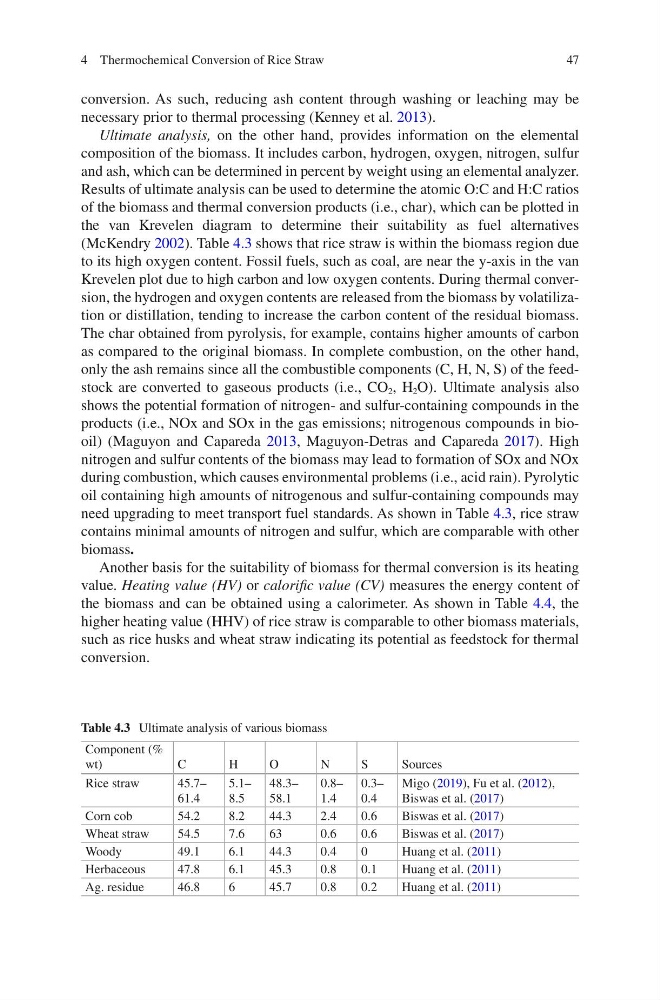
(McKendry 2002). Table 4.3 shows that rice straw is within the biomass region due
to its high oxygen content. Fossil fuels, such as coal, are near the y-axis in the van
Krevelen plot due to high carbon and low oxygen contents. During thermal conversion, the hydrogen and oxygen contents are released from the biomass by volatilization or distillation, tending to increase the carbon content of the residual biomass.
The char obtained from pyrolysis, for example, contains higher amounts of carbon
as compared to the original biomass. In complete combustion, on the other hand,
only the ash remains since all the combustible components (C, H, N, S) of the feedstock are converted to gaseous products (i.e., CO 2 , H 2 O). Ultimate analysis also
shows the potential formation of nitrogen- and sulfur-containing compounds in the
products (i.e., NOx and SOx in the gas emissions; nitrogenous compounds in biooil) (Maguyon and Capareda 2013, Maguyon-Detras and Capareda 2017). High
nitrogen and sulfur contents of the biomass may lead to formation of SOx and NOx
during combustion, which causes environmental problems (i.e., acid rain). Pyrolytic
oil containing high amounts of nitrogenous and sulfur-containing compounds may
need upgrading to meet transport fuel standards. As shown in Table 4.3, rice straw
contains minimal amounts of nitrogen and sulfur, which are comparable with other
biomass.
Another basis for the suitability of biomass for thermal conversion is its heating
value. Heating value (HV) or calorific value (CV) measures the energy content of
the biomass and can be obtained using a calorimeter. As shown in Table 4.4, the
higher heating value (HHV) of rice straw is comparable to other biomass materials,
such as rice husks and wheat straw indicating its potential as feedstock for thermal
conversion.
Table 4.3 Ultimate analysis of various biomass
Component (%
wt)
C
H
O
N
S
Sources
Rice straw
45.7–
61.4
5.1–
8.5
48.3–
58.1
0.8–
1.4
0.3–
0.4
Migo (2019), Fu et al. (2012),
Biswas et al. (2017)
Corn cob
54.2
8.2
44.3
2.4
0.6
Biswas et al. (2017)
Wheat straw
54.5
7.6
63
0.6
0.6
Biswas et al. (2017)
Woody
49.1
6.1
44.3
0.4
0
Huang et al. (2011)
Herbaceous
47.8
6.1
45.3
0.8
0.1
Huang et al. (2011)
Ag. residue
46.8
6
45.7
0.8
0.2
Huang et al. (2011)
4 Thermochemical Conversion of Rice Straw
conversion. As such, reducing ash content through washing or leaching may be
necessary prior to thermal processing (Kenney et al. 2013).
Ultimate analysis, on the other hand, provides information on the elemental
composition of the biomass. It includes carbon, hydrogen, oxygen, nitrogen, sulfur
and ash, which can be determined in percent by weight using an elemental analyzer.
Results of ultimate analysis can be used to determine the atomic O:C and H:C ratios
of the biomass and thermal conversion products (i.e., char), which can be plotted in
the van Krevelen diagram to determine their suitability as fuel alternatives
(McKendry 2002). Table 4.3 shows that rice straw is within the biomass region due
to its high oxygen content. Fossil fuels, such as coal, are near the y-axis in the van
Krevelen plot due to high carbon and low oxygen contents. During thermal conversion, the hydrogen and oxygen contents are released from the biomass by volatilization or distillation, tending to increase the carbon content of the residual biomass.
The char obtained from pyrolysis, for example, contains higher amounts of carbon
as compared to the original biomass. In complete combustion, on the other hand,
only the ash remains since all the combustible components (C, H, N, S) of the feedstock are converted to gaseous products (i.e., CO 2 , H 2 O). Ultimate analysis also
shows the potential formation of nitrogen- and sulfur-containing compounds in the
products (i.e., NOx and SOx in the gas emissions; nitrogenous compounds in biooil) (Maguyon and Capareda 2013, Maguyon-Detras and Capareda 2017). High
nitrogen and sulfur contents of the biomass may lead to formation of SOx and NOx
during combustion, which causes environmental problems (i.e., acid rain). Pyrolytic
oil containing high amounts of nitrogenous and sulfur-containing compounds may
need upgrading to meet transport fuel standards. As shown in Table 4.3, rice straw
contains minimal amounts of nitrogen and sulfur, which are comparable with other
biomass.
Another basis for the suitability of biomass for thermal conversion is its heating
value. Heating value (HV) or calorific value (CV) measures the energy content of
the biomass and can be obtained using a calorimeter. As shown in Table 4.4, the
higher heating value (HHV) of rice straw is comparable to other biomass materials,
such as rice husks and wheat straw indicating its potential as feedstock for thermal
conversion.
Table 4.3 Ultimate analysis of various biomass
Component (%
wt)
C
H
O
N
S
Sources
Rice straw
45.7–
61.4
5.1–
8.5
48.3–
58.1
0.8–
1.4
0.3–
0.4
Migo (2019), Fu et al. (2012),
Biswas et al. (2017)
Corn cob
54.2
8.2
44.3
2.4
0.6
Biswas et al. (2017)
Wheat straw
54.5
7.6
63
0.6
0.6
Biswas et al. (2017)
Woody
49.1
6.1
44.3
0.4
0
Huang et al. (2011)
Herbaceous
47.8
6.1
45.3
0.8
0.1
Huang et al. (2011)
Ag. residue
46.8
6
45.7
0.8
0.2
Huang et al. (2011)
4 Thermochemical Conversion of Rice Straw