

169
10.4 Case Study Using LCA and SIMAPRO for Rice
Production
LCA research relevant to agricultural products or processes can be found in recent
publications on rice straw bioenergy (Shie et al. 2011; Kami et al. 2012; Singh et al.
2013), rice straw biofuel and fertilizer (Silalertruksa and Gheewala 2013), power
generation (Suramaythangkoor and Gheewalal 2011; Shafie et al. 2014), rice production (Brodt et al. 2014), rice straw management (Fusi et al. 2014), rice straw
anaerobic digestion (Nguyen et al. 2016), and rice straw collection (Nguyen
et al. 2017).
Here we present a case study on rice production for different rice straw management practices based on research conducted at IRRI from 2015 to 2016 (Nguyen
et al. 2019). The goal and scope of the study were to compare environmental profiles, grain yield and quality, energy efficiency, and GHGEs of rice production at the
IRRI farm during the 2015 wet season and 2016 dry season, followed by four different rice-straw management options: retaining the straw and incorporation, straw
burning, partial straw removal, and complete straw removal through LCA (Fig. 10.6).
The functional unit of the system is 1 ha of rice production and the impact results
were translated to 1 t of rice based on the yield data.
For life-cycle inventory analysis, we measured operations and agricultural inputs
of rice production on the IRRI farm (including grain yield and total biomass) during
the 2015 wet and 2016 dry seasons. Soil sampling and analysis were also conducted. Inputs and outputs for each process in the system boundary (Fig. 10.6) were
itemized. For LCIA, single scores on net energy and net GHGEs were evaluated.
This step was done with the aid of SIMAPRO software. Data on net energy values
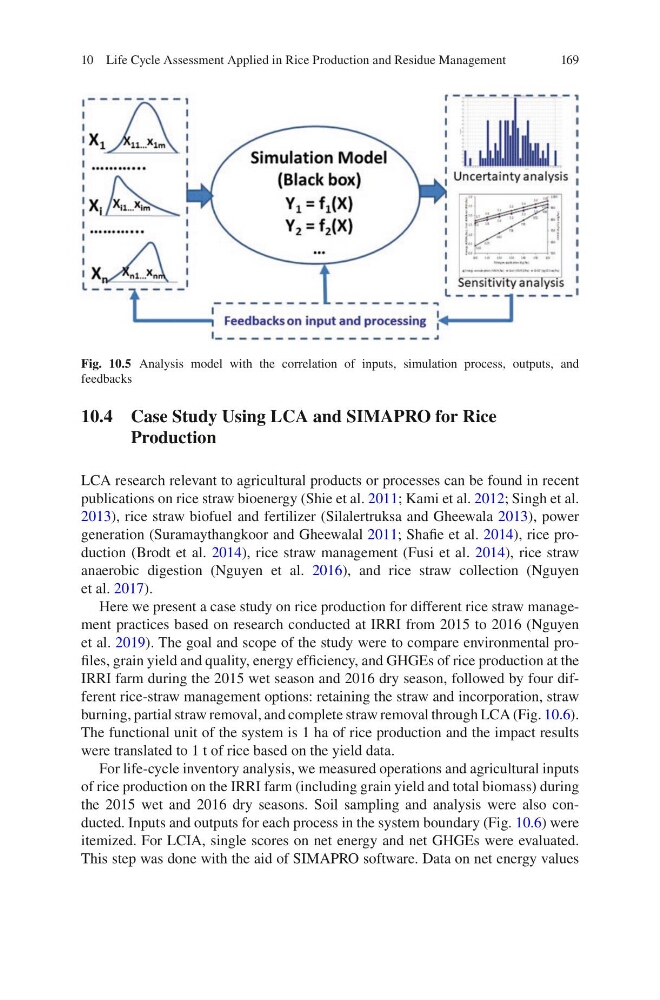
Fig. 10.5 Analysis model with the correlation of inputs, simulation process, outputs, and
feedbacks
10 Life Cycle Assessment Applied in Rice Production and Residue Management
10.4 Case Study Using LCA and SIMAPRO for Rice
Production
LCA research relevant to agricultural products or processes can be found in recent
publications on rice straw bioenergy (Shie et al. 2011; Kami et al. 2012; Singh et al.
2013), rice straw biofuel and fertilizer (Silalertruksa and Gheewala 2013), power
generation (Suramaythangkoor and Gheewalal 2011; Shafie et al. 2014), rice production (Brodt et al. 2014), rice straw management (Fusi et al. 2014), rice straw
anaerobic digestion (Nguyen et al. 2016), and rice straw collection (Nguyen
et al. 2017).
Here we present a case study on rice production for different rice straw management practices based on research conducted at IRRI from 2015 to 2016 (Nguyen
et al. 2019). The goal and scope of the study were to compare environmental profiles, grain yield and quality, energy efficiency, and GHGEs of rice production at the
IRRI farm during the 2015 wet season and 2016 dry season, followed by four different rice-straw management options: retaining the straw and incorporation, straw
burning, partial straw removal, and complete straw removal through LCA (Fig. 10.6).
The functional unit of the system is 1 ha of rice production and the impact results
were translated to 1 t of rice based on the yield data.
For life-cycle inventory analysis, we measured operations and agricultural inputs
of rice production on the IRRI farm (including grain yield and total biomass) during
the 2015 wet and 2016 dry seasons. Soil sampling and analysis were also conducted. Inputs and outputs for each process in the system boundary (Fig. 10.6) were
itemized. For LCIA, single scores on net energy and net GHGEs were evaluated.
This step was done with the aid of SIMAPRO software. Data on net energy values
Fig. 10.5 Analysis model with the correlation of inputs, simulation process, outputs, and
feedbacks
10 Life Cycle Assessment Applied in Rice Production and Residue Management