

164
On the other hand, the scope should describe the most important methodological
assumptions and limitations (PRé Product Ecology Consultants 2013). At this stage
of the LCA, the functional unit or comparison basis is also defined. An example in
rice science is the most common functional units of per kg or per ton of grain harvested. After defining the goal, scope, and functional unit, it is suggested to specify
a system boundary that will determine which processes will be included in the LCA.
The life cycle inventory (LCI) involves listing all inputs and outputs and collecting data related to unit processes within the system boundary (Guinée 2004). In rice
production, one input is the seed and one output is the grain. Thus, data collection
on grain yield is necessary. The product of this step is called the LCI result. In some
cases, systems have multi-functionality, as with rice production where there are two
products, paddy and straw. Such cases require the LCA practitioner to allocate the
inputs and outputs between the two products. However, according to the ISO 14040
standard, such allocation should be avoided as much as possible (Agri-footprint
2015). If allocation is unavoidable, the system inputs and outputs can be divided
across mass allocation, gross energy allocation, and/or economic allocation (Agrifootprint 2015). Mass allocation is based on the mass or dry matter of the products.
Gross energy allocation is based on the nutritional feed material list. Economic
allocation is based on the prices of the products.
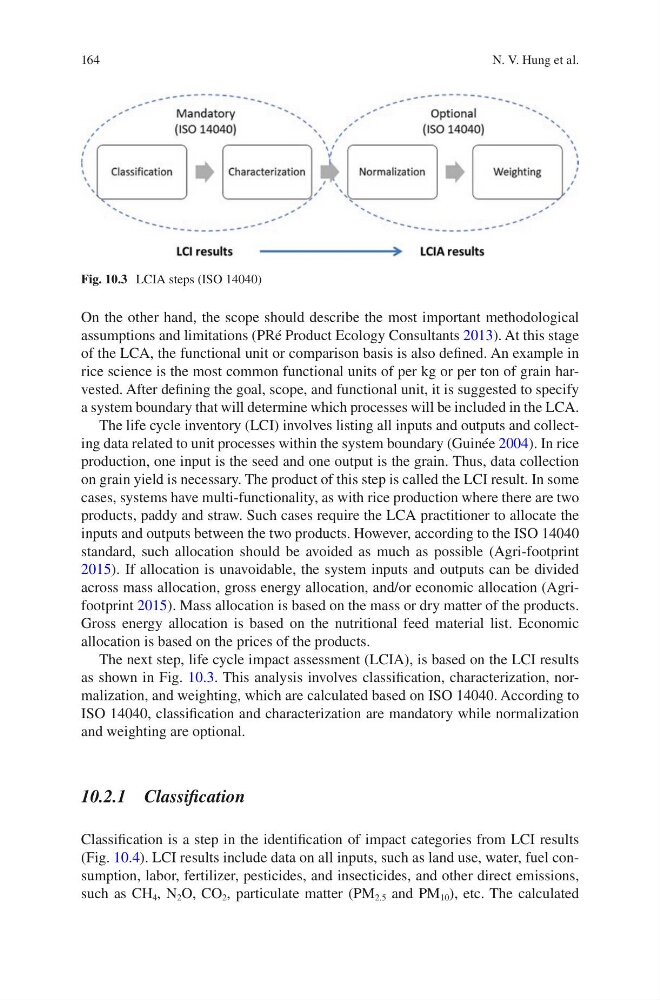
The next step, life cycle impact assessment (LCIA), is based on the LCI results
as shown in Fig. 10.3. This analysis involves classification, characterization, normalization, and weighting, which are calculated based on ISO 14040. According to
ISO 14040, classification and characterization are mandatory while normalization
and weighting are optional.
10.2.1 Classification
Classification is a step in the identification of impact categories from LCI results
(Fig. 10.4). LCI results include data on all inputs, such as land use, water, fuel consumption, labor, fertilizer, pesticides, and insecticides, and other direct emissions,
such as CH 4 , N 2 O, CO 2 , particulate matter (PM 2.5 and PM 10 ), etc. The calculated
Fig. 10.3 LCIA steps (ISO 14040)
N. V. Hung et al.
On the other hand, the scope should describe the most important methodological
assumptions and limitations (PRé Product Ecology Consultants 2013). At this stage
of the LCA, the functional unit or comparison basis is also defined. An example in
rice science is the most common functional units of per kg or per ton of grain harvested. After defining the goal, scope, and functional unit, it is suggested to specify
a system boundary that will determine which processes will be included in the LCA.
The life cycle inventory (LCI) involves listing all inputs and outputs and collecting data related to unit processes within the system boundary (Guinée 2004). In rice
production, one input is the seed and one output is the grain. Thus, data collection
on grain yield is necessary. The product of this step is called the LCI result. In some
cases, systems have multi-functionality, as with rice production where there are two
products, paddy and straw. Such cases require the LCA practitioner to allocate the
inputs and outputs between the two products. However, according to the ISO 14040
standard, such allocation should be avoided as much as possible (Agri-footprint
2015). If allocation is unavoidable, the system inputs and outputs can be divided
across mass allocation, gross energy allocation, and/or economic allocation (Agrifootprint 2015). Mass allocation is based on the mass or dry matter of the products.
Gross energy allocation is based on the nutritional feed material list. Economic
allocation is based on the prices of the products.
The next step, life cycle impact assessment (LCIA), is based on the LCI results
as shown in Fig. 10.3. This analysis involves classification, characterization, normalization, and weighting, which are calculated based on ISO 14040. According to
ISO 14040, classification and characterization are mandatory while normalization
and weighting are optional.
10.2.1 Classification
Classification is a step in the identification of impact categories from LCI results
(Fig. 10.4). LCI results include data on all inputs, such as land use, water, fuel consumption, labor, fertilizer, pesticides, and insecticides, and other direct emissions,
such as CH 4 , N 2 O, CO 2 , particulate matter (PM 2.5 and PM 10 ), etc. The calculated
Fig. 10.3 LCIA steps (ISO 14040)
N. V. Hung et al.