

163
to reduce the moisture content to about 14%, which helps to prevent grain
discoloration, mold formation, and insect attack. The paddy can be stored or milled
to remove the husks and bran layers revealing the edible white kernels. The rice
husks and bran are considered to be byproduct as well.
Life cycle assessment (LCA) is a tool for the analysis of the energy balance and
environmental impacts of a process from cradle to grave, beginning with the gathering of raw materials from the earth to create the product and ending at the point
when all materials are returned to the earth (US EPA 2006). LCA can be applied to
compute or simulate energy balance and environmental impact categories, such as
climate change, ozone depletion, terrestrial acidification, freshwater eutrophication,
and marine eutrophication. LCA can also be applied for crop production and agricultural systems for the following purposes:
• Comparative analyses and identification of the best options among different production systems, practices, technologies based on some specific economic and
environmental factors;
• Production process improvement, product development, and promotion; and
• Strategic planning and decision support.
10.2 LCA Framework
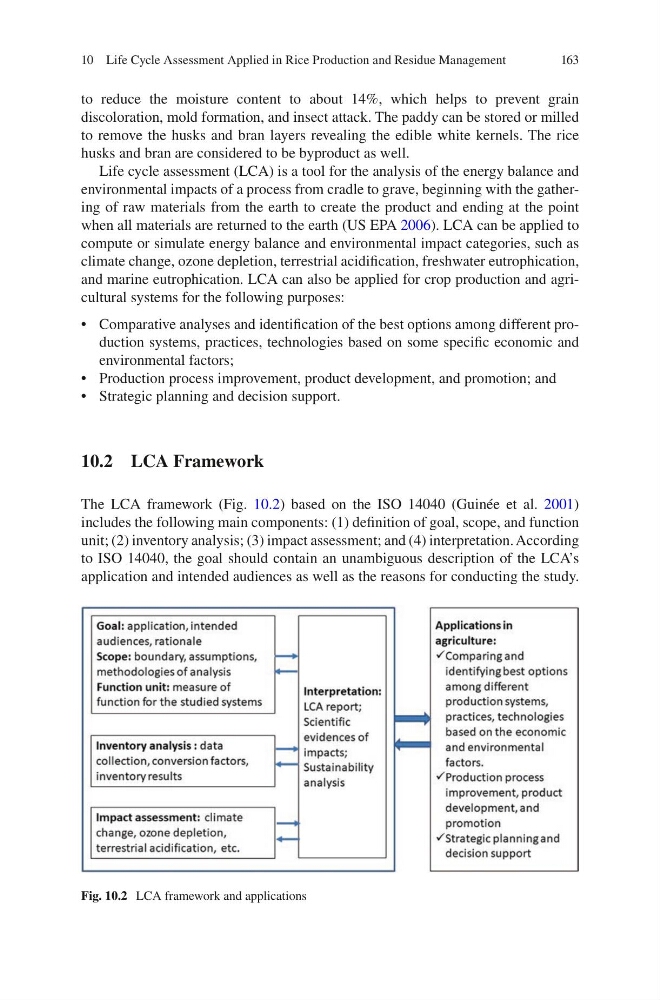
The LCA framework (Fig. 10.2) based on the ISO 14040 (Guinée et al. 2001)
includes the following main components: (1) definition of goal, scope, and function
unit; (2) inventory analysis; (3) impact assessment; and (4) interpretation. According
to ISO 14040, the goal should contain an unambiguous description of the LCA’s
application and intended audiences as well as the reasons for conducting the study.
Fig. 10.2 LCA framework and applications
10 Life Cycle Assessment Applied in Rice Production and Residue Management
to reduce the moisture content to about 14%, which helps to prevent grain
discoloration, mold formation, and insect attack. The paddy can be stored or milled
to remove the husks and bran layers revealing the edible white kernels. The rice
husks and bran are considered to be byproduct as well.
Life cycle assessment (LCA) is a tool for the analysis of the energy balance and
environmental impacts of a process from cradle to grave, beginning with the gathering of raw materials from the earth to create the product and ending at the point
when all materials are returned to the earth (US EPA 2006). LCA can be applied to
compute or simulate energy balance and environmental impact categories, such as
climate change, ozone depletion, terrestrial acidification, freshwater eutrophication,
and marine eutrophication. LCA can also be applied for crop production and agricultural systems for the following purposes:
• Comparative analyses and identification of the best options among different production systems, practices, technologies based on some specific economic and
environmental factors;
• Production process improvement, product development, and promotion; and
• Strategic planning and decision support.
10.2 LCA Framework
The LCA framework (Fig. 10.2) based on the ISO 14040 (Guinée et al. 2001)
includes the following main components: (1) definition of goal, scope, and function
unit; (2) inventory analysis; (3) impact assessment; and (4) interpretation. According
to ISO 14040, the goal should contain an unambiguous description of the LCA’s
application and intended audiences as well as the reasons for conducting the study.
Fig. 10.2 LCA framework and applications
10 Life Cycle Assessment Applied in Rice Production and Residue Management