

162
In preplanting, the variety is chosen and the field is prepared for planting. Land
preparation consists of plowing or overturning the soil, harrowing or breaking the
soil into smaller masses, and leveling the field. Equipment, which can be used in
mechanized land preparation, include the power tiller, moldboard plow, hydrotiller,
and rotovator. If herbicide is applied to kill weeds, the land is irrigated from 2 to
3 days after its application.
In the plant growth phase, rice is either directly seeded or transplanted. Fertilizers,
pesticides, and herbicides are applied and, traditionally, the land is continuously
flooded since rice is very sensitive to water shortages. Improved water management
options, such as alternate wetting and drying (AWD), have been developed recently
to conserve water and reduce greenhouse gas emissions (Carrijo et al. 2017; Linquist
et al. 2015). Snails, which are persistent pests during this period, can be managed by
manual removal or chemical control. During the growth phase, it is also important
to apply N-P-K fertilizers and pesticides and herbicides (when necessary) to enhance
yield. In addition, it is imperative to manage the water level to sustain the crop and
control weeds.
Postproduction activities include harvesting, drying, storage, milling, and processing. Harvest operations include reaping, threshing, cleaning, hauling, field drying, piling, and bagging. Harvesting may involve traditional manual labor for all
steps, semi-mechanical using a machine thresher, or full mechanization using a
combine harvester. After combine harvesting, rice straw is left on the field and can
either be collected, burned, or left to decompose (on the surface or after soil incorporation). When manually harvested, the rice stalks are cut and moved to a central
threshing area, leaving behind uncut rice straw stubble, which can be burned or
incorporated into the soil. Loose rice straw and stubble are considered byproducts.
The paddy is then dried (traditional sun drying, solar drying, or mechanical drying)
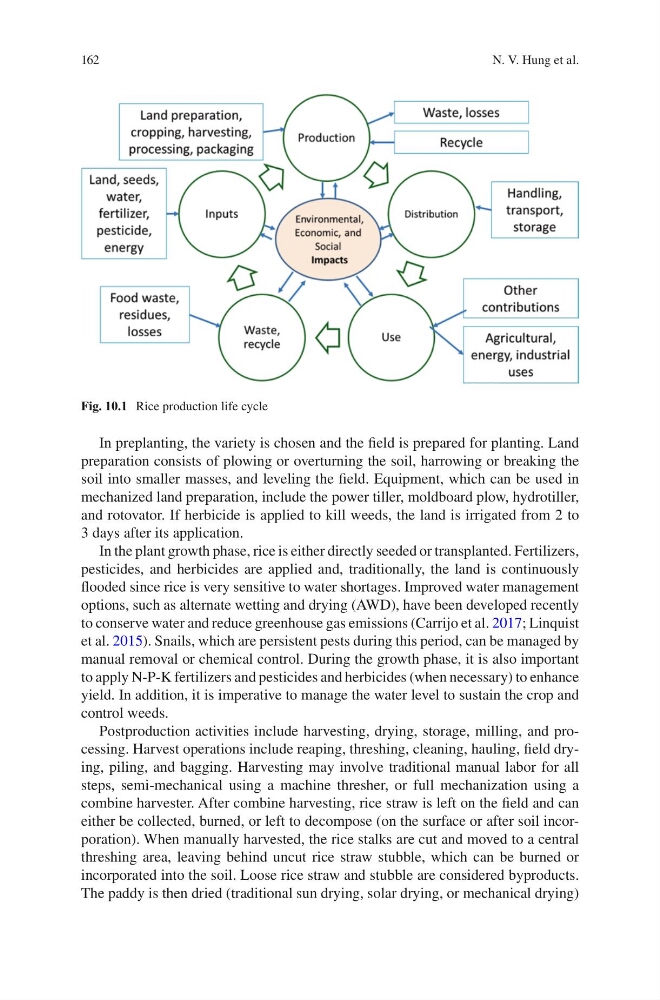
Fig. 10.1 Rice production life cycle
N. V. Hung et al.
In preplanting, the variety is chosen and the field is prepared for planting. Land
preparation consists of plowing or overturning the soil, harrowing or breaking the
soil into smaller masses, and leveling the field. Equipment, which can be used in
mechanized land preparation, include the power tiller, moldboard plow, hydrotiller,
and rotovator. If herbicide is applied to kill weeds, the land is irrigated from 2 to
3 days after its application.
In the plant growth phase, rice is either directly seeded or transplanted. Fertilizers,
pesticides, and herbicides are applied and, traditionally, the land is continuously
flooded since rice is very sensitive to water shortages. Improved water management
options, such as alternate wetting and drying (AWD), have been developed recently
to conserve water and reduce greenhouse gas emissions (Carrijo et al. 2017; Linquist
et al. 2015). Snails, which are persistent pests during this period, can be managed by
manual removal or chemical control. During the growth phase, it is also important
to apply N-P-K fertilizers and pesticides and herbicides (when necessary) to enhance
yield. In addition, it is imperative to manage the water level to sustain the crop and
control weeds.
Postproduction activities include harvesting, drying, storage, milling, and processing. Harvest operations include reaping, threshing, cleaning, hauling, field drying, piling, and bagging. Harvesting may involve traditional manual labor for all
steps, semi-mechanical using a machine thresher, or full mechanization using a
combine harvester. After combine harvesting, rice straw is left on the field and can
either be collected, burned, or left to decompose (on the surface or after soil incorporation). When manually harvested, the rice stalks are cut and moved to a central
threshing area, leaving behind uncut rice straw stubble, which can be burned or
incorporated into the soil. Loose rice straw and stubble are considered byproducts.
The paddy is then dried (traditional sun drying, solar drying, or mechanical drying)
Fig. 10.1 Rice production life cycle
N. V. Hung et al.