

97
higher hampers mycelia growth (Akinyele and Adetuyi 2005). This species grows
well on a number of cellulosic substrates, such as rice straw, wheat straw, sugarcane
bagasse, banana leaves, water hyacinth, etc. RSM production can be intensified with
the development of cutting-edge technologies. It can be grown outdoors or indoors.
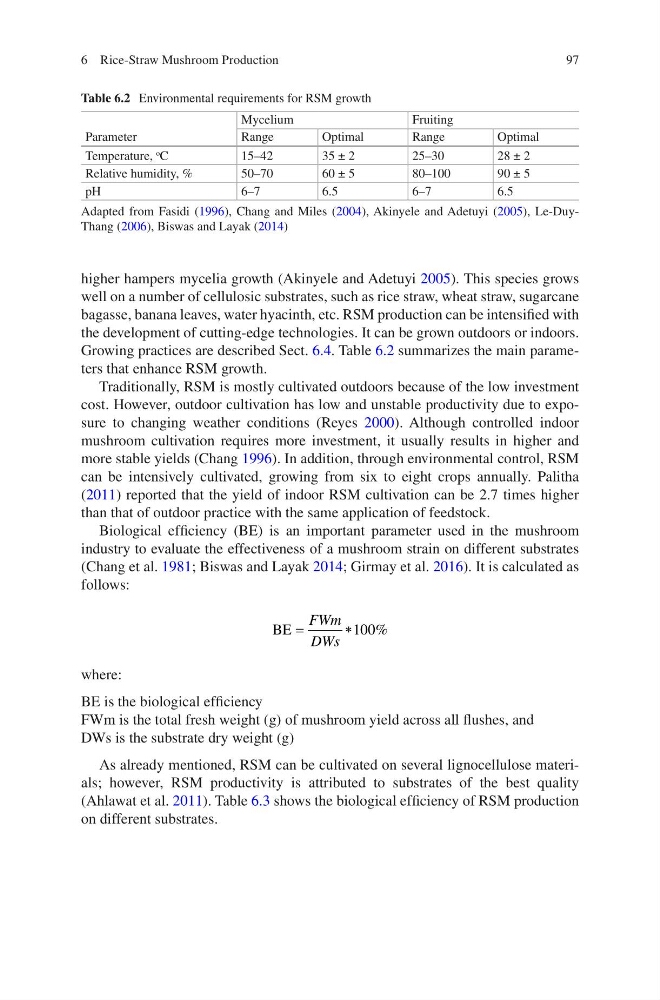
Growing practices are described Sect. 6.4. Table 6.2 summarizes the main parameters that enhance RSM growth.
Traditionally, RSM is mostly cultivated outdoors because of the low investment
cost. However, outdoor cultivation has low and unstable productivity due to exposure to changing weather conditions (Reyes 2000). Although controlled indoor
mushroom cultivation requires more investment, it usually results in higher and
more stable yields (Chang 1996). In addition, through environmental control, RSM
can be intensively cultivated, growing from six to eight crops annually. Palitha
(2011) reported that the yield of indoor RSM cultivation can be 2.7 times higher
than that of outdoor practice with the same application of feedstock.
Biological efficiency (BE) is an important parameter used in the mushroom
industry to evaluate the effectiveness of a mushroom strain on different substrates
(Chang et al. 1981; Biswas and Layak 2014; Girmay et al. 2016). It is calculated as
follows:
BE =
*
FWm
DWs
100%
where:
BE is the biological efficiency
FWm is the total fresh weight (g) of mushroom yield across all flushes, and
DWs is the substrate dry weight (g)
As already mentioned, RSM can be cultivated on several lignocellulose materials; however, RSM productivity is attributed to substrates of the best quality
(Ahlawat et al. 2011). Table 6.3 shows the biological efficiency of RSM production
on different substrates.
Table 6.2 Environmental requirements for RSM growth
Parameter
Mycelium
Fruiting
Range
Optimal
Range
Optimal
Temperature,
o C
15–42
35 ± 2
25–30
28 ± 2
Relative humidity, %
50–70
60 ± 5
80–100
90 ± 5
pH
6–7
6.5
6–7
6.5
Adapted from Fasidi (1996), Chang and Miles (2004), Akinyele and Adetuyi (2005), Le-DuyThang (2006), Biswas and Layak (2014)
6 Rice-Straw Mushroom Production
higher hampers mycelia growth (Akinyele and Adetuyi 2005). This species grows
well on a number of cellulosic substrates, such as rice straw, wheat straw, sugarcane
bagasse, banana leaves, water hyacinth, etc. RSM production can be intensified with
the development of cutting-edge technologies. It can be grown outdoors or indoors.
Growing practices are described Sect. 6.4. Table 6.2 summarizes the main parameters that enhance RSM growth.
Traditionally, RSM is mostly cultivated outdoors because of the low investment
cost. However, outdoor cultivation has low and unstable productivity due to exposure to changing weather conditions (Reyes 2000). Although controlled indoor
mushroom cultivation requires more investment, it usually results in higher and
more stable yields (Chang 1996). In addition, through environmental control, RSM
can be intensively cultivated, growing from six to eight crops annually. Palitha
(2011) reported that the yield of indoor RSM cultivation can be 2.7 times higher
than that of outdoor practice with the same application of feedstock.
Biological efficiency (BE) is an important parameter used in the mushroom
industry to evaluate the effectiveness of a mushroom strain on different substrates
(Chang et al. 1981; Biswas and Layak 2014; Girmay et al. 2016). It is calculated as
follows:
BE =
*
FWm
DWs
100%
where:
BE is the biological efficiency
FWm is the total fresh weight (g) of mushroom yield across all flushes, and
DWs is the substrate dry weight (g)
As already mentioned, RSM can be cultivated on several lignocellulose materials; however, RSM productivity is attributed to substrates of the best quality
(Ahlawat et al. 2011). Table 6.3 shows the biological efficiency of RSM production
on different substrates.
Table 6.2 Environmental requirements for RSM growth
Parameter
Mycelium
Fruiting
Range
Optimal
Range
Optimal
Temperature,
o C
15–42
35 ± 2
25–30
28 ± 2
Relative humidity, %
50–70
60 ± 5
80–100
90 ± 5
pH
6–7
6.5
6–7
6.5
Adapted from Fasidi (1996), Chang and Miles (2004), Akinyele and Adetuyi (2005), Le-DuyThang (2006), Biswas and Layak (2014)
6 Rice-Straw Mushroom Production