

98
6.4 Current Practices for Growing Mushroom
6.4.1 Outdoor RSM Cultivation
The steps for outdoor RSM production (Fig. 6.3), as it is done in Vietnam, are shown
in Fig. 6.4.
6.4.1.1 Rice Straw for Mushroom Growing and Preparation
of the Growing Location
Rice straw intended for growing RSM should be dry, clean, without mold contamination, and should not have been exposed to rain or should not have started rotting
in the field. Rice straw contaminated with molds may have mycelia or spawns with
a white color. To minimize contamination and for best quality, the straw should be
collected right after harvest. The location for growing RSM should be cleaned and
treated with 300–500 kg ha
−1
(3–5 kg 100 m
−2
) of lime (CaCO 3 ) 3 days before
incubation.
6.4.1.2 Growing Preparation and Maintenance of Planting Spawn
The most commonly used spawn substrate is a mixture of tobacco midrib and sawdust. The tobacco midribs are first soaked in clean water overnight. After soaking,
they are washed at least three times, drained, and then chopped into lengths of from
2 to 4 cm. The chopped midribs are boiled for 30 minutes and then drained until the
moisture content reaches around 65%. Next, the midribs are mixed with the sawdust. About 350 g of mixed spawn substrate is placed inside a 6- × 12-in. polypropylene (PP) bag. For easier handling, a plastic ring may be placed as a “bottle neck”
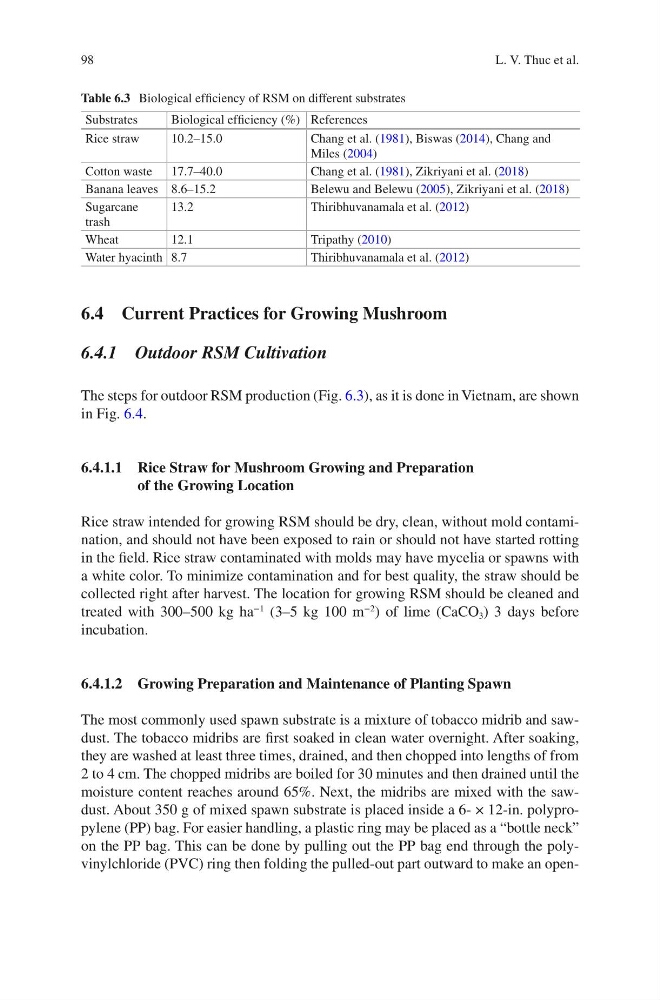
on the PP bag. This can be done by pulling out the PP bag end through the polyvinylchloride (PVC) ring then folding the pulled-out part outward to make an openTable 6.3 Biological efficiency of RSM on different substrates
Substrates
Biological efficiency (%) References
Rice straw
10.2–15.0
Chang et al. (1981), Biswas (2014), Chang and
Miles (2004)
Cotton waste 17.7–40.0
Chang et al. (1981), Zikriyani et al. (2018)
Banana leaves 8.6–15.2
Belewu and Belewu (2005), Zikriyani et al. (2018)
Sugarcane
trash
13.2
Thiribhuvanamala et al. (2012)
Wheat
12.1
Tripathy (2010)
Water hyacinth 8.7
Thiribhuvanamala et al. (2012)
L. V. Thuc et al.
6.4 Current Practices for Growing Mushroom
6.4.1 Outdoor RSM Cultivation
The steps for outdoor RSM production (Fig. 6.3), as it is done in Vietnam, are shown
in Fig. 6.4.
6.4.1.1 Rice Straw for Mushroom Growing and Preparation
of the Growing Location
Rice straw intended for growing RSM should be dry, clean, without mold contamination, and should not have been exposed to rain or should not have started rotting
in the field. Rice straw contaminated with molds may have mycelia or spawns with
a white color. To minimize contamination and for best quality, the straw should be
collected right after harvest. The location for growing RSM should be cleaned and
treated with 300–500 kg ha
−1
(3–5 kg 100 m
−2
) of lime (CaCO 3 ) 3 days before
incubation.
6.4.1.2 Growing Preparation and Maintenance of Planting Spawn
The most commonly used spawn substrate is a mixture of tobacco midrib and sawdust. The tobacco midribs are first soaked in clean water overnight. After soaking,
they are washed at least three times, drained, and then chopped into lengths of from
2 to 4 cm. The chopped midribs are boiled for 30 minutes and then drained until the
moisture content reaches around 65%. Next, the midribs are mixed with the sawdust. About 350 g of mixed spawn substrate is placed inside a 6- × 12-in. polypropylene (PP) bag. For easier handling, a plastic ring may be placed as a “bottle neck”
on the PP bag. This can be done by pulling out the PP bag end through the polyvinylchloride (PVC) ring then folding the pulled-out part outward to make an openTable 6.3 Biological efficiency of RSM on different substrates
Substrates
Biological efficiency (%) References
Rice straw
10.2–15.0
Chang et al. (1981), Biswas (2014), Chang and
Miles (2004)
Cotton waste 17.7–40.0
Chang et al. (1981), Zikriyani et al. (2018)
Banana leaves 8.6–15.2
Belewu and Belewu (2005), Zikriyani et al. (2018)
Sugarcane
trash
13.2
Thiribhuvanamala et al. (2012)
Wheat
12.1
Tripathy (2010)
Water hyacinth 8.7
Thiribhuvanamala et al. (2012)
L. V. Thuc et al.