

96
ferred for harvesting because of the mushroom’s high-protein content at this point
(about 25%), best palatability, and longer shelf life. The elongation stage occurs
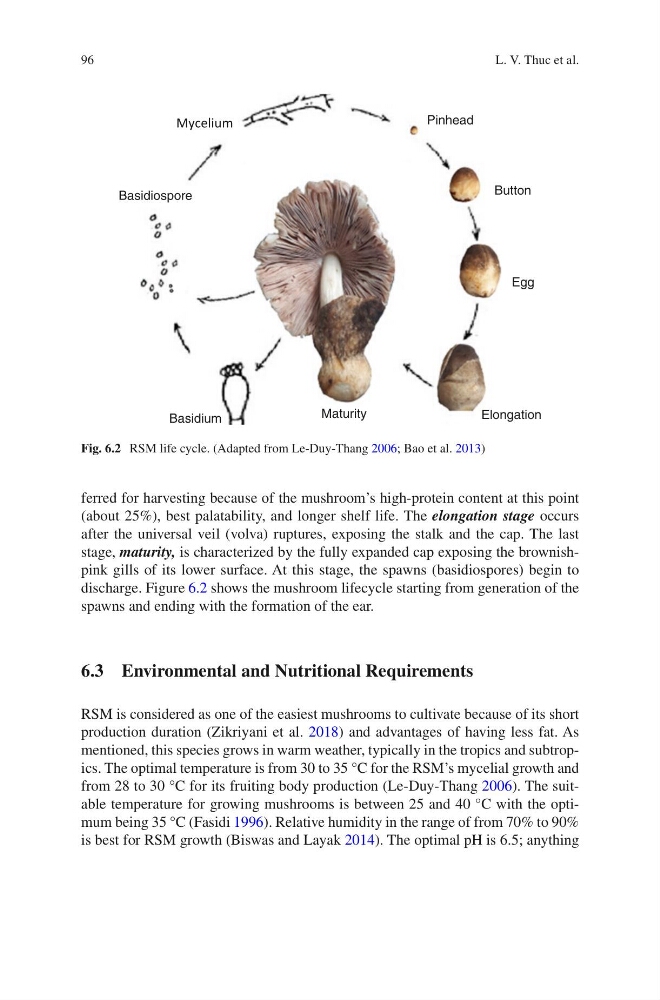
after the universal veil (volva) ruptures, exposing the stalk and the cap. The last
stage, maturity, is characterized by the fully expanded cap exposing the brownishpink gills of its lower surface. At this stage, the spawns (basidiospores) begin to
discharge. Figure 6.2 shows the mushroom lifecycle starting from generation of the
spawns and ending with the formation of the ear.
6.3 Environmental and Nutritional Requirements
RSM is considered as one of the easiest mushrooms to cultivate because of its short
production duration (Zikriyani et al. 2018) and advantages of having less fat. As
mentioned, this species grows in warm weather, typically in the tropics and subtropics. The optimal temperature is from 30 to 35 °C for the RSM’s mycelial growth and
from 28 to 30 °C for its fruiting body production (Le-Duy-Thang 2006). The suitable temperature for growing mushrooms is between 25 and 40 °C with the optimum being 35 °C (Fasidi 1996). Relative humidity in the range of from 70% to 90%
is best for RSM growth (Biswas and Layak 2014). The optimal pH is 6.5; anything
Mycelium
Basidiospore
Pinhead
Basidium
Elongation
Button
Egg
Maturity
Fig. 6.2 RSM life cycle. (Adapted from Le-Duy-Thang 2006; Bao et al. 2013)
L. V. Thuc et al.
ferred for harvesting because of the mushroom’s high-protein content at this point
(about 25%), best palatability, and longer shelf life. The elongation stage occurs
after the universal veil (volva) ruptures, exposing the stalk and the cap. The last
stage, maturity, is characterized by the fully expanded cap exposing the brownishpink gills of its lower surface. At this stage, the spawns (basidiospores) begin to
discharge. Figure 6.2 shows the mushroom lifecycle starting from generation of the
spawns and ending with the formation of the ear.
6.3 Environmental and Nutritional Requirements
RSM is considered as one of the easiest mushrooms to cultivate because of its short
production duration (Zikriyani et al. 2018) and advantages of having less fat. As
mentioned, this species grows in warm weather, typically in the tropics and subtropics. The optimal temperature is from 30 to 35 °C for the RSM’s mycelial growth and
from 28 to 30 °C for its fruiting body production (Le-Duy-Thang 2006). The suitable temperature for growing mushrooms is between 25 and 40 °C with the optimum being 35 °C (Fasidi 1996). Relative humidity in the range of from 70% to 90%
is best for RSM growth (Biswas and Layak 2014). The optimal pH is 6.5; anything
Mycelium
Basidiospore
Pinhead
Basidium
Elongation
Button
Egg
Maturity
Fig. 6.2 RSM life cycle. (Adapted from Le-Duy-Thang 2006; Bao et al. 2013)
L. V. Thuc et al.