

95
acid, and tannins that contribute to its high antioxidant properties (Hung and Nhi
2012). Other sources of antioxidants in RSM are catalase, superoxide dismutase,
glutathione peroxidase, peroxidase, glutathione-S-transferase, and glutathione
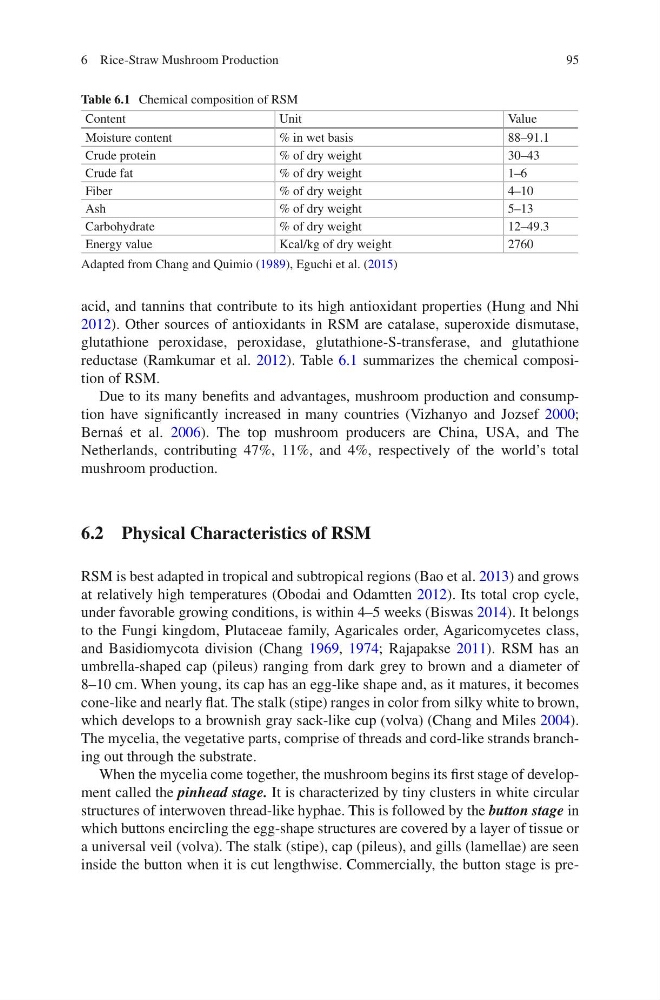
reductase (Ramkumar et al. 2012). Table 6.1 summarizes the chemical composition of RSM.
Due to its many benefits and advantages, mushroom production and consumption have significantly increased in many countries (Vizhanyo and Jozsef 2000;
Bernaś et al. 2006). The top mushroom producers are China, USA, and The
Netherlands, contributing 47%, 11%, and 4%, respectively of the world’s total
mushroom production.
6.2 Physical Characteristics of RSM
RSM is best adapted in tropical and subtropical regions (Bao et al. 2013) and grows
at relatively high temperatures (Obodai and Odamtten 2012). Its total crop cycle,
under favorable growing conditions, is within 4–5 weeks (Biswas 2014). It belongs
to the Fungi kingdom, Plutaceae family, Agaricales order, Agaricomycetes class,
and Basidiomycota division (Chang 1969, 1974; Rajapakse 2011). RSM has an
umbrella-shaped cap (pileus) ranging from dark grey to brown and a diameter of
8–10 cm. When young, its cap has an egg-like shape and, as it matures, it becomes
cone-like and nearly flat. The stalk (stipe) ranges in color from silky white to brown,
which develops to a brownish gray sack-like cup (volva) (Chang and Miles 2004).
The mycelia, the vegetative parts, comprise of threads and cord-like strands branching out through the substrate.
When the mycelia come together, the mushroom begins its first stage of development called the pinhead stage. It is characterized by tiny clusters in white circular
structures of interwoven thread-like hyphae. This is followed by the button stage in
which buttons encircling the egg-shape structures are covered by a layer of tissue or
a universal veil (volva). The stalk (stipe), cap (pileus), and gills (lamellae) are seen
inside the button when it is cut lengthwise. Commercially, the button stage is preTable 6.1 Chemical composition of RSM
Content
Unit
Value
Moisture content
% in wet basis
88–91.1
Crude protein
% of dry weight
30–43
Crude fat
% of dry weight
1–6
Fiber
% of dry weight
4–10
Ash
% of dry weight
5–13
Carbohydrate
% of dry weight
12–49.3
Energy value
Kcal/kg of dry weight
2760
Adapted from Chang and Quimio (1989), Eguchi et al. (2015)
6 Rice-Straw Mushroom Production
acid, and tannins that contribute to its high antioxidant properties (Hung and Nhi
2012). Other sources of antioxidants in RSM are catalase, superoxide dismutase,
glutathione peroxidase, peroxidase, glutathione-S-transferase, and glutathione
reductase (Ramkumar et al. 2012). Table 6.1 summarizes the chemical composition of RSM.
Due to its many benefits and advantages, mushroom production and consumption have significantly increased in many countries (Vizhanyo and Jozsef 2000;
Bernaś et al. 2006). The top mushroom producers are China, USA, and The
Netherlands, contributing 47%, 11%, and 4%, respectively of the world’s total
mushroom production.
6.2 Physical Characteristics of RSM
RSM is best adapted in tropical and subtropical regions (Bao et al. 2013) and grows
at relatively high temperatures (Obodai and Odamtten 2012). Its total crop cycle,
under favorable growing conditions, is within 4–5 weeks (Biswas 2014). It belongs
to the Fungi kingdom, Plutaceae family, Agaricales order, Agaricomycetes class,
and Basidiomycota division (Chang 1969, 1974; Rajapakse 2011). RSM has an
umbrella-shaped cap (pileus) ranging from dark grey to brown and a diameter of
8–10 cm. When young, its cap has an egg-like shape and, as it matures, it becomes
cone-like and nearly flat. The stalk (stipe) ranges in color from silky white to brown,
which develops to a brownish gray sack-like cup (volva) (Chang and Miles 2004).
The mycelia, the vegetative parts, comprise of threads and cord-like strands branching out through the substrate.
When the mycelia come together, the mushroom begins its first stage of development called the pinhead stage. It is characterized by tiny clusters in white circular
structures of interwoven thread-like hyphae. This is followed by the button stage in
which buttons encircling the egg-shape structures are covered by a layer of tissue or
a universal veil (volva). The stalk (stipe), cap (pileus), and gills (lamellae) are seen
inside the button when it is cut lengthwise. Commercially, the button stage is preTable 6.1 Chemical composition of RSM
Content
Unit
Value
Moisture content
% in wet basis
88–91.1
Crude protein
% of dry weight
30–43
Crude fat
% of dry weight
1–6
Fiber
% of dry weight
4–10
Ash
% of dry weight
5–13
Carbohydrate
% of dry weight
12–49.3
Energy value
Kcal/kg of dry weight
2760
Adapted from Chang and Quimio (1989), Eguchi et al. (2015)
6 Rice-Straw Mushroom Production