

Since each M&E approach can be implemented in a variety of ways, the descriptions are based on a general application and cannot take every possible variation
into account. Corresponding to its nature as decision support tool, the Adaptation
M&E Navigator has to maintain a balance between level of detail and concise, easy
to grasp information. Hence, it cannot provide comprehensive detail on how to
carry out any of the listed M&E approaches. For the latter purpose the template
includes links to practical examples, guidance and further resources that users can
refer to. Thus, the Adaptation M&E Navigator equips decision makers and their
technical advisors with an overview of relevant approaches and information to
support the selection of an M&E approach.
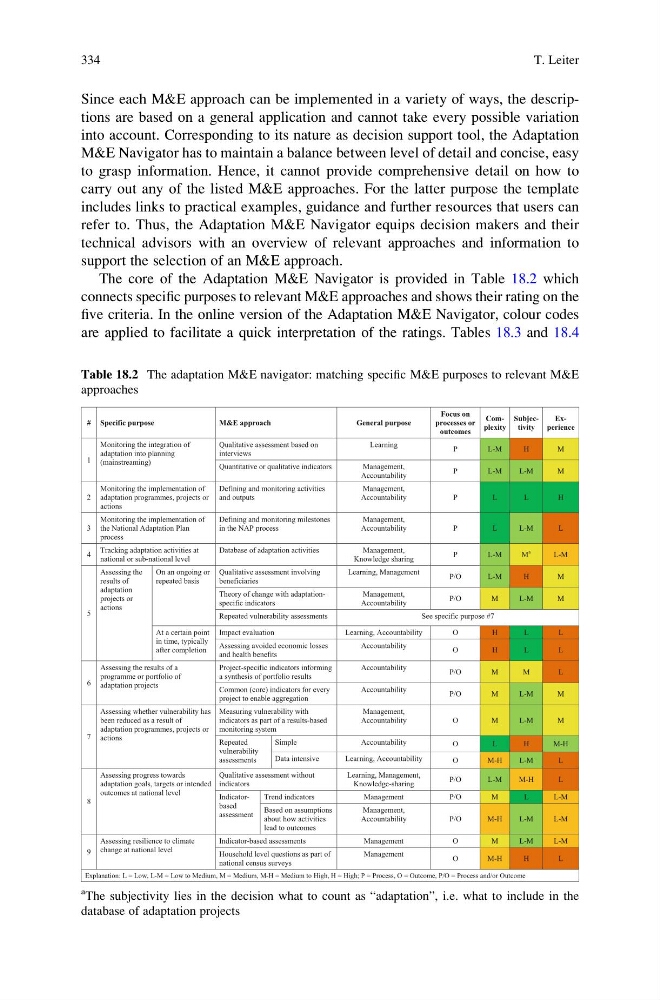
The core of the Adaptation M&E Navigator is provided in Table 18.2 which
connects specific purposes to relevant M&E approaches and shows their rating on the
five criteria. In the online version of the Adaptation M&E Navigator, colour codes
are applied to facilitate a quick interpretation of the ratings. Tables 18.3 and 18.4
Table 18.2 The adaptation M&E navigator: matching specific M&E purposes to relevant M&E
approaches
# Specific purpose
M&E approach
General purpose
Focus on
processes or
outcomes
Complexity
Subjectivity
Experience
1
Monitoring the integration of
adaptation into planning
(mainstreaming)
Qualitative assessment based on
interviews
Learning
P
L-M
H
M
Quantitative or qualitative indicators
Management,
Accountability
P
L-M
L-M
M
2
Monitoring the implementation of
adaptation programmes, projects or
actions
Defining and monitoring activities
and outputs
Management,
Accountability
P
L
L
H
3
Monitoring the implementation of
the National Adaptation Plan
process
Defining and monitoring milestones
in the NAP process
Management,
Accountability
P
L
L-M
L
4
Tracking adaptation activities at
national or sub-national level
Database of adaptation activities
Management,
Knowledge sharing
P
L-M
M a
L-M
5
Assessing the
results of
adaptation
projects or
actions
On an ongoing or
repeated basis
Qualitative assessment involving
beneficiaries
Learning, Management
P/O
L-M
H
M
Theory of change with adaptationspecific indicators
Management,
Accountability
P/O
M
L-M
M
Repeated vulnerability assessments
See specific purpose #7
At a certain point
in time, typically
after completion
Impact evaluation
Learning, Accountability
O
H
L
L
Assessing avoided economic losses
and health benefits
Accountability
O
H
L
L
6
Assessing the results of a
programme or portfolio of
adaptation projects
Project-specific indicators informing
a synthesis of portfolio results
Accountability
P/O
M
M
L
Common (core) indicators for every
project to enable aggregation
Accountability
P/O
M
L-M
M
7
Assessing whether vulnerability has
been reduced as a result of
adaptation programmes, projects or
actions
Measuring vulnerability with
indicators as part of a results-based
monitoring system
Management,
Accountability
O
M
L-M
M
Repeated
vulnerability
assessments
Simple
Accountability
O
L
H
M-H
Data intensive
Learning, Accountability
O
M-H
L-M
L
8
Assessing progress towards
adaptation goals, targets or intended
outcomes at national level
Qualitative assessment without
indicators
Learning, Management,
Knowledge-sharing
P/O
L-M
M-H
L
Indicatorbased
assessment
Trend indicators
Management
P/O
M
L
L-M
Based on assumptions
about how activities
lead to outcomes
Management,
Accountability
P/O
M-H
L-M
L-M
9
Assessing resilience to climate
change at national level
Indicator-based assessments
Management
O
M
L-M
L-M
Household level questions as part of
national census surveys
Management
O
M-H
H
L
Explanation: L = Low, L-M = Low to Medium, M = Medium, M-H = Medium to High, H = High; P = Process, O = Outcome, P/O = Process and/or Outcome
a
The subjectivity lies in the decision what to count as “adaptation”, i.e. what to include in the
database of adaptation projects
334
T. Leiter
into account. Corresponding to its nature as decision support tool, the Adaptation
M&E Navigator has to maintain a balance between level of detail and concise, easy
to grasp information. Hence, it cannot provide comprehensive detail on how to
carry out any of the listed M&E approaches. For the latter purpose the template
includes links to practical examples, guidance and further resources that users can
refer to. Thus, the Adaptation M&E Navigator equips decision makers and their
technical advisors with an overview of relevant approaches and information to
support the selection of an M&E approach.
The core of the Adaptation M&E Navigator is provided in Table 18.2 which
connects specific purposes to relevant M&E approaches and shows their rating on the
five criteria. In the online version of the Adaptation M&E Navigator, colour codes
are applied to facilitate a quick interpretation of the ratings. Tables 18.3 and 18.4
Table 18.2 The adaptation M&E navigator: matching specific M&E purposes to relevant M&E
approaches
# Specific purpose
M&E approach
General purpose
Focus on
processes or
outcomes
Complexity
Subjectivity
Experience
1
Monitoring the integration of
adaptation into planning
(mainstreaming)
Qualitative assessment based on
interviews
Learning
P
L-M
H
M
Quantitative or qualitative indicators
Management,
Accountability
P
L-M
L-M
M
2
Monitoring the implementation of
adaptation programmes, projects or
actions
Defining and monitoring activities
and outputs
Management,
Accountability
P
L
L
H
3
Monitoring the implementation of
the National Adaptation Plan
process
Defining and monitoring milestones
in the NAP process
Management,
Accountability
P
L
L-M
L
4
Tracking adaptation activities at
national or sub-national level
Database of adaptation activities
Management,
Knowledge sharing
P
L-M
M a
L-M
5
Assessing the
results of
adaptation
projects or
actions
On an ongoing or
repeated basis
Qualitative assessment involving
beneficiaries
Learning, Management
P/O
L-M
H
M
Theory of change with adaptationspecific indicators
Management,
Accountability
P/O
M
L-M
M
Repeated vulnerability assessments
See specific purpose #7
At a certain point
in time, typically
after completion
Impact evaluation
Learning, Accountability
O
H
L
L
Assessing avoided economic losses
and health benefits
Accountability
O
H
L
L
6
Assessing the results of a
programme or portfolio of
adaptation projects
Project-specific indicators informing
a synthesis of portfolio results
Accountability
P/O
M
M
L
Common (core) indicators for every
project to enable aggregation
Accountability
P/O
M
L-M
M
7
Assessing whether vulnerability has
been reduced as a result of
adaptation programmes, projects or
actions
Measuring vulnerability with
indicators as part of a results-based
monitoring system
Management,
Accountability
O
M
L-M
M
Repeated
vulnerability
assessments
Simple
Accountability
O
L
H
M-H
Data intensive
Learning, Accountability
O
M-H
L-M
L
8
Assessing progress towards
adaptation goals, targets or intended
outcomes at national level
Qualitative assessment without
indicators
Learning, Management,
Knowledge-sharing
P/O
L-M
M-H
L
Indicatorbased
assessment
Trend indicators
Management
P/O
M
L
L-M
Based on assumptions
about how activities
lead to outcomes
Management,
Accountability
P/O
M-H
L-M
L-M
9
Assessing resilience to climate
change at national level
Indicator-based assessments
Management
O
M
L-M
L-M
Household level questions as part of
national census surveys
Management
O
M-H
H
L
Explanation: L = Low, L-M = Low to Medium, M = Medium, M-H = Medium to High, H = High; P = Process, O = Outcome, P/O = Process and/or Outcome
a
The subjectivity lies in the decision what to count as “adaptation”, i.e. what to include in the
database of adaptation projects
334
T. Leiter