

In addition to the five criteria, the Adaptation M&E Navigator provides further
details for every M&E approach according to a template illustrated in Tables 18.3
and 18.4. The template provides information on the required human and financial
resources to implement an M&E approach as well as on benefits and limitations.
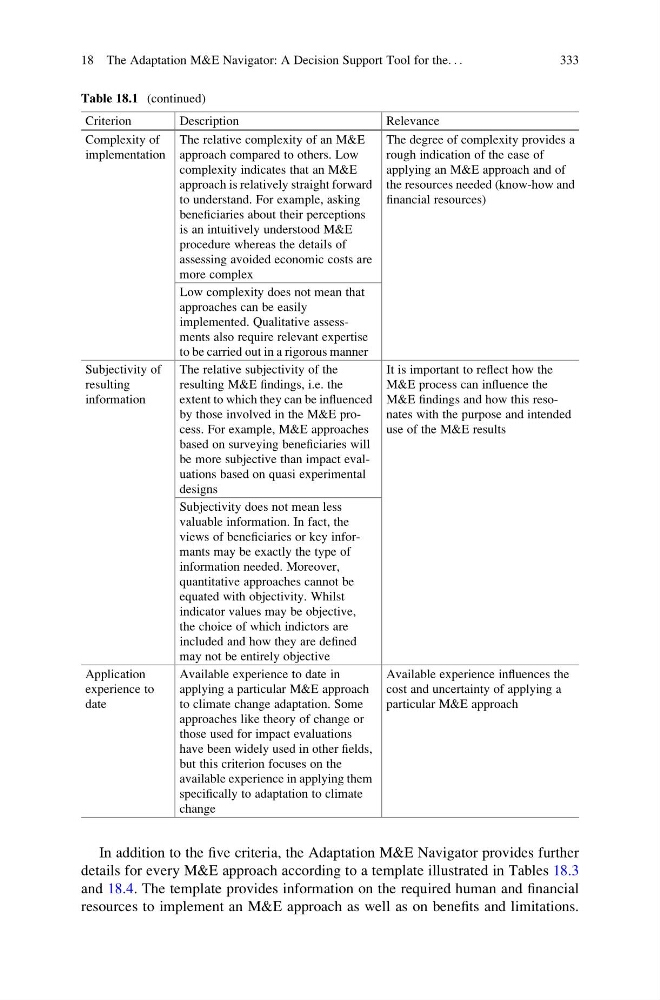
Table 18.1 (continued)
Criterion
Description
Relevance
Complexity of
implementation
The relative complexity of an M&E
approach compared to others. Low
complexity indicates that an M&E
approach is relatively straight forward
to understand. For example, asking
beneficiaries about their perceptions
is an intuitively understood M&E
procedure whereas the details of
assessing avoided economic costs are
more complex
The degree of complexity provides a
rough indication of the ease of
applying an M&E approach and of
the resources needed (know-how and
financial resources)
Low complexity does not mean that
approaches can be easily
implemented. Qualitative assessments also require relevant expertise
to be carried out in a rigorous manner
Subjectivity of
resulting
information
The relative subjectivity of the
resulting M&E findings, i.e. the
extent to which they can be influenced
by those involved in the M&E process. For example, M&E approaches
based on surveying beneficiaries will
be more subjective than impact evaluations based on quasi experimental
designs
It is important to reflect how the
M&E process can influence the
M&E findings and how this resonates with the purpose and intended
use of the M&E results
Subjectivity does not mean less
valuable information. In fact, the
views of beneficiaries or key informants may be exactly the type of
information needed. Moreover,
quantitative approaches cannot be
equated with objectivity. Whilst
indicator values may be objective,
the choice of which indictors are
included and how they are defined
may not be entirely objective
Application
experience to
date
Available experience to date in
applying a particular M&E approach
to climate change adaptation. Some
approaches like theory of change or
those used for impact evaluations
have been widely used in other fields,
but this criterion focuses on the
available experience in applying them
specifically to adaptation to climate
change
Available experience influences the
cost and uncertainty of applying a
particular M&E approach
18 The Adaptation M&E Navigator: A Decision Support Tool for the. . .
333
details for every M&E approach according to a template illustrated in Tables 18.3
and 18.4. The template provides information on the required human and financial
resources to implement an M&E approach as well as on benefits and limitations.
Table 18.1 (continued)
Criterion
Description
Relevance
Complexity of
implementation
The relative complexity of an M&E
approach compared to others. Low
complexity indicates that an M&E
approach is relatively straight forward
to understand. For example, asking
beneficiaries about their perceptions
is an intuitively understood M&E
procedure whereas the details of
assessing avoided economic costs are
more complex
The degree of complexity provides a
rough indication of the ease of
applying an M&E approach and of
the resources needed (know-how and
financial resources)
Low complexity does not mean that
approaches can be easily
implemented. Qualitative assessments also require relevant expertise
to be carried out in a rigorous manner
Subjectivity of
resulting
information
The relative subjectivity of the
resulting M&E findings, i.e. the
extent to which they can be influenced
by those involved in the M&E process. For example, M&E approaches
based on surveying beneficiaries will
be more subjective than impact evaluations based on quasi experimental
designs
It is important to reflect how the
M&E process can influence the
M&E findings and how this resonates with the purpose and intended
use of the M&E results
Subjectivity does not mean less
valuable information. In fact, the
views of beneficiaries or key informants may be exactly the type of
information needed. Moreover,
quantitative approaches cannot be
equated with objectivity. Whilst
indicator values may be objective,
the choice of which indictors are
included and how they are defined
may not be entirely objective
Application
experience to
date
Available experience to date in
applying a particular M&E approach
to climate change adaptation. Some
approaches like theory of change or
those used for impact evaluations
have been widely used in other fields,
but this criterion focuses on the
available experience in applying them
specifically to adaptation to climate
change
Available experience influences the
cost and uncertainty of applying a
particular M&E approach
18 The Adaptation M&E Navigator: A Decision Support Tool for the. . .
333