

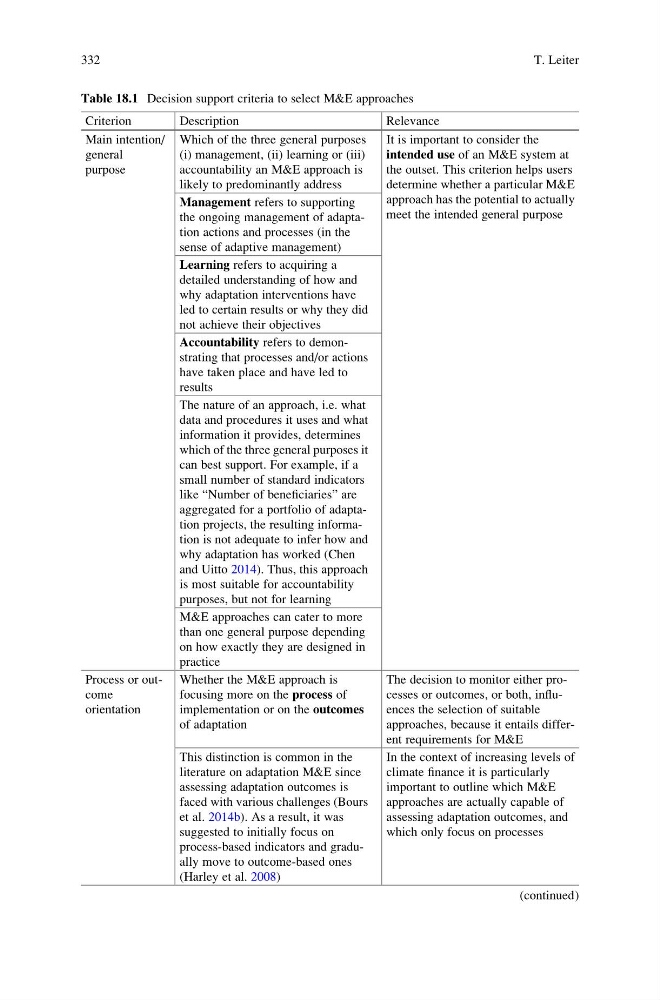
Table 18.1 Decision support criteria to select M&E approaches
Criterion
Description
Relevance
Main intention/
general
purpose
Which of the three general purposes
(i) management, (ii) learning or (iii)
accountability an M&E approach is
likely to predominantly address
It is important to consider the
intended use of an M&E system at
the outset. This criterion helps users
determine whether a particular M&E
approach has the potential to actually
meet the intended general purpose
Management refers to supporting
the ongoing management of adaptation actions and processes (in the
sense of adaptive management)
Learning refers to acquiring a
detailed understanding of how and
why adaptation interventions have
led to certain results or why they did
not achieve their objectives
Accountability refers to demonstrating that processes and/or actions
have taken place and have led to
results
The nature of an approach, i.e. what
data and procedures it uses and what
information it provides, determines
which of the three general purposes it
can best support. For example, if a
small number of standard indicators
like “Number of beneficiaries” are
aggregated for a portfolio of adaptation projects, the resulting information is not adequate to infer how and
why adaptation has worked (Chen
and Uitto 2014). Thus, this approach
is most suitable for accountability
purposes, but not for learning
M&E approaches can cater to more
than one general purpose depending
on how exactly they are designed in
practice
Process or outcome
orientation
Whether the M&E approach is
focusing more on the process of
implementation or on the outcomes
of adaptation
The decision to monitor either processes or outcomes, or both, influences the selection of suitable
approaches, because it entails different requirements for M&E
In the context of increasing levels of
climate finance it is particularly
important to outline which M&E
approaches are actually capable of
assessing adaptation outcomes, and
which only focus on processes
This distinction is common in the
literature on adaptation M&E since
assessing adaptation outcomes is
faced with various challenges (Bours
et al. 2014b). As a result, it was
suggested to initially focus on
process-based indicators and gradually move to outcome-based ones
(Harley et al. 2008)
(continued)
332
T. Leiter
Criterion
Description
Relevance
Main intention/
general
purpose
Which of the three general purposes
(i) management, (ii) learning or (iii)
accountability an M&E approach is
likely to predominantly address
It is important to consider the
intended use of an M&E system at
the outset. This criterion helps users
determine whether a particular M&E
approach has the potential to actually
meet the intended general purpose
Management refers to supporting
the ongoing management of adaptation actions and processes (in the
sense of adaptive management)
Learning refers to acquiring a
detailed understanding of how and
why adaptation interventions have
led to certain results or why they did
not achieve their objectives
Accountability refers to demonstrating that processes and/or actions
have taken place and have led to
results
The nature of an approach, i.e. what
data and procedures it uses and what
information it provides, determines
which of the three general purposes it
can best support. For example, if a
small number of standard indicators
like “Number of beneficiaries” are
aggregated for a portfolio of adaptation projects, the resulting information is not adequate to infer how and
why adaptation has worked (Chen
and Uitto 2014). Thus, this approach
is most suitable for accountability
purposes, but not for learning
M&E approaches can cater to more
than one general purpose depending
on how exactly they are designed in
practice
Process or outcome
orientation
Whether the M&E approach is
focusing more on the process of
implementation or on the outcomes
of adaptation
The decision to monitor either processes or outcomes, or both, influences the selection of suitable
approaches, because it entails different requirements for M&E
In the context of increasing levels of
climate finance it is particularly
important to outline which M&E
approaches are actually capable of
assessing adaptation outcomes, and
which only focus on processes
This distinction is common in the
literature on adaptation M&E since
assessing adaptation outcomes is
faced with various challenges (Bours
et al. 2014b). As a result, it was
suggested to initially focus on
process-based indicators and gradually move to outcome-based ones
(Harley et al. 2008)
(continued)
332
T. Leiter