

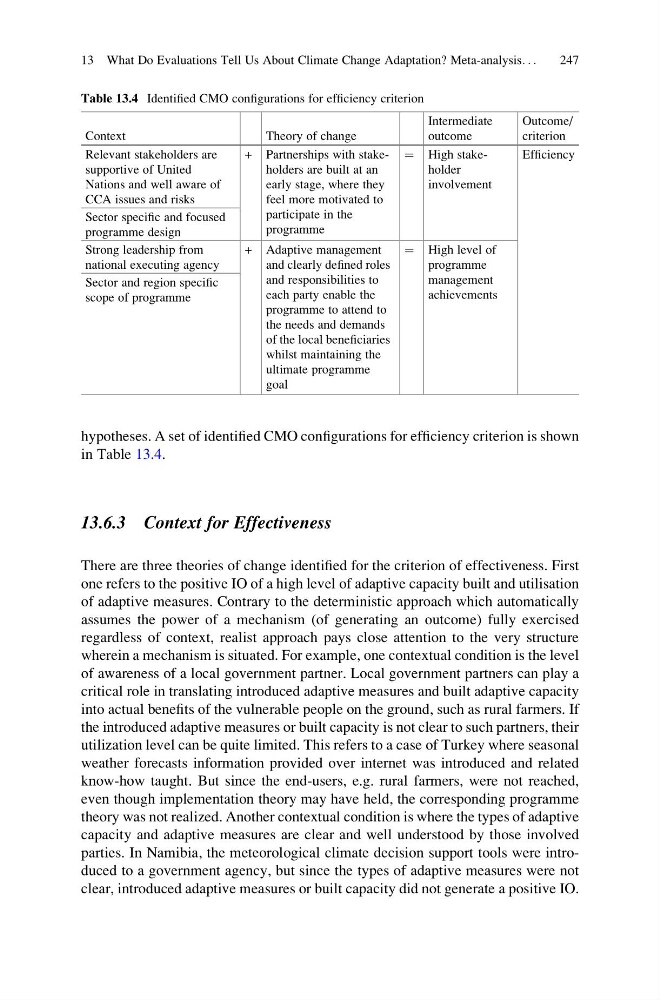
hypotheses. A set of identified CMO configurations for efficiency criterion is shown
in Table 13.4.
13.6.3 Context for Effectiveness
There are three theories of change identified for the criterion of effectiveness. First
one refers to the positive IO of a high level of adaptive capacity built and utilisation
of adaptive measures. Contrary to the deterministic approach which automatically
assumes the power of a mechanism (of generating an outcome) fully exercised
regardless of context, realist approach pays close attention to the very structure
wherein a mechanism is situated. For example, one contextual condition is the level
of awareness of a local government partner. Local government partners can play a
critical role in translating introduced adaptive measures and built adaptive capacity
into actual benefits of the vulnerable people on the ground, such as rural farmers. If
the introduced adaptive measures or built capacity is not clear to such partners, their
utilization level can be quite limited. This refers to a case of Turkey where seasonal
weather forecasts information provided over internet was introduced and related
know-how taught. But since the end-users, e.g. rural farmers, were not reached,
even though implementation theory may have held, the corresponding programme
theory was not realized. Another contextual condition is where the types of adaptive
capacity and adaptive measures are clear and well understood by those involved
parties. In Namibia, the meteorological climate decision support tools were introduced to a government agency, but since the types of adaptive measures were not
clear, introduced adaptive measures or built capacity did not generate a positive IO.
Table 13.4 Identified CMO configurations for efficiency criterion
Context
Theory of change
Intermediate
outcome
Outcome/
criterion
Relevant stakeholders are
supportive of United
Nations and well aware of
CCA issues and risks
+ Partnerships with stakeholders are built at an
early stage, where they
feel more motivated to
participate in the
programme
¼ High stakeholder
involvement
Efficiency
Sector specific and focused
programme design
Strong leadership from
national executing agency
+ Adaptive management
and clearly defined roles
and responsibilities to
each party enable the
programme to attend to
the needs and demands
of the local beneficiaries
whilst maintaining the
ultimate programme
goal
¼ High level of
programme
management
achievements
Sector and region specific
scope of programme
13 What Do Evaluations Tell Us About Climate Change Adaptation? Meta-analysis. . .
247
in Table 13.4.
13.6.3 Context for Effectiveness
There are three theories of change identified for the criterion of effectiveness. First
one refers to the positive IO of a high level of adaptive capacity built and utilisation
of adaptive measures. Contrary to the deterministic approach which automatically
assumes the power of a mechanism (of generating an outcome) fully exercised
regardless of context, realist approach pays close attention to the very structure
wherein a mechanism is situated. For example, one contextual condition is the level
of awareness of a local government partner. Local government partners can play a
critical role in translating introduced adaptive measures and built adaptive capacity
into actual benefits of the vulnerable people on the ground, such as rural farmers. If
the introduced adaptive measures or built capacity is not clear to such partners, their
utilization level can be quite limited. This refers to a case of Turkey where seasonal
weather forecasts information provided over internet was introduced and related
know-how taught. But since the end-users, e.g. rural farmers, were not reached,
even though implementation theory may have held, the corresponding programme
theory was not realized. Another contextual condition is where the types of adaptive
capacity and adaptive measures are clear and well understood by those involved
parties. In Namibia, the meteorological climate decision support tools were introduced to a government agency, but since the types of adaptive measures were not
clear, introduced adaptive measures or built capacity did not generate a positive IO.
Table 13.4 Identified CMO configurations for efficiency criterion
Context
Theory of change
Intermediate
outcome
Outcome/
criterion
Relevant stakeholders are
supportive of United
Nations and well aware of
CCA issues and risks
+ Partnerships with stakeholders are built at an
early stage, where they
feel more motivated to
participate in the
programme
¼ High stakeholder
involvement
Efficiency
Sector specific and focused
programme design
Strong leadership from
national executing agency
+ Adaptive management
and clearly defined roles
and responsibilities to
each party enable the
programme to attend to
the needs and demands
of the local beneficiaries
whilst maintaining the
ultimate programme
goal
¼ High level of
programme
management
achievements
Sector and region specific
scope of programme
13 What Do Evaluations Tell Us About Climate Change Adaptation? Meta-analysis. . .
247