

To assess the avoided emissions of the PSH it is necessary to assess what would
have been the additional GHG emissions to reach the same indoor temperature in
non PSH. For that, an OLS regression model is developed to assess the relation
between the indoor temperature and the GHG emission considering a similar
outdoor temperature between non PSH and PSH. For the purpose of this study a
simplified model is developed linking the GHG emission and the outdoor temperature to the indoor temperature (Fig. 10.5).
Based on the model developed the avoided emission from the PSH technology if
the non PSH household were reaching the same indoor temperature as well as the
total climate change mitigation impact are calculated for the whole winter season
and presented in the Table 10.5.
The difference between the emission reduction and the avoided emission is
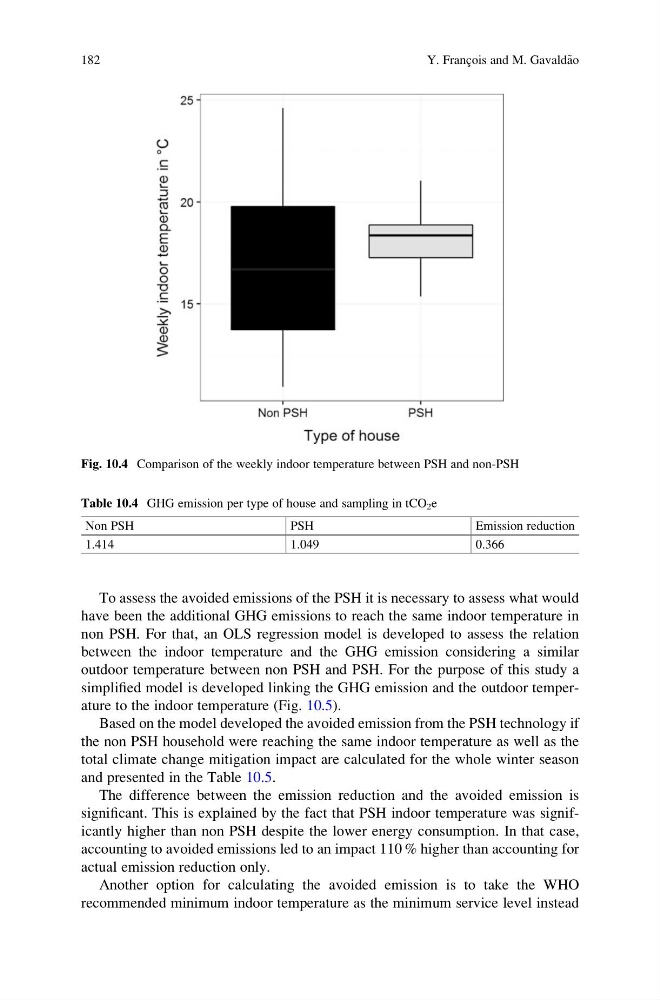
significant. This is explained by the fact that PSH indoor temperature was significantly higher than non PSH despite the lower energy consumption. In that case,
accounting to avoided emissions led to an impact 110 % higher than accounting for
actual emission reduction only.
Another option for calculating the avoided emission is to take the WHO
recommended minimum indoor temperature as the minimum service level instead
Fig. 10.4 Comparison of the weekly indoor temperature between PSH and non-PSH
Table 10.4 GHG emission per type of house and sampling in tCO 2 e
Non PSH
PSH
Emission reduction
1.414
1.049
0.366
182
Y. Franc ¸ois and M. Gavald~ ao
have been the additional GHG emissions to reach the same indoor temperature in
non PSH. For that, an OLS regression model is developed to assess the relation
between the indoor temperature and the GHG emission considering a similar
outdoor temperature between non PSH and PSH. For the purpose of this study a
simplified model is developed linking the GHG emission and the outdoor temperature to the indoor temperature (Fig. 10.5).
Based on the model developed the avoided emission from the PSH technology if
the non PSH household were reaching the same indoor temperature as well as the
total climate change mitigation impact are calculated for the whole winter season
and presented in the Table 10.5.
The difference between the emission reduction and the avoided emission is
significant. This is explained by the fact that PSH indoor temperature was significantly higher than non PSH despite the lower energy consumption. In that case,
accounting to avoided emissions led to an impact 110 % higher than accounting for
actual emission reduction only.
Another option for calculating the avoided emission is to take the WHO
recommended minimum indoor temperature as the minimum service level instead
Fig. 10.4 Comparison of the weekly indoor temperature between PSH and non-PSH
Table 10.4 GHG emission per type of house and sampling in tCO 2 e
Non PSH
PSH
Emission reduction
1.414
1.049
0.366
182
Y. Franc ¸ois and M. Gavald~ ao