

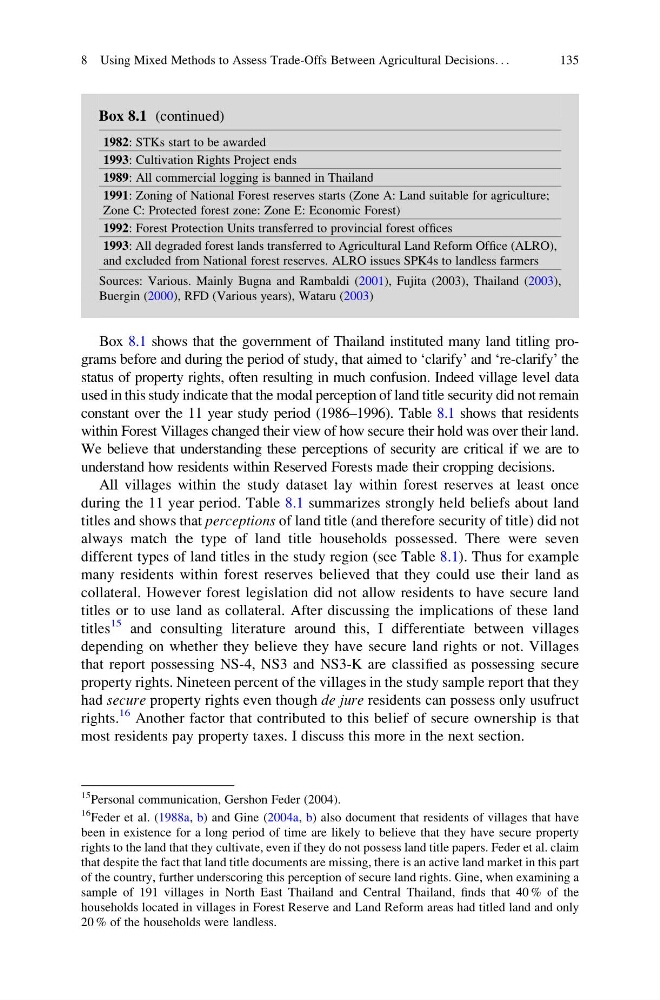
Box 8.1 (continued)
1982: STKs start to be awarded
1993: Cultivation Rights Project ends
1989: All commercial logging is banned in Thailand
1991: Zoning of National Forest reserves starts (Zone A: Land suitable for agriculture;
Zone C: Protected forest zone: Zone E: Economic Forest)
1992: Forest Protection Units transferred to provincial forest offices
1993: All degraded forest lands transferred to Agricultural Land Reform Office (ALRO),
and excluded from National forest reserves. ALRO issues SPK4s to landless farmers
Sources: Various. Mainly Bugna and Rambaldi (2001), Fujita (2003), Thailand (2003),
Buergin (2000), RFD (Various years), Wataru (2003)
Box 8.1 shows that the government of Thailand instituted many land titling programs before and during the period of study, that aimed to ‘clarify’ and ‘re-clarify’ the
status of property rights, often resulting in much confusion. Indeed village level data
used in this study indicate that the modal perception of land title security did not remain
constant over the 11 year study period (1986–1996). Table 8.1 shows that residents
within Forest Villages changed their view of how secure their hold was over their land.
We believe that understanding these perceptions of security are critical if we are to
understand how residents within Reserved Forests made their cropping decisions.
All villages within the study dataset lay within forest reserves at least once
during the 11 year period. Table 8.1 summarizes strongly held beliefs about land
titles and shows that perceptions of land title (and therefore security of title) did not
always match the type of land title households possessed. There were seven
different types of land titles in the study region (see Table 8.1). Thus for example
many residents within forest reserves believed that they could use their land as
collateral. However forest legislation did not allow residents to have secure land
titles or to use land as collateral. After discussing the implications of these land
titles
15 and consulting literature around this, I differentiate between villages
depending on whether they believe they have secure land rights or not. Villages
that report possessing NS-4, NS3 and NS3-K are classified as possessing secure
property rights. Nineteen percent of the villages in the study sample report that they
had secure property rights even though de jure residents can possess only usufruct
rights.
16 Another factor that contributed to this belief of secure ownership is that
most residents pay property taxes. I discuss this more in the next section.
15 Personal communication, Gershon Feder (2004).
16 Feder et al. (1988a, b) and Gine (2004a, b) also document that residents of villages that have
been in existence for a long period of time are likely to believe that they have secure property
rights to the land that they cultivate, even if they do not possess land title papers. Feder et al. claim
that despite the fact that land title documents are missing, there is an active land market in this part
of the country, further underscoring this perception of secure land rights. Gine, when examining a
sample of 191 villages in North East Thailand and Central Thailand, finds that 40 % of the
households located in villages in Forest Reserve and Land Reform areas had titled land and only
20 % of the households were landless.
8 Using Mixed Methods to Assess Trade-Offs Between Agricultural Decisions. . .
135
1982: STKs start to be awarded
1993: Cultivation Rights Project ends
1989: All commercial logging is banned in Thailand
1991: Zoning of National Forest reserves starts (Zone A: Land suitable for agriculture;
Zone C: Protected forest zone: Zone E: Economic Forest)
1992: Forest Protection Units transferred to provincial forest offices
1993: All degraded forest lands transferred to Agricultural Land Reform Office (ALRO),
and excluded from National forest reserves. ALRO issues SPK4s to landless farmers
Sources: Various. Mainly Bugna and Rambaldi (2001), Fujita (2003), Thailand (2003),
Buergin (2000), RFD (Various years), Wataru (2003)
Box 8.1 shows that the government of Thailand instituted many land titling programs before and during the period of study, that aimed to ‘clarify’ and ‘re-clarify’ the
status of property rights, often resulting in much confusion. Indeed village level data
used in this study indicate that the modal perception of land title security did not remain
constant over the 11 year study period (1986–1996). Table 8.1 shows that residents
within Forest Villages changed their view of how secure their hold was over their land.
We believe that understanding these perceptions of security are critical if we are to
understand how residents within Reserved Forests made their cropping decisions.
All villages within the study dataset lay within forest reserves at least once
during the 11 year period. Table 8.1 summarizes strongly held beliefs about land
titles and shows that perceptions of land title (and therefore security of title) did not
always match the type of land title households possessed. There were seven
different types of land titles in the study region (see Table 8.1). Thus for example
many residents within forest reserves believed that they could use their land as
collateral. However forest legislation did not allow residents to have secure land
titles or to use land as collateral. After discussing the implications of these land
titles
15 and consulting literature around this, I differentiate between villages
depending on whether they believe they have secure land rights or not. Villages
that report possessing NS-4, NS3 and NS3-K are classified as possessing secure
property rights. Nineteen percent of the villages in the study sample report that they
had secure property rights even though de jure residents can possess only usufruct
rights.
16 Another factor that contributed to this belief of secure ownership is that
most residents pay property taxes. I discuss this more in the next section.
15 Personal communication, Gershon Feder (2004).
16 Feder et al. (1988a, b) and Gine (2004a, b) also document that residents of villages that have
been in existence for a long period of time are likely to believe that they have secure property
rights to the land that they cultivate, even if they do not possess land title papers. Feder et al. claim
that despite the fact that land title documents are missing, there is an active land market in this part
of the country, further underscoring this perception of secure land rights. Gine, when examining a
sample of 191 villages in North East Thailand and Central Thailand, finds that 40 % of the
households located in villages in Forest Reserve and Land Reform areas had titled land and only
20 % of the households were landless.
8 Using Mixed Methods to Assess Trade-Offs Between Agricultural Decisions. . .
135