

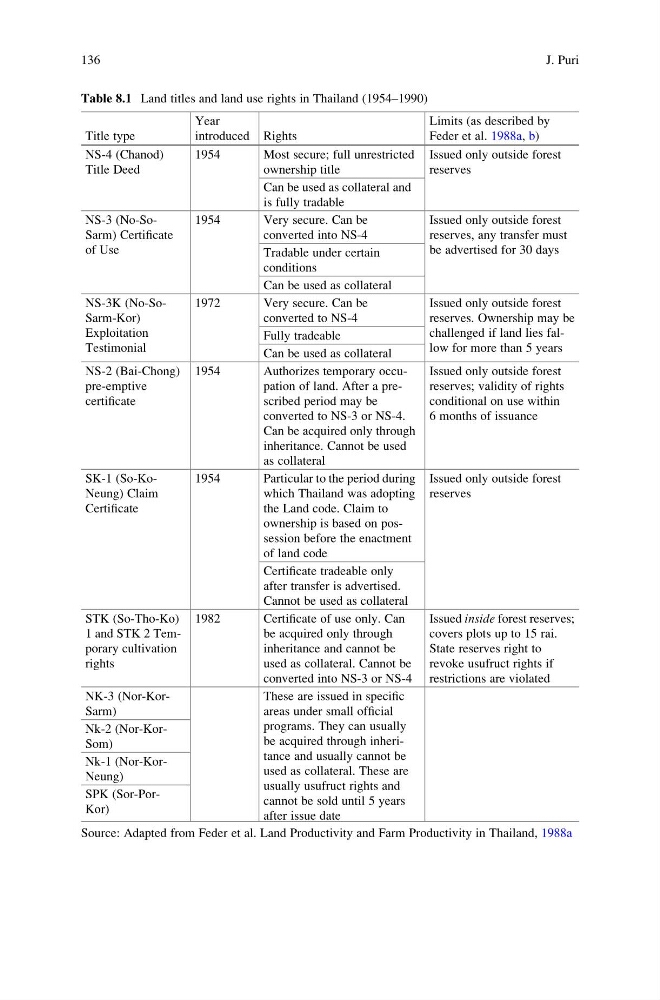
Table 8.1 Land titles and land use rights in Thailand (1954–1990)
Title type
Year
introduced Rights
Limits (as described by
Feder et al. 1988a, b)
NS-4 (Chanod)
Title Deed
1954
Most secure; full unrestricted
ownership title
Issued only outside forest
reserves
Can be used as collateral and
is fully tradable
NS-3 (No-SoSarm) Certificate
of Use
1954
Very secure. Can be
converted into NS-4
Issued only outside forest
reserves, any transfer must
be advertised for 30 days
Tradable under certain
conditions
Can be used as collateral
NS-3K (No-SoSarm-Kor)
Exploitation
Testimonial
1972
Very secure. Can be
converted to NS-4
Issued only outside forest
reserves. Ownership may be
challenged if land lies fallow for more than 5 years
Fully tradeable
Can be used as collateral
NS-2 (Bai-Chong)
pre-emptive
certificate
1954
Authorizes temporary occupation of land. After a prescribed period may be
converted to NS-3 or NS-4.
Can be acquired only through
inheritance. Cannot be used
as collateral
Issued only outside forest
reserves; validity of rights
conditional on use within
6 months of issuance
SK-1 (So-KoNeung) Claim
Certificate
1954
Particular to the period during
which Thailand was adopting
the Land code. Claim to
ownership is based on possession before the enactment
of land code
Issued only outside forest
reserves
Certificate tradeable only
after transfer is advertised.
Cannot be used as collateral
STK (So-Tho-Ko)
1 and STK 2 Temporary cultivation
rights
1982
Certificate of use only. Can
be acquired only through
inheritance and cannot be
used as collateral. Cannot be
converted into NS-3 or NS-4
Issued inside forest reserves;
covers plots up to 15 rai.
State reserves right to
revoke usufruct rights if
restrictions are violated
NK-3 (Nor-KorSarm)
These are issued in specific
areas under small official
programs. They can usually
be acquired through inheritance and usually cannot be
used as collateral. These are
usually usufruct rights and
cannot be sold until 5 years
after issue date
Nk-2 (Nor-KorSom)
Nk-1 (Nor-KorNeung)
SPK (Sor-PorKor)
Source: Adapted from Feder et al. Land Productivity and Farm Productivity in Thailand, 1988a
136
J. Puri
Title type
Year
introduced Rights
Limits (as described by
Feder et al. 1988a, b)
NS-4 (Chanod)
Title Deed
1954
Most secure; full unrestricted
ownership title
Issued only outside forest
reserves
Can be used as collateral and
is fully tradable
NS-3 (No-SoSarm) Certificate
of Use
1954
Very secure. Can be
converted into NS-4
Issued only outside forest
reserves, any transfer must
be advertised for 30 days
Tradable under certain
conditions
Can be used as collateral
NS-3K (No-SoSarm-Kor)
Exploitation
Testimonial
1972
Very secure. Can be
converted to NS-4
Issued only outside forest
reserves. Ownership may be
challenged if land lies fallow for more than 5 years
Fully tradeable
Can be used as collateral
NS-2 (Bai-Chong)
pre-emptive
certificate
1954
Authorizes temporary occupation of land. After a prescribed period may be
converted to NS-3 or NS-4.
Can be acquired only through
inheritance. Cannot be used
as collateral
Issued only outside forest
reserves; validity of rights
conditional on use within
6 months of issuance
SK-1 (So-KoNeung) Claim
Certificate
1954
Particular to the period during
which Thailand was adopting
the Land code. Claim to
ownership is based on possession before the enactment
of land code
Issued only outside forest
reserves
Certificate tradeable only
after transfer is advertised.
Cannot be used as collateral
STK (So-Tho-Ko)
1 and STK 2 Temporary cultivation
rights
1982
Certificate of use only. Can
be acquired only through
inheritance and cannot be
used as collateral. Cannot be
converted into NS-3 or NS-4
Issued inside forest reserves;
covers plots up to 15 rai.
State reserves right to
revoke usufruct rights if
restrictions are violated
NK-3 (Nor-KorSarm)
These are issued in specific
areas under small official
programs. They can usually
be acquired through inheritance and usually cannot be
used as collateral. These are
usually usufruct rights and
cannot be sold until 5 years
after issue date
Nk-2 (Nor-KorSom)
Nk-1 (Nor-KorNeung)
SPK (Sor-PorKor)
Source: Adapted from Feder et al. Land Productivity and Farm Productivity in Thailand, 1988a
136
J. Puri