

these changes have contributed to ambiguity about land rights for ethnic tribes
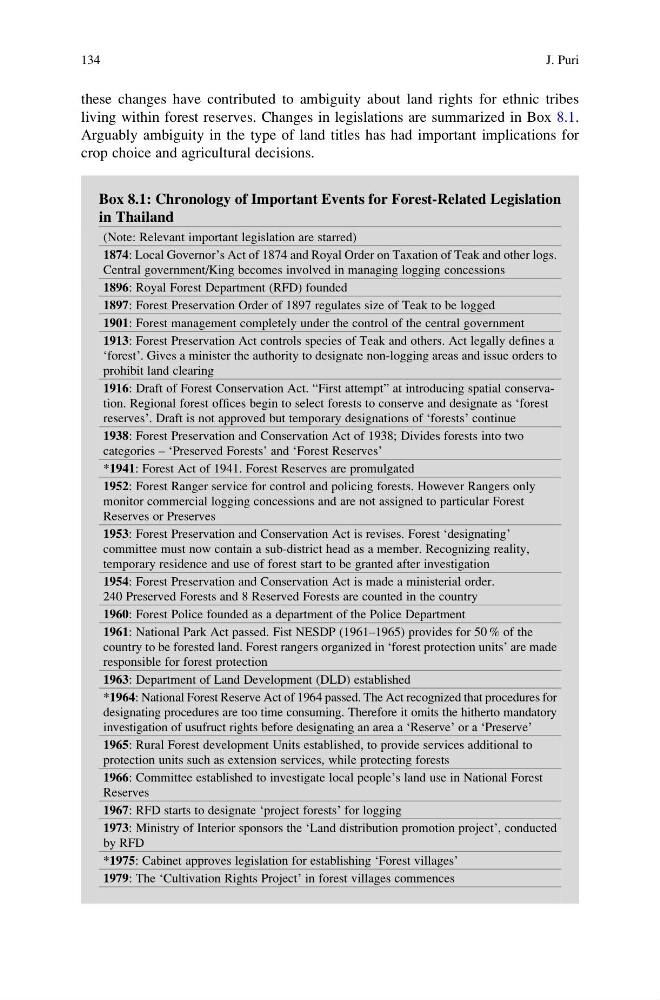
living within forest reserves. Changes in legislations are summarized in Box 8.1.
Arguably ambiguity in the type of land titles has had important implications for
crop choice and agricultural decisions.
Box 8.1: Chronology of Important Events for Forest-Related Legislation
in Thailand
(Note: Relevant important legislation are starred)
1874: Local Governor’s Act of 1874 and Royal Order on Taxation of Teak and other logs.
Central government/King becomes involved in managing logging concessions
1896: Royal Forest Department (RFD) founded
1897: Forest Preservation Order of 1897 regulates size of Teak to be logged
1901: Forest management completely under the control of the central government
1913: Forest Preservation Act controls species of Teak and others. Act legally defines a
‘forest’. Gives a minister the authority to designate non-logging areas and issue orders to
prohibit land clearing
1916: Draft of Forest Conservation Act. “First attempt” at introducing spatial conservation. Regional forest offices begin to select forests to conserve and designate as ‘forest
reserves’. Draft is not approved but temporary designations of ‘forests’ continue
1938: Forest Preservation and Conservation Act of 1938; Divides forests into two
categories – ‘Preserved Forests’ and ‘Forest Reserves’
*1941: Forest Act of 1941. Forest Reserves are promulgated
1952: Forest Ranger service for control and policing forests. However Rangers only
monitor commercial logging concessions and are not assigned to particular Forest
Reserves or Preserves
1953: Forest Preservation and Conservation Act is revises. Forest ‘designating’
committee must now contain a sub-district head as a member. Recognizing reality,
temporary residence and use of forest start to be granted after investigation
1954: Forest Preservation and Conservation Act is made a ministerial order.
240 Preserved Forests and 8 Reserved Forests are counted in the country
1960: Forest Police founded as a department of the Police Department
1961: National Park Act passed. Fist NESDP (1961–1965) provides for 50 % of the
country to be forested land. Forest rangers organized in ‘forest protection units’ are made
responsible for forest protection
1963: Department of Land Development (DLD) established
*1964: National Forest Reserve Act of 1964 passed. The Act recognized that procedures for
designating procedures are too time consuming. Therefore it omits the hitherto mandatory
investigation of usufruct rights before designating an area a ‘Reserve’ or a ‘Preserve’
1965: Rural Forest development Units established, to provide services additional to
protection units such as extension services, while protecting forests
1966: Committee established to investigate local people’s land use in National Forest
Reserves
1967: RFD starts to designate ‘project forests’ for logging
1973: Ministry of Interior sponsors the ‘Land distribution promotion project’, conducted
by RFD
*1975: Cabinet approves legislation for establishing ‘Forest villages’
1979: The ‘Cultivation Rights Project’ in forest villages commences
134
J. Puri
living within forest reserves. Changes in legislations are summarized in Box 8.1.
Arguably ambiguity in the type of land titles has had important implications for
crop choice and agricultural decisions.
Box 8.1: Chronology of Important Events for Forest-Related Legislation
in Thailand
(Note: Relevant important legislation are starred)
1874: Local Governor’s Act of 1874 and Royal Order on Taxation of Teak and other logs.
Central government/King becomes involved in managing logging concessions
1896: Royal Forest Department (RFD) founded
1897: Forest Preservation Order of 1897 regulates size of Teak to be logged
1901: Forest management completely under the control of the central government
1913: Forest Preservation Act controls species of Teak and others. Act legally defines a
‘forest’. Gives a minister the authority to designate non-logging areas and issue orders to
prohibit land clearing
1916: Draft of Forest Conservation Act. “First attempt” at introducing spatial conservation. Regional forest offices begin to select forests to conserve and designate as ‘forest
reserves’. Draft is not approved but temporary designations of ‘forests’ continue
1938: Forest Preservation and Conservation Act of 1938; Divides forests into two
categories – ‘Preserved Forests’ and ‘Forest Reserves’
*1941: Forest Act of 1941. Forest Reserves are promulgated
1952: Forest Ranger service for control and policing forests. However Rangers only
monitor commercial logging concessions and are not assigned to particular Forest
Reserves or Preserves
1953: Forest Preservation and Conservation Act is revises. Forest ‘designating’
committee must now contain a sub-district head as a member. Recognizing reality,
temporary residence and use of forest start to be granted after investigation
1954: Forest Preservation and Conservation Act is made a ministerial order.
240 Preserved Forests and 8 Reserved Forests are counted in the country
1960: Forest Police founded as a department of the Police Department
1961: National Park Act passed. Fist NESDP (1961–1965) provides for 50 % of the
country to be forested land. Forest rangers organized in ‘forest protection units’ are made
responsible for forest protection
1963: Department of Land Development (DLD) established
*1964: National Forest Reserve Act of 1964 passed. The Act recognized that procedures for
designating procedures are too time consuming. Therefore it omits the hitherto mandatory
investigation of usufruct rights before designating an area a ‘Reserve’ or a ‘Preserve’
1965: Rural Forest development Units established, to provide services additional to
protection units such as extension services, while protecting forests
1966: Committee established to investigate local people’s land use in National Forest
Reserves
1967: RFD starts to designate ‘project forests’ for logging
1973: Ministry of Interior sponsors the ‘Land distribution promotion project’, conducted
by RFD
*1975: Cabinet approves legislation for establishing ‘Forest villages’
1979: The ‘Cultivation Rights Project’ in forest villages commences
134
J. Puri