

84
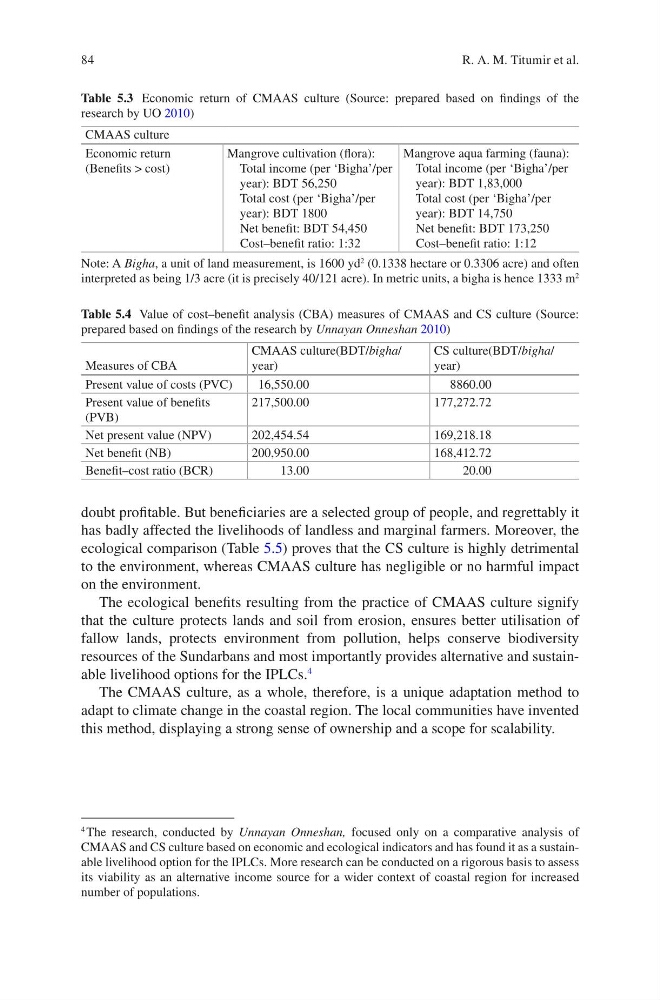
doubt profitable. But beneficiaries are a selected group of people, and regrettably it
has badly affected the livelihoods of landless and marginal farmers. Moreover, the
ecological comparison (Table 5.5) proves that the CS culture is highly detrimental
to the environment, whereas CMAAS culture has negligible or no harmful impact
on the environment.
The ecological benefits resulting from the practice of CMAAS culture signify
that the culture protects lands and soil from erosion, ensures better utilisation of
fallow lands, protects environment from pollution, helps conserve biodiversity
resources of the Sundarbans and most importantly provides alternative and sustainable livelihood options for the IPLCs.
4
The CMAAS culture, as a whole, therefore, is a unique adaptation method to
adapt to climate change in the coastal region. The local communities have invented
this method, displaying a strong sense of ownership and a scope for scalability.
4 The research, conducted by Unnayan Onneshan, focused only on a comparative analysis of
CMAAS and CS culture based on economic and ecological indicators and has found it as a sustainable livelihood option for the IPLCs. More research can be conducted on a rigorous basis to assess
its viability as an alternative income source for a wider context of coastal region for increased
number of populations.
Table 5.3 Economic return of CMAAS culture (Source: prepared based on findings of the
research by UO 2010)
CMAAS culture
Economic return
(Benefits > cost)
Mangrove cultivation (flora):
Total income (per ‘Bigha’/per
year): BDT 56,250
Total cost (per ‘Bigha’/per
year): BDT 1800
Net benefit: BDT 54,450
Cost–benefit ratio: 1:32
Mangrove aqua farming (fauna):
Total income (per ‘Bigha’/per
year): BDT 1,83,000
Total cost (per ‘Bigha’/per
year): BDT 14,750
Net benefit: BDT 173,250
Cost–benefit ratio: 1:12
Note: A Bigha, a unit of land measurement, is 1600 yd
2 (0.1338 hectare or 0.3306 acre) and often
interpreted as being 1/3 acre (it is precisely 40/121 acre). In metric units, a bigha is hence 1333 m
2
Table 5.4 Value of cost–benefit analysis (CBA) measures of CMAAS and CS culture (Source:
prepared based on findings of the research by Unnayan Onneshan 2010)
Measures of CBA
CMAAS culture(BDT/bigha/
year)
CS culture(BDT/bigha/
year)
Present value of costs (PVC)
16,550.00
8860.00
Present value of benefits
(PVB)
217,500.00
177,272.72
Net present value (NPV)
202,454.54
169,218.18
Net benefit (NB)
200,950.00
168,412.72
Benefit–cost ratio (BCR)
13.00
20.00
R. A. M. Titumir et al.
doubt profitable. But beneficiaries are a selected group of people, and regrettably it
has badly affected the livelihoods of landless and marginal farmers. Moreover, the
ecological comparison (Table 5.5) proves that the CS culture is highly detrimental
to the environment, whereas CMAAS culture has negligible or no harmful impact
on the environment.
The ecological benefits resulting from the practice of CMAAS culture signify
that the culture protects lands and soil from erosion, ensures better utilisation of
fallow lands, protects environment from pollution, helps conserve biodiversity
resources of the Sundarbans and most importantly provides alternative and sustainable livelihood options for the IPLCs.
4
The CMAAS culture, as a whole, therefore, is a unique adaptation method to
adapt to climate change in the coastal region. The local communities have invented
this method, displaying a strong sense of ownership and a scope for scalability.
4 The research, conducted by Unnayan Onneshan, focused only on a comparative analysis of
CMAAS and CS culture based on economic and ecological indicators and has found it as a sustainable livelihood option for the IPLCs. More research can be conducted on a rigorous basis to assess
its viability as an alternative income source for a wider context of coastal region for increased
number of populations.
Table 5.3 Economic return of CMAAS culture (Source: prepared based on findings of the
research by UO 2010)
CMAAS culture
Economic return
(Benefits > cost)
Mangrove cultivation (flora):
Total income (per ‘Bigha’/per
year): BDT 56,250
Total cost (per ‘Bigha’/per
year): BDT 1800
Net benefit: BDT 54,450
Cost–benefit ratio: 1:32
Mangrove aqua farming (fauna):
Total income (per ‘Bigha’/per
year): BDT 1,83,000
Total cost (per ‘Bigha’/per
year): BDT 14,750
Net benefit: BDT 173,250
Cost–benefit ratio: 1:12
Note: A Bigha, a unit of land measurement, is 1600 yd
2 (0.1338 hectare or 0.3306 acre) and often
interpreted as being 1/3 acre (it is precisely 40/121 acre). In metric units, a bigha is hence 1333 m
2
Table 5.4 Value of cost–benefit analysis (CBA) measures of CMAAS and CS culture (Source:
prepared based on findings of the research by Unnayan Onneshan 2010)
Measures of CBA
CMAAS culture(BDT/bigha/
year)
CS culture(BDT/bigha/
year)
Present value of costs (PVC)
16,550.00
8860.00
Present value of benefits
(PVB)
217,500.00
177,272.72
Net present value (NPV)
202,454.54
169,218.18
Net benefit (NB)
200,950.00
168,412.72
Benefit–cost ratio (BCR)
13.00
20.00
R. A. M. Titumir et al.